Abstract
Recent peer-reviewed research published in Nature (2026), PNAS, and a January 2026 analysis in Taylor & Francis Online converges on a stark conclusion: climate change now constitutes a measurable and escalating threat to youth mental health. Extreme weather exposure, chronic climate disruption, and perceived governmental inaction are driving significant increases in post-traumatic stress disorder (PTSD), depression, anxiety, and climate-related distress among children and adolescents worldwide.
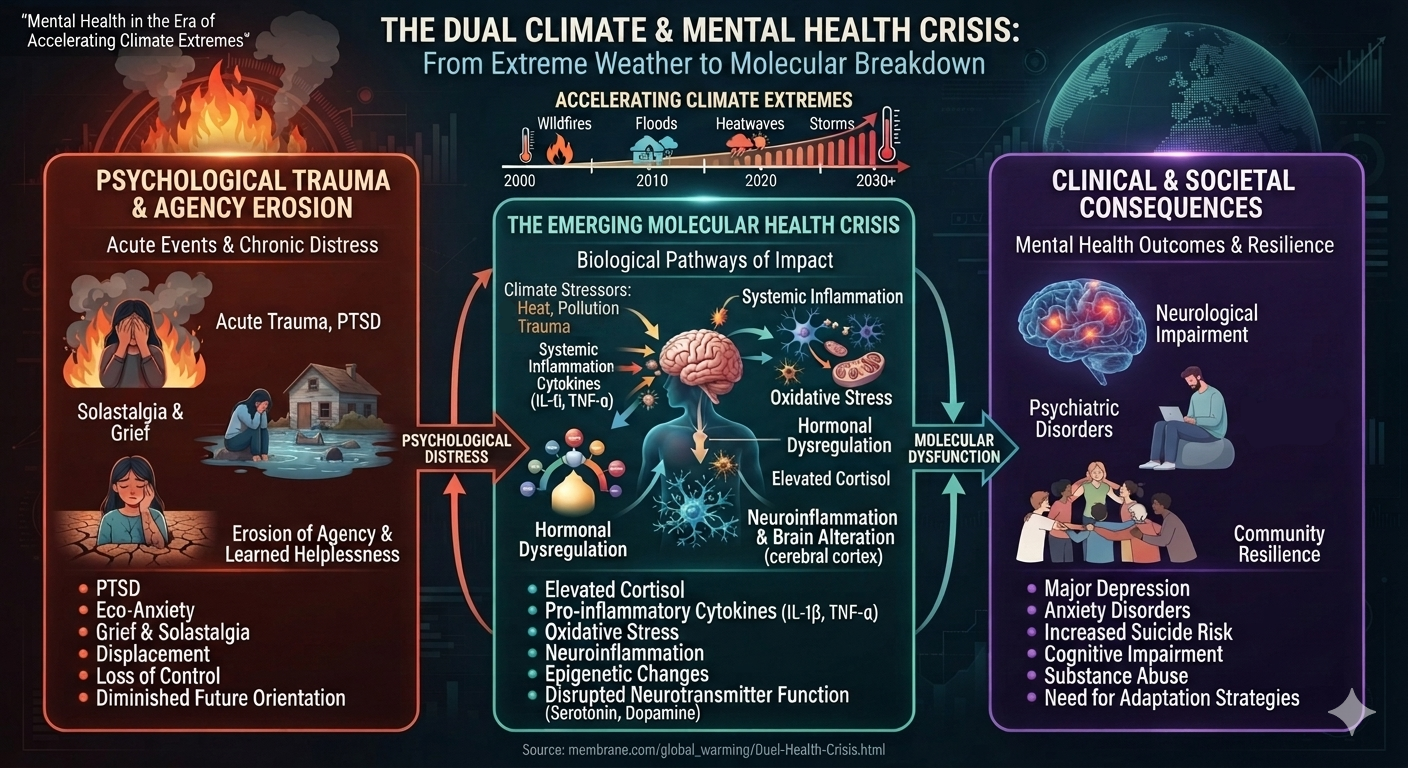
Approximately half of reported psychological burden appears directly linked to lived exposure to climate disasters; the remaining burden reflects a crisis of agency — young people’s recognition of existential threat coupled with limited power to alter outcomes. Simultaneously, escalating heat exposure and pollution are exerting measurable biological stress at the cellular and epigenetic level. Together, these findings suggest that climate change is not only an environmental and economic emergency but a multi-generational public health crisis spanning mental and physical domains.
1. Introduction
The climate system’s accelerating instability is increasingly mirrored in the psychological health of younger generations. Unlike abstract environmental concerns of prior decades, today’s youth are growing up amid direct, recurrent, and intensifying exposure to floods, hurricanes, tornadoes, extreme rainfall, landslides, drought, extreme heat, bomb cyclones, wind shear events, hailstorms, wildfires, and zoonotic disease outbreaks.
The cumulative effect is no longer speculative. It is clinically observable.
Research in Nature (2026) and related analyses demonstrate that climate change is contributing to measurable increases in PTSD, depression, anxiety disorders, and chronic distress among children and adolescents. Many young people report feelings of betrayal and abandonment, citing perceived governmental inaction in the face of escalating evidence.
2. Widespread Distress and Solastalgia
A defining feature of this crisis is the phenomenon of solastalgia — often described as “homesickness while still at home.”
Unlike eco-anxiety, which is anticipatory fear about future environmental collapse, solastalgia arises when one’s immediate home environment is visibly degraded. It is the distress of watching familiar landscapes burn, flood, dry, or decay.
Key findings indicate:
- Increasing climate-related disasters and heat exposure are directly associated with higher rates of anxiety, depression, and PTSD in children.
- Communities repeatedly exposed to extreme events exhibit compounding psychological harm.
- Emotional distress often intensifies when environmental change alters identity, place attachment, and cultural continuity.
The PTSD reported by youth is frequently rooted in direct lived experience — evacuations, home loss, displacement, community destruction, and prolonged instability.
3. Direct Exposure and the Paradox of Agency
A study published in PNAS finds that direct experience with climate-related disasters correlates strongly with increased eco-anxiety and functional impairment. However, the same exposure can also catalyze adaptation behaviors and activism.
This introduces a paradox.
Approximately 50% of mental health burden appears to stem from direct trauma exposure. The remaining burden relates to agency — or lack thereof.
Children and adolescents possess the cognitive capacity to understand the existential dimensions of climate destabilization. Their distress is amplified not by ignorance, but by insight. What compounds the trauma is the recognition that decision-making power rests largely with adults whose responses are often perceived as insufficient, dismissive, or delayed.
The psychological strain thus reflects both trauma and moral injury.
4. Climate Change as a Dual Health Crisis
The emerging data suggest that climate change must be understood as both a mental and physical health emergency.
4.1 Heat Mortality and Rising Exposure
- Global heat-related deaths now approximate one fatality per minute during peak periods.
- Over the past four years, the average person has endured approximately 19 days annually of life-threatening heat exposure, largely attributable to anthropogenic warming.
- Extreme heat contributes to heatstroke, dehydration, acute kidney injury, cardiovascular stress, and respiratory complications.
- Heat exposure worsens pre-existing heart and lung diseases and increases hospitalization rates.
Heat stress also directly exacerbates depression, anxiety, aggression, and suicide risk.
5. Climate Extremes and Cellular Breakdown
Prolonged exposure to extreme heat accelerates biological aging. Research indicates:
- Tissue damage linked to chronic heat stress.
- Telomere shortening, a marker of accelerated cellular aging.
- Increased risk of chronic diseases including cancer, dementia, and diabetes.
These risks are compounded by pollution exposure and infectious disease burden. Climate-related stressors do not act in isolation; they interact and amplify vulnerability across organ systems.
6. Epigenetic Changes: The Molecular Convergence of Climate Stressors
A critical and emerging dimension of this crisis involves epigenetic modification — chemical changes that regulate gene expression without altering the underlying DNA sequence.
Epigenetic mechanisms function as molecular switches, activating or silencing genes in response to environmental stimuli.
Extreme heat, tropospheric ozone exposure, and COVID-19 infection have all been associated with epigenetic alterations linked to:
- Cardiovascular disease
- Diabetes
- Cancer susceptibility
- Neurodegenerative disorders
- Immune dysregulation
When multiple stressors occur simultaneously — heat, pollution, infection, psychological trauma — their effects compound rather than merely accumulate. These converging stressors may increase lifetime disease risk and potentially influence transgenerational health outcomes.
This represents a shared biological pathway through which climate destabilization translates into long-term systemic illness.
7. Intergenerational Implications
The possibility that stress-induced epigenetic modifications may influence subsequent generations raises profound ethical and policy implications. Climate-driven biological stress today may shape disease risk tomorrow.
Thus, the youth mental health crisis is not an isolated psychological phenomenon. It is embedded within broader ecological, physiological, and social systems undergoing rapid destabilization.
8. Conclusion
The emerging research makes clear that climate change is a cascading public health emergency affecting both mind and body.
Youth mental distress reflects:
- Direct trauma from climate disasters,
- Chronic environmental degradation (solastalgia),
- Existential awareness without adequate agency.
Simultaneously, climate stressors are accelerating cellular aging, increasing chronic disease risk, and potentially altering gene expression across generations.
Addressing climate anxiety cannot be separated from addressing climate change itself. Tangible mitigation, adaptation, and accountability are not only environmental imperatives — they are mental health interventions.
Recognizing adult responsibility in driving this crisis may be uncomfortable. Yet acknowledging that responsibility may be the first step toward restoring both ecological stability and psychological resilience.
The climate crisis is no longer abstract. It is lived, felt, and embodied — particularly by those who will inherit its consequences.