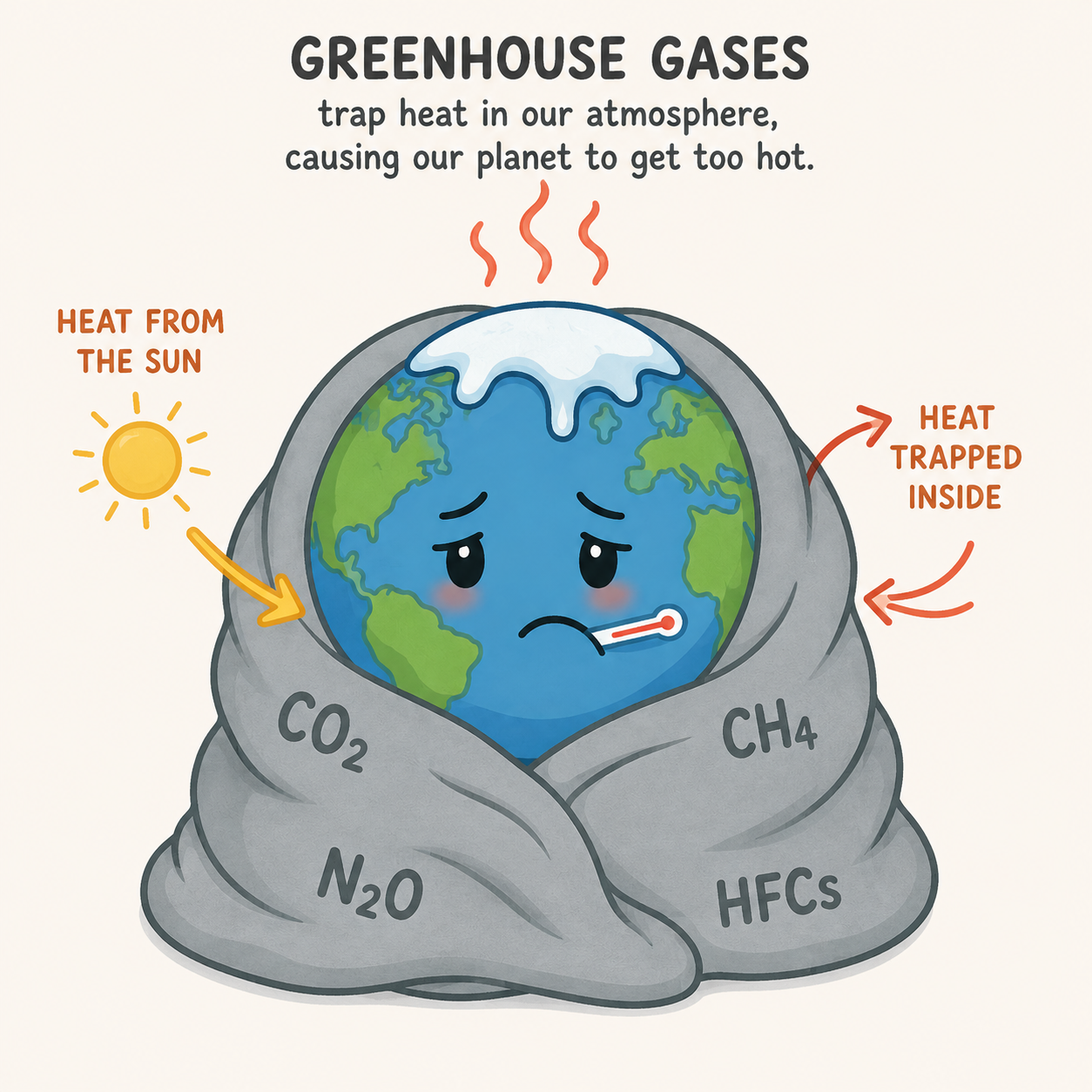
How Is the Climate Energy Hitting You?
Reno, Nevada and Lake Tahoe
For the Reno Nevada and Lake Tahoe region, the major climate impacts include extreme urban heat, declining Sierra Nevada snowpack, prolonged drought, abrupt swings between wet and dry conditions, extreme winds, flash flooding, and an expanding wildfire season.
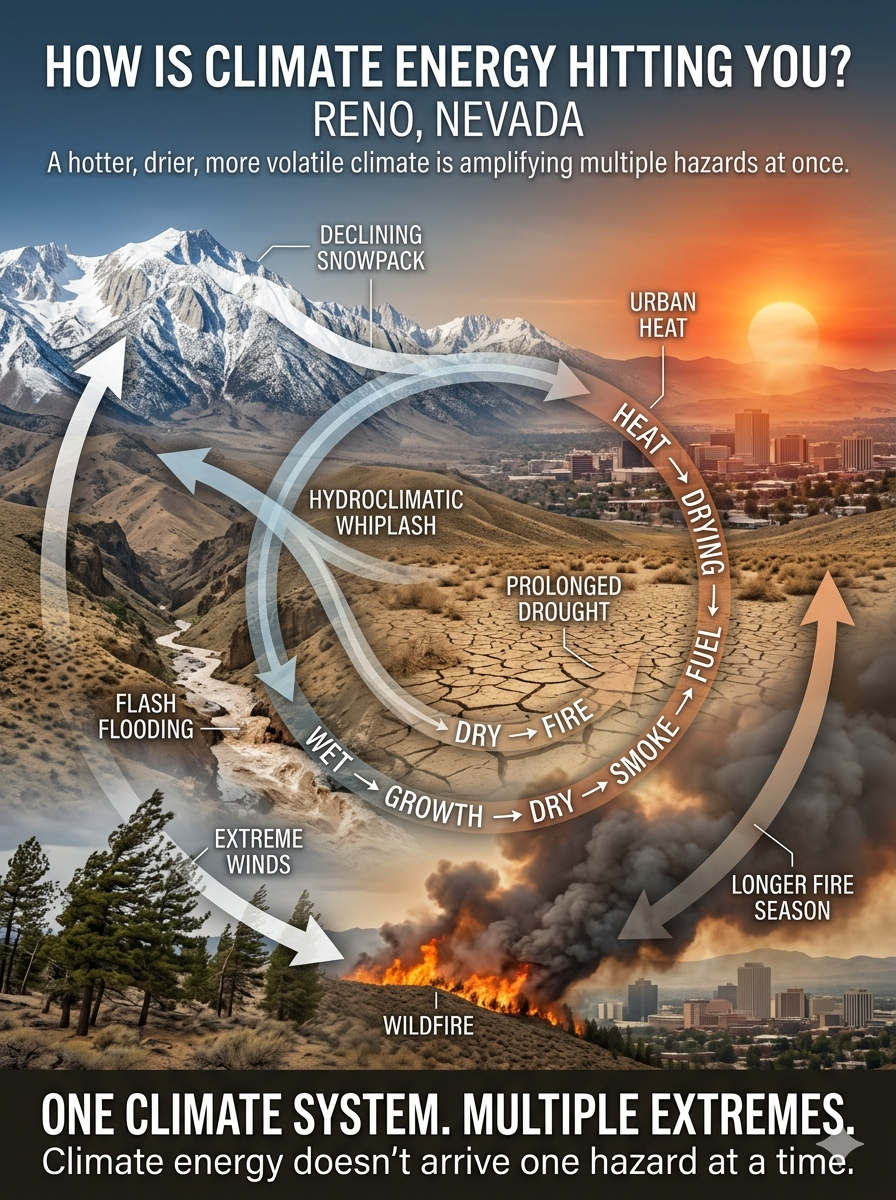
Reno and Tahoe: Hydroclimatic Whiplash, Flash Droughts, Extreme Winds, Wildfires, and Thermal Stratification
Reno, Nevada, is experiencing some of the most pronounced climate stresses in the American West. Rapid warming is intensifying the region’s existing desert and alpine vulnerabilities, while simultaneously altering snowpack, water supplies, vegetation, wildfire conditions, and extreme precipitation.
For the Reno–Sparks region, the major climate pressures include extreme urban heat, declining Sierra Nevada snowpack, prolonged drought, abrupt swings between wet and dry conditions, extreme winds, flash flooding, and an expanding wildfire season.
These impacts do not occur independently. They interact, creating compound hazards in which one climate extreme can prepare the landscape for another.
Extreme Urban Heat and Season Shifts
Rapid Temperature Increases
Reno has experienced substantial long-term warming, with average temperatures increasing by approximately 7.9°F overall. Average summer temperatures have increased by more than 11°F since 1970, intensifying heat stress across the region.
Urban Heat Island Effect
Rapid population growth has replaced natural landscapes with pavement, buildings, roads, and other heat-absorbing surfaces. The resulting urban heat island effect can substantially increase temperatures within developed areas, placing the greatest burden on residents and communities with fewer resources to adapt.
A Later First Freeze
Reno’s autumn is warming particularly rapidly. The average date of the first winter freeze has shifted later by nearly six weeks, extending the period during which heat-sensitive ecosystems, agriculture, and disease vectors remain active.
Longer Mosquito Seasons
Warmer autumn conditions can delay the seasonal die-off of mosquitoes. In Washoe County, mosquito abundance has increased dramatically, with reports of an eight-fold increase in mosquitoes per trap.
The result is more than a warmer city. The seasonal timing of biological systems is changing.
Snowpack, Water Supply, and Flooding
Diminishing Snowpack
Warming at higher elevations is reducing the amount of winter precipitation stored as snow. Sierra Nevada snowpack has reached exceptionally low levels, at times falling to approximately 48% of the historical median.
Snowpack is not simply frozen precipitation. It is a natural reservoir that stores water through winter and releases it gradually during spring and summer.
Earlier Snowmelt
Warmer winters are shortening the snow season and causing snow to melt earlier. That shifts runoff toward earlier months, leaving less water available during the hot, dry summer period when vegetation, ecosystems, agriculture, and communities need it most.
Lake Tahoe Under Stress
Nearby Lake Tahoe is also responding to a warming climate. Increased thermal stratification can reduce mixing between surface and deeper waters, affecting oxygen distribution, water quality, and ecosystem conditions while creating opportunities for invasive species.
From Drought to Flash Flood
Climate change does not simply mean “more drought.”
A warmer atmosphere can hold more water vapor, increasing the potential for intense precipitation when storms occur. An +11°F increase in temperature equates to an approximate 43% increase in the atmosphere’s maximum capacity to hold moisture. After prolonged dry periods, intense rainfall can produce rapid runoff, flash flooding, erosion, and debris flows across steep mountain terrain.
The same landscape can therefore experience both water scarcity and dangerous excess water—sometimes within a relatively short period.
Wildfires and Public Health
The Invisible Dual Disaster
Reno increasingly faces the convergence of extreme heat and wildfire smoke.
Wildfire smoke can severely degrade outdoor and indoor air quality. During smoke events, poorly sealed buildings and certain cooling systems can allow polluted outdoor air to enter indoor spaces, creating an additional public-health burden precisely when residents are trying to escape the heat.
A Longer Fire-Weather Season
Climate change has contributed to a substantial increase in fire-weather conditions across the region, with estimates of approximately 28 additional fire-weather days annually.
A longer period of hot, dry, windy conditions creates a larger window for vegetation to dry out and fires to spread rapidly.
But temperature alone does not explain the danger.
Water availability, vegetation growth, drought, snowpack, humidity, and wind interact to determine how much fuel is available—and how quickly that fuel can burn.
The Hawk Fire: Hydroclimatic Whiplash in Action
The Hawk Fire, threatening communities northwest of Reno, illustrates how multiple climate and weather processes can converge into a rapidly escalating wildfire emergency.
The fire has expanded dramatically across the Peavine Peak area and threatened residential communities and the University of Nevada, Reno campus. It is occurring amid a broader sequence of major wildfires across northern Nevada.
The immediate fire emergency is being amplified by dry fuels, limited snowpack, extreme fire-weather conditions, and powerful, shifting winds.
This is where the concept of hydroclimatic whiplash becomes important.
Hydroclimatic Whiplash
Hydroclimatic whiplash describes rapid swings between substantially wetter and substantially drier conditions.
The danger is not simply the wet period or the dry period individually.
It is what happens when they occur in succession.
1. Priming the Landscape
An unusually wet period can produce explosive growth of grasses, brush, and other fine fuels.
2. Rapid Dry-Down
If that period is followed by an exceptionally hot and dry summer, the newly produced vegetation can cure rapidly, transforming abundant biomass into highly flammable fuel.
3. Ignition
Once the landscape is sufficiently dry, a single ignition source can rapidly transform a fuel-rich environment into a fast-moving wildfire.
This creates a dangerous sequence:
Wet → Growth → Heat → Drought → Fuel Curing → Ignition → Rapid Fire Spread
The climate hazard is therefore not one isolated extreme. It is the interaction between extremes.
Extreme and Shifting Winds
Wind can turn a dangerous wildfire into an urban emergency.
Powerful red-flag conditions can push flames rapidly across foothills and directly toward residential neighborhoods. At the same time, shifting winds can cause fire behavior to change direction with little warning.
For firefighters, this creates extraordinary tactical difficulties.
Rapidly changing winds can:
- accelerate fire spread;
- generate intense fire runs;
- loft embers ahead of the main fire;
- ignite new fires across containment lines;
- block access routes;
- change evacuation conditions;
- and place firefighters and equipment in rapidly changing danger zones.
Reports of extreme fire behavior underscore the interaction between wind, dry fuels, topography, and heat.
The result is a wildfire that does not simply spread outward.
It can surge, jump, change direction, and accelerate.
Mitigation and Policy Adaptation
Reno’s climate risks are forcing governments to rethink how cities are designed and how resources are managed.
Heat Mitigation
Nevada’s Assembly Bill 96 establishes requirements for incorporating heat-mitigation strategies into local planning. Measures can include cool roofs, exterior shading, and drought-tolerant landscaping and trees.
These interventions address an important reality: climate adaptation increasingly has to occur at the neighborhood and building scale.
Resource-Demand Feedback
The rapid increase in extreme heat is also increasing pressure on water supplies, electricity demand, energy storage, and grid reliability.
During extreme heat, demand for air conditioning and other cooling systems can rise sharply—at the same time that drought and declining water availability place additional pressure on regional water resources.
This creates a reinforcing feedback:
More heat → More cooling → More electricity demand → Greater grid stress
At the same time:
More development → More water demand → Greater pressure on limited water supplies
These pressures can compound one another. A rapidly growing population and expanding technology sector increase demand for both electricity and water, while extreme heat makes both resources more critical.
Climate adaptation, therefore, cannot be separated from infrastructure planning, resource management, and the capacity of the electric grid and water systems to withstand increasingly extreme conditions.
The Bigger Picture
Reno’s climate challenge is not simply that the city is becoming hotter.
The more important change is that multiple parts of the climate system are beginning to interact in ways that amplify risk.
A warmer atmosphere changes precipitation.
Warmer winters reduce snowpack.
Reduced snowpack changes runoff.
Earlier runoff increases summer dryness.
Summer heat dries vegetation.
Drought converts vegetation into fuel.
Wind accelerates fire.
Wildfire produces smoke.
Smoke threatens public health.
And intense rainfall following dry periods can produce flash floods and debris flows.
This is hydroclimatic whiplash: not merely more extreme weather, but increasingly abrupt transitions between opposing extremes.
For Reno, the question is therefore not simply:
How much warmer will it become?
The more consequential question is:
How will all of these changes interact—and how quickly will they compound one another?
That is how climate energy is hitting Reno.
Hotter. Drier. Windier. More volatile. And increasingly difficult to manage one hazard at a time.
Taking the Temperature of Climate Change: How Is Climate Energy Hitting You?
Easy-to-Read Resources