Trump, Epstein, Wright: Climate Crimes Against Humanity
Overview
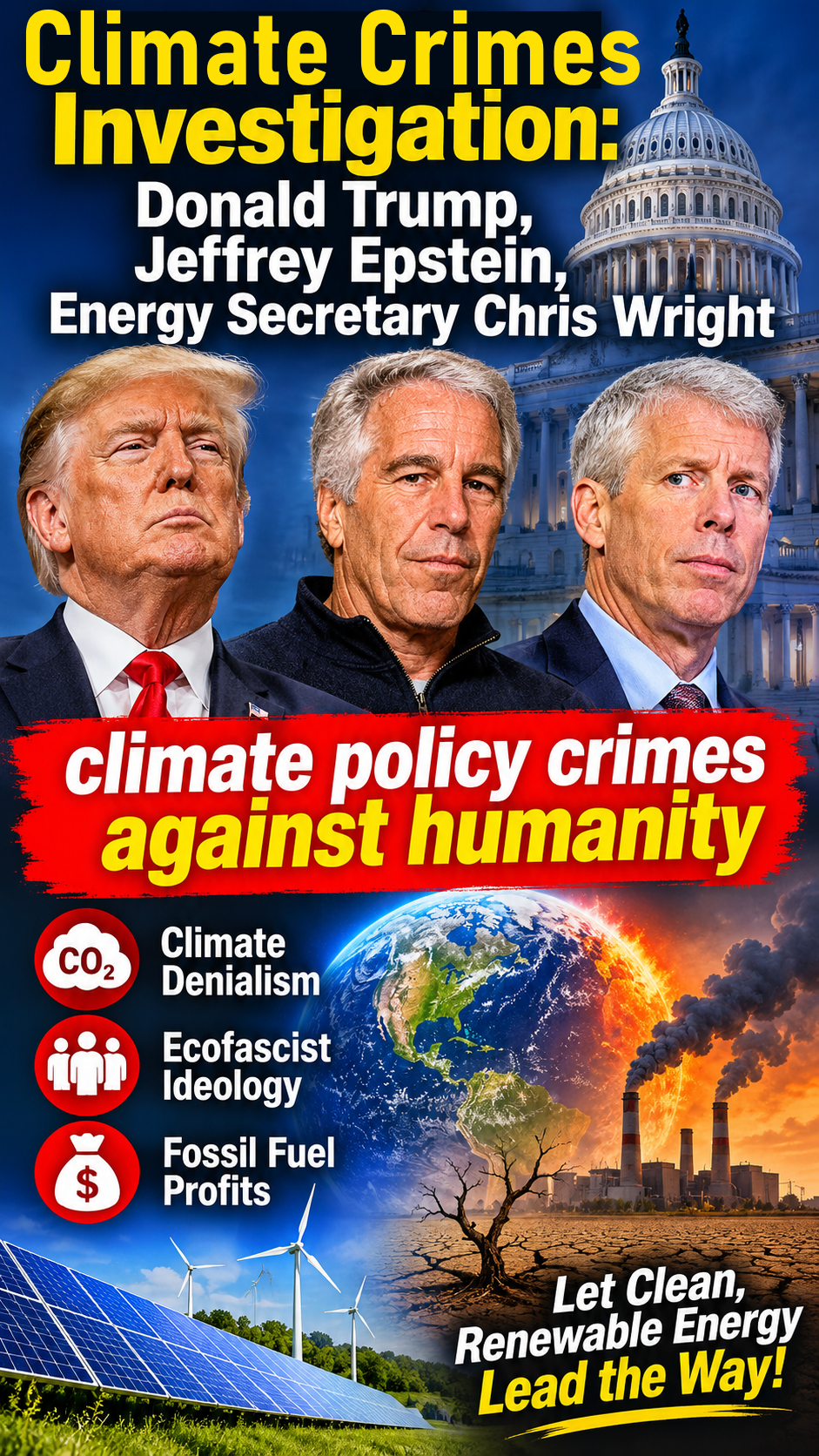
Court rulings have established that the Department of Energy’s (DOE) Climate Working Group (CWG) violated the Federal Advisory Committee Act (FACA), a federal law requiring transparency, balanced representation, and public accountability in the operation of federal advisory committees.
The case exposes serious questions about the group’s formation, membership, ideological affiliations, and influence over federal climate policy.
Several individuals associated with the CWG have connections to the CO₂ Coalition, a nonprofit organization that challenges established climate science and promotes arguments emphasizing the benefits of atmospheric carbon dioxide.
The group’s analysis became a foundation for the Trump administration’s effort to overturn the EPA Endangerment Finding, a cornerstone of federal climate regulation. That reversal provided the administration with a basis for dismantling major climate and pollution protections.
The connections among the DOE, the CWG, fossil fuel interests, and individuals appearing in the Epstein files demand congressional investigation. Those connections include reported associations involving members of the administration and the broader climate-policy network.
Chris Wright: Fossil Fuel Industry to Secretary of Energy
Chris Wright (born January 15, 1965) is an American businessman and politician serving as the 17th U.S. Secretary of Energy.
His professional background is rooted in the fossil fuel industry.
Business Background
Liberty Energy
Wright founded and formerly served as CEO of Liberty Energy, a Denver-based energy company that became North America’s second-largest hydraulic fracturing (fracking) company.
Pinnacle Technologies
Founded in 1992, Pinnacle Technologies helped pioneer the hydraulic fracture mapping industry.
Wright’s transition from fossil fuel industry leadership to directing federal energy policy places his professional interests and policy decisions squarely within the scope of congressional oversight.
The Investigative Report: From Climate Denialism to Ecofascist Ideology
I began investigating climate denialism and the CO₂ Coalition in the spring of 2025, tracing its connections to the Department of Energy’s Climate Working Group.
My initial hypothesis centered on financial interests: fossil fuel companies and affiliated organizations fund campaigns that challenge established climate science, protect existing investments, and delay environmental regulation.
That financial motive explains part of the pattern. It does not explain the entire network.
The release of the Epstein files introduced another dimension to the investigation. Correspondence, affiliations, and publicly documented rhetoric raised questions about the intersection of elite networks, population ideology, eugenics, and environmental collapse.
The investigation therefore expanded beyond conventional climate denialism to examine the relationship between fossil fuel interests and ecofascist ideology.
Ecofascism: Environmental Collapse as a Tool of Human Elimination
Ecofascism combines environmental ideology with authoritarian hierarchy, racialized survival theories, eugenics, and the belief that certain populations are expendable.
Rather than treating environmental destruction as a threat to humanity, this ideology rationalizes unequal human survival and frames population reduction through catastrophe as beneficial.
The distinction is fundamental:
- Climate denialism: Protects economic and political interests by undermining climate science and delaying environmental protections.
- Eugenics: Assigns unequal value to human lives based on inherited characteristics and perceived human worth.
- Ecofascism: Combines environmental collapse with authoritarian and eliminationist population ideology.
These ideas warrant examination wherever they intersect with political influence, environmental policy, and elite networks.
Epstein’s Publicly Released Statements
Publicly released statements attributed to Jeffrey Epstein include:
“I liked the argument that more CO₂ is good for plants.”
This statement echoes a central argument promoted by the CO₂ Coalition: that increased atmospheric carbon dioxide benefits vegetation through its role in plant growth.
However, the physiological benefits of additional CO₂ do not negate the destructive consequences of accelerating climate change, including extreme heat, drought, ecosystem disruption, and damage to agricultural systems.
Other statements attributed to Epstein reveal an explicit interest in population reduction, eugenics, and racial hierarchy:
“Maybe climate change is a good way of dealing with overpopulation—the earth’s forest fire. Potentially a good thing for the species.”
“Executions of the elderly and infirm make sense.”
“African music has lots of beats and little development—not an accident. It mirrors their learning process.”
These statements, if accurately attributed and understood in their documentary context, expose a worldview that extends far beyond conventional environmental policy disagreement.
They invoke population elimination, the devaluation of vulnerable people, and racialized judgments about human capability.
The Central Investigative Question
This investigation concerns more than climate science or fossil fuel industry influence.
It concerns the intersection of money, political power, ideological networks, environmental policy, and the unequal valuation of human life.
Financial interests can explain efforts to undermine climate science and obstruct regulation. Eugenic and eliminationist rhetoric raises a separate and deeply troubling question: whether environmental catastrophe is being rationalized within ideological networks that assign different values to different human populations.
The DOE Climate Working Group’s documented legal violations, its connections to climate-denial organizations, the administration’s reliance on its work, and the wider network of reported associations warrant a comprehensive congressional investigation.
Climate policy must serve humanity—not fossil fuel profits, authoritarian ideology, or theories that treat human lives as expendable.
The investigations need to follow the evidence, trace the money, expose the networks, establish accountability, and protect the public interest.
And the solution is clear: let clean, renewable energy lead the way.
The DOE Climate Working Group: Legal Violations, Ideological Networks, and Ecofascist Connections
Introduction
Recent court rulings have raised significant questions about the formation and operation of a Department of Energy (DOE) advisory body informally referred to as the “Climate Working Group.” A U.S. District Court found that the group violated the Federal Advisory Committee Act (FACA), a law requiring transparency, balanced representation, and public accountability for federal advisory committees.
The case has drawn attention because several individuals associated with the group have ties to the CO₂ Coalition, a nonprofit organization known for challenging key elements of the mainstream scientific consensus on climate change. The analysis was relied upon by the Trump administration in overturning the Endangerment Finding — a move used by the EPA to roll back major climate and pollution regulations.
Donald J. Trump
Donald J. Trump has repeatedly voiced skepticism toward climate science and taken concrete actions to undermine climate research and policy. He has publicly called climate change a "hoax," the "greatest scam of all time," and “bullshit,” reflecting a long-standing pattern of dismissing mainstream scientific consensus.
In a major address to the United Nations General Assembly on September 23, 2025, President Trump delivered a comprehensive rejection of global climate efforts, labeling climate change the "greatest con job ever perpetrated on the world." Key claims from this speech included:
- Climate Science as a Hoax: He dismissed the concept of a "carbon footprint" as fabricated by individuals with “evil intentions” and characterized UN climate projections as the work of “stupid people.”
- Renewable Energy as a “Scam”: Trump repeatedly labeled wind and solar power as a “joke,” “pathetic,” and a “scam,” claiming these technologies are too expensive and unreliable for modern infrastructure.
- Rebranding Fossil Fuels: He actively promoted American fossil fuels, issuing a standing White House directive to refer to coal only as “clean, beautiful coal” to counter negative perceptions of fossil energy.
- Criticism of the Paris Agreement: Trump referred to the Paris Climate Accord as “fake,” claiming the United States contributed far more than other nations while receiving little benefit in return.
- Attacking European Policy: He warned that Europe—and Germany in particular—was “going to hell” economically due to its green energy transition and immigration policies.
- Caricaturing Environmentalists: Trump used hyperbolic claims to paint climate advocates as extremists, asserting that radical environmentalists “want to kill all the cows” to reduce methane emissions.
Beyond rhetoric, Trump took significant steps to dismantle climate science and regulatory frameworks at the federal level, particularly through the Environmental Protection Agency (EPA) and the National Institutes of Health (NIH). Among the most consequential actions was the repeal of the 2009 Endangerment Finding, which legally designated greenhouse gases as a threat to public health and enabled regulation of emissions. These actions have had lasting effects on U.S. climate policy, weakening federal oversight, slowing renewable energy development, and reducing the country’s ability to respond to the accelerating climate crisis.
Trump’s tenure illustrates the intersection of political ideology, personal branding, and science denial, with consequences that extend far beyond domestic policy into global environmental governance.
Trump has been widely criticized for white nationalist rhetoric and is also well-documented for his connections to Jeffrey Epstein, a known ecofascist. Ecofascists understand the physics of climate change, with the short-term upper limit of warming estimated around +9°C. Their goal, alarmingly, is to push humanity toward that upper bound as a means of drastically reducing the global population—particularly targeting vulnerable regions in the Global South.
United States Department of Energy
Chris Wright (born January 15, 1965) is an American businessman and politician currently serving as the 17th U.S. Secretary of Energy (DOE).
Business Background
Before entering government, Wright was a prominent executive in the fossil fuel industry:
- Liberty Energy: Founder and former CEO of the Denver-based company, which became the second-largest hydraulic fracturing (fracking) firm in North America.
- Pinnacle Technologies: Founded in 1992, this company helped pioneer the hydraulic fracture mapping industry.
The Federal Court Ruling
The U.S. District Court ruled that the DOE’s formation of the “Climate Working Group” violated FACA requirements. Under FACA, federal advisory committees must:
- Operate transparently
- Provide balanced viewpoints
- Maintain publicly accessible records
According to the court, the group did not meet these standards and operated without sufficient public oversight. The report produced by the group was reportedly referenced in efforts related to reconsideration of the Endangerment Finding.
Composition of the Climate Working Group
The group was coordinated by Travis Fisher and included five researchers known for publicly questioning aspects of prevailing climate models and projections:
- Steven E. Koonin
- John Christy
- Judith Curry
- Roy Spencer
- Ross McKitrick
Member Backgrounds
- Steven E. Koonin: Physicist and senior fellow at Stanford's Hoover Institution; former DOE official under Obama and chief scientist for BP; author of a book arguing climate science is "unsettled".
- Judith Curry: Climatologist, professor emerita at Georgia Institute of Technology; known for criticizing what she terms "alarmism" regarding climate change.
- Ross McKitrick: Environmental economics professor at University of Guelph, senior fellow at Fraser Institute; argues that the climate crisis is not a major issue.
Connections to the CO₂ Coalition
The CO₂ Coalition is a nonprofit organization advocating a reassessment of carbon dioxide’s role in climate change and opposing certain regulatory approaches.
- Roy Spencer is publicly listed as affiliated with the CO₂ Coalition and has authored or reviewed materials distributed by the organization.
- John Christy has collaborated with individuals within the same policy network and has worked closely with Spencer on satellite temperature research.
These overlapping affiliations have raised concerns regarding ideological alignment and potential lack of viewpoint diversity in the DOE advisory process.
Heartland Institute
The Climate Working Group (CWG) is closely tied to the Heartland Institute through shared personnel, institutional advocacy, and a unified mission to challenge mainstream climate science.
Direct Personnel & Advocacy Ties
- Several members of the 2025 DOE CWG have long-standing ties to the Heartland Institute, including Roy Spencer, Koonin, Curry, and McKitrick.
- The Heartland Institute promoted the CWG's 2025 report A Critical Review of Impacts of Greenhouse Gas Emissions on the US Climate through its Climate Realism Show and press releases.
- Ross McKitrick and Steven Koonin are frequently featured speakers at Heartland's International Conferences on Climate Change.
Shared Policy Goals
- Endangerment Finding: CWG and Heartland focused on overturning the EPA's 2009 Endangerment Finding. Heartland publicly applauded the CWG report as a tool to justify rescinding these regulations.
- NIPCC Reports: CWG methodology mirrors Heartland-sponsored NIPCC reports promoting natural climate variability and benefits of CO₂.
Institutional Influence
Investigative reports describe the CWG as an extension of a “climate denial machine” funded by groups like Heartland, aiming to influence federal policy. Heartland claimed influence at the "highest level" during the CWG’s formation.
Key Affiliated Organizations and Dark Money
- Hoover Institution: Steven Koonin, Senior Fellow, focused on challenging EPA's Endangerment Finding.
- Heritage Foundation: Roy Spencer, visiting fellow, uses rhetoric to sow doubt about climate policy.
- Cato Institute: Ross McKitrick, advises against CO₂ legislation.
- Fraser Institute: Ross McKitrick, promotes arguments against climate emergency narratives.
- Competitive Enterprise Institute: John Christy and others, historically challenge scientific consensus on climate change.
Dark Money Connections
- Donors Trust & Donors Capital Fund: Over $20M distributed to climate-skeptic groups including Heartland, CEI, CO₂ Coalition.
- Koch Foundations: Millions provided to Cato, Americans for Prosperity, Heritage Foundation.
- CO₂ Coalition: Founded by William Happer, funded by Sarah Scaife and Bradley Foundations, promoting benefits of CO₂.
Status Update (February 2026)
Following the CWG’s dissolution, members (led by Judith Curry) launched ClimateWorkingGroup.com. Court-mandated disclosures revealed the group tailored their report to provide a legal basis for repealing the 2009 Endangerment Finding.
Rob Bradley Jr. and Policy Influence
Under the Trump administration, Bradley promoted CWG work via IER and MasterResource, using the report to justify repealing the Endangerment Finding and reducing fossil fuel restrictions. His professional relationship with DOE Secretary Chris Wright further amplified CWG influence.
Connections to Epstein and Ecofascist Rhetoric
Investigations reveal intersections between elite networks, climate denial, and ecofascist ideologies:
- Jeffrey Epstein expressed views consistent with ecofascism, discussing overpopulation and questioning climate science.
- His networks overlapped with climate skeptics and fossil fuel advocates.
- Ecofascist reasoning frames environmental collapse as a selective survival mechanism targeting vulnerable populations.
Epstein, Climate Misinformation, and Elite Networks
“Potentially a good thing for the species”
In a series of July 2016 emails with Joscha Bach, a German philosopher and AI researcher, Jeffrey Epstein raised climate change in the context of a broader discussion about cognition and race. In one exchange, Epstein wrote:
“Maybe climate change is a good way of dealing with overpopulation — the earth’s forest fire. Potentially a good thing for the species.”
The statement reflects a willingness to frame climate-driven catastrophe as a population-level corrective rather than a humanitarian crisis.
Epstein and Climate Misinformation
In other emails, Epstein circulated material promoting climate misinformation.
In December 2016, he sent theoretical physicist Lawrence Krauss a YouTube video titled “Nobel Laureate Smashes the Global Warming Hoax,” featuring Ivar Giaever, a Nobel Prize–winning physicist whose expertise was unrelated to climate science and who had publicly denied mainstream climate findings.
Krauss responded: “So you are listening to an old Nobel laureate whose expertise has nothing to do with this, who has never studied this in detail, built models, done experiments.”
Epstein replied:
“i liked the argument that more co2 is good for plants?”
This echoes a common climate denial talking point that isolates the fertilization effect of CO₂ while ignoring well-documented countervailing harms — including heat stress, drought intensification, soil degradation, extreme weather, and nutrient dilution in crops.
In a later exchange, Epstein asked:
“is the south pole getting colder and more ice?”
Krauss responded that the West Antarctic Ice Sheet was melting at an unprecedented rate — consistent with peer-reviewed observations showing accelerating ice mass loss in parts of Antarctica despite regional variability.
Lomborg, Koonin, and Elite Circulation of Climate Skeptic Narratives
The released files also reference interactions between Epstein and prominent public figures involved in climate policy debates.
According to reporting, Bjørn Lomborg met with Epstein in September 2012 regarding philanthropic investments. A spokesperson for Lomborg’s Copenhagen Consensus Center stated that no funding was received and no further contact occurred.
Climate scientist Michael Mann has argued that certain policy commentators use concern for economic development in the Global South to justify continued fossil fuel dependence, despite the disproportionate vulnerability of those regions to climate impacts.
Emails also show Epstein receiving and circulating opinion pieces critical of mainstream climate science. In 2014, Nathan Myhrvold forwarded Epstein a Wall Street Journal op-ed by Steven Koonin titled “Climate Science Is Not Settled,” calling it “a good summary.” Koonin later participated in a Department of Energy report that downplayed aspects of climate risk.
The files further mention connections to individuals and entities linked to fossil-fuel-dependent states, underscoring how climate narratives circulate within networks that include financiers, technologists, policy commentators, and actors tied to petrostates.
This convergence suggests that some climate inaction may result from ideological indifference, not only profit motives.
Humanitarian and Legal Implications
Policy actions influenced by the CWG and allied networks have foreseeable harms for children and vulnerable populations:
- Air pollution exposure
- Heat stress
- Flood displacement
- Food insecurity
- Long-term developmental impacts
These impacts raise potential civil liability, federal civil rights issues, and, in systemic cases, international crimes against humanity.
Conclusion
The DOE Climate Working Group case highlights the dangers of ideologically motivated, opaque advisory networks shaping federal policy. Ensuring transparency, accountability, and diversity in scientific advisory processes is critical to protect human health, vulnerable populations, and future generations.
RESOURCES:
- Nonlinear Climate Acceleration and the Convergence of Ecofascist and Eugenics Ideologies
- The Accidental Fascist Hunter: How a Climate Investigation Uncovered Ecofascist Networks
- Epstein’s Network, Climate Denialism, and the Rise of Ecofascist Ideology
- Koonin’s Continuing Calumnies
- 'A good way of dealing with overpopulation': Epstein files reveal how the rich fuel climate denialism
- Rob Bradley Jr., the Climate Working Group, and Policy Influence Under the Trump Administration
- Trump, Chris Wright, Rob Bradley Jr., the CO2 Coalition, Epstein Elite, and Crimes Against Humanity
- Climate Disinformation 101: The CO₂ Coalition’s Dangerous Fantasy of ‘More CO₂ is Better’
- Additional Legal and Government Sources