Nonlinear Climate Acceleration and the Convergence of Ecofascist and Eugenics Ideologies
By Daniel Brouse and Sidd Mukherjee
February 28, 2026
Abstract
This paper examines two independent lines of inquiry that have converged over the past three decades: (1) empirical evidence demonstrating nonlinear acceleration in climate system impacts, and (2) the emergence of ecofascist rhetoric within certain segments of elite discourse. Drawing on rate-of-change analysis, sea-level rise doubling time calculations, radiative forcing theory, and documented public statements, this article argues that accelerating climate dynamics and destabilizing ideological responses now intersect in ways that warrant rigorous scrutiny.
1. Introduction
Two independent research trajectories converged in a striking manner. In the late 1990s, separate investigators identified measurable acceleration in climate system impacts based on empirical datasets. Decades later—again independently and at roughly the same time—both lines of inquiry expanded to examine the emergence of what can be described as ecofascist ideology within segments of elite discourse.
The scientific trajectory concerned nonlinear acceleration in physical systems. The later inquiry concerned ideological responses that appear to frame climate destabilization not solely as a crisis to prevent, but in some cases as a demographic or geopolitical corrective.
2. The Nonlinear Acceleration Hypothesis
In the late 1990s, we analyzed the doubling time of sea-level rise (SLR) to determine whether climate change impacts were accelerating. Rather than assuming linear progression, our approach focused on nonlinear dynamics and second-order rate-of-change analysis.
The core mathematical insight governing acceleration is:
Doubling Time Formula (Discrete Growth):
Td = ln(2) / ln(1 + r)
Where:
- Td = doubling time
- r = fractional growth rate
- ln = natural logarithm
If the growth rate itself increases over time due to feedback amplification, then:
Continuous Form:
Td(t) = ln(2) / k(t)
Where k(t) represents a time-dependent growth constant. Feedback loops modify k(t), collapsing doubling times.
By the early 2000s, multiple independent datasets supported nonlinear acceleration, including:
- Surface and tropospheric temperature trends
- Ice mass balance observations (Greenland and Antarctica)
- Wildfire frequency and burned area metrics
- Ocean heat content accumulation
- Hydrological extreme events
Our analysis indicates that observable climate impact doubling times declined from approximately ~100 years (pre-industrial baseline), to ~10 years by 2000, and to approximately 2–5 years by 2024 in certain high-sensitivity indicators.
Under exponential acceleration, cumulative impacts could increase by a factor of 64 within a decade (26) if doubling intervals compress to ~1.5–2 years. Such compression signals entry into a regime of chaotic instability, consistent with nonlinear feedback dynamics.
3. Radiative Forcing and the Hockey Stick Reconstruction
In 1998–1999, Michael E. Mann and colleagues published the now well-known “hockey stick” temperature reconstruction, demonstrating relative Northern Hemisphere temperature stability over the previous millennium followed by a sharp 20th-century increase.
Radiative forcing provides the physical mechanism underlying this acceleration.
CO₂ Radiative Forcing Formula:
ΔF = 5.35 ln(C / C0) [W/m²]
Where:
- ΔF = radiative forcing (W/m²)
- C = current atmospheric CO₂ concentration (ppm)
- C0 = pre-industrial CO₂ concentration (~280 ppm)
- ln = natural logarithm
This logarithmic forcing relationship, combined with observed increases from ~280 ppm to >420 ppm, yields measurable planetary energy imbalance. Satellite radiometry and ocean heat content data confirm persistent positive forcing.
4. Convergence with Ecofascist and Eugenics Ideologies
Decades later, independent research identified ideological currents within elite discourse that frame climate destabilization as potentially beneficial in demographic terms.
This worldview—often termed ecofascism—reinterprets environmental catastrophe as a selective corrective, particularly affecting vulnerable populations.
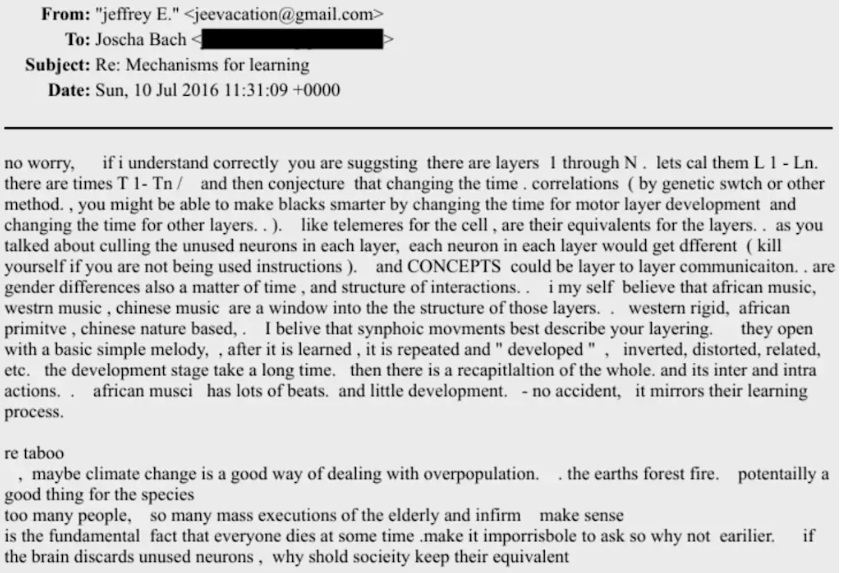
Publicly released materials in the Epstein files include statements attributed to Jeffrey Epstein such as:
“I liked the argument that more CO₂ is good for plants.”
“Maybe climate change is a good way of dealing with overpopulation — the earth’s forest fire. Potentially a good thing for the species.”
“Executions of the elderly and infirm make sense.”
In commentary regarding these materials, climate scientist Michael Mann stated:
“Citing climate change as a solution to overpopulation isn’t a totally surprising position for someone like Epstein... The overpopulation quote is entirely keeping with the ethos of this group.”
The convergence is notable: accelerating physical destabilization accompanied by ideological normalization of selective harm.
5. Discussion
The scientific evidence for nonlinear acceleration in climate impacts is robust, grounded in radiative transfer physics, isotopic carbon analysis, ocean heat accumulation, and cryospheric mass balance observations.
The ideological evidence, while distinct from the physical science, raises serious ethical and governance concerns when climate destabilization is reframed as advantageous for population reduction.
These domains—physical acceleration and ideological normalization—should not be conflated, but neither should their convergence be ignored.
6. Conclusion
The empirical evidence for accelerating climate dynamics has strengthened over three decades. Simultaneously, documented rhetoric in certain elite contexts reveals a willingness to reinterpret climate destabilization through demographic or authoritarian lenses.
The physical science demonstrates measurable nonlinear acceleration. The ideological trajectory warrants equally rigorous scrutiny.
References
Brouse, D. The Accidental Fascist Hunter: How a Climate Investigation Uncovered Ecofascist Networks
Brouse, D., & Mukherjee, S. The DOE Climate Working Group: Legal Violations, Ideological Networks, and Ecofascist Connections.
Climate-Working-Group.html
Mann, M. E. Interview 'A good way of dealing with overpopulation': Epstein files reveal how the rich fuel climate denialism
https://www.fastcompany.com/91490280/epstein-files-how-ultra-wealthy-peddle-climate-denialism
The Epstein Files: