2026: Confirmation of Nonlinear Climate Acceleration in the Arctic–North Atlantic System
Daniel Brouse and Sidd Mukherjee
Ongoing Study
Abstract
Recent observational evidence from the Arctic–North Atlantic system indicates that climate change is not proceeding linearly but is accelerating through interacting feedback mechanisms. Arctic amplification has intensified beyond earlier projections, coinciding with destabilization of large-scale atmospheric circulation patterns, increased Greenland Ice Sheet mass loss, nonlinear cryospheric events, and measurable geophysical responses such as rapid isostatic rebound. This paper synthesizes multi-decadal satellite, atmospheric, oceanographic, and cryospheric observations through early 2026, arguing that the collapse of doubling times across key indicators—Arctic temperature anomalies, sea-ice loss, ice mass balance, and circulation variability—confirms a regime shift toward accelerated climate disruption.
1. Introduction
Three decades ago, we proposed that anthropogenic climate forcing would manifest through nonlinear acceleration rather than gradual linear warming. Increasing greenhouse gas concentrations alter Earth’s radiative balance, while feedback loops—albedo loss, water vapor amplification, permafrost carbon release, ocean circulation shifts—compress the “doubling time” of key climate indicators.
As of early 2026, the Arctic provides the clearest confirmation of this hypothesis. Observations demonstrate extreme amplification, destabilized jet stream dynamics, Greenland hydrological disruption, and geophysical rebound occurring at rates inconsistent with linear change.
2. Arctic Amplification and Circulation Destabilization
2.1 Arctic Warming Rates
Arctic amplification has long been observed at approximately three to four times the global mean warming rate (Serreze & Barry, 2011; IPCC AR6, 2021). Since 2006, some Arctic regions have exhibited warming exceeding double the global rate, with episodic winter anomalies reaching 10–20× the hemispheric average during extreme events.
This amplification accelerates:
- Sea-ice loss, reducing albedo and enhancing ocean heat absorption.
- Permafrost thaw, increasing methane and CO₂ release.
- Ocean–atmosphere heat exchange, destabilizing circulation patterns.
The Arctic is transitioning toward a warmer, seasonally ice-diminished state (Overland et al., 2019).
2.2 Jet Stream, Rossby Waves, and SSW Events
As the equator-to-pole temperature gradient weakens, the polar jet stream slows and becomes more meridional (Francis & Vavrus, 2012; Mann et al., 2017). Amplified Rossby waves lead to persistent droughts, floods, and cold-air outbreaks.
Sudden Stratospheric Warming (SSW) events—rapid stratospheric temperature increases of up to 50°C within days—disrupt the polar vortex (Baldwin et al., 2021). When displaced, Arctic air masses surge southward while anomalous warmth intrudes northward.
In early 2026, Utqiaġvik (Barrow), Alaska recorded January temperatures above 40°F, exceeding the previous 36°F record set in 2017. Concurrently, mid-latitude regions such as the northeastern United States experienced record cold outbreaks. These extremes exemplify circulation destabilization rather than contradiction of warming.
3. Greenland Ice Sheet: Nonlinear Dynamics
3.1 Mass Loss and Sea-Level Contribution
Greenland has lost approximately 169 ± 12 gigatons of ice per year since 2002 (IMBIE Team, 2020), contributing ~14 mm to global mean sea-level rise. Roughly half of this loss arises from surface melt and runoff, projected to intensify under continued Arctic warming.
Recent satellite data show global sea-level rise accelerating from ~1.5 mm/yr in the 1990s to over 5 mm/yr in 2024–2025 (NASA, 2025), consistent with collapsing doubling times.
3.12 Greenland Ice Mass Loss Has Been Remarkably Linear for 25 Years
Satellite observations over the past quarter century indicate that Greenland’s total ice mass loss has followed a surprisingly near-linear trajectory rather than an exponential one. This apparent linearity does not contradict nonlinear climate dynamics; rather, it reflects the current geometric and dynamical state of the ice sheet.
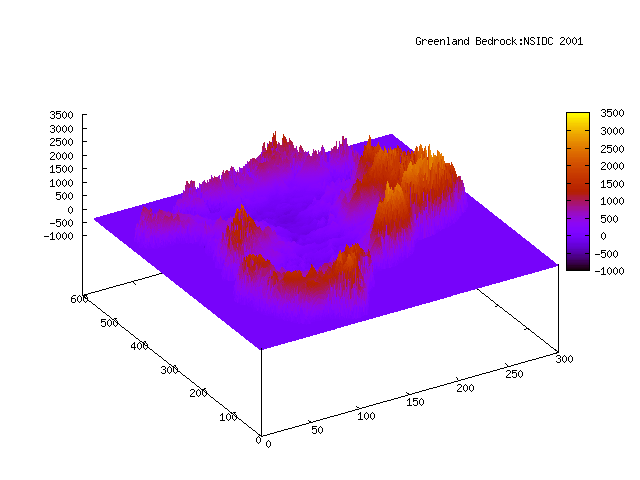
A central structural factor is Greenland’s basin-like topography. Much of the interior ice sheet rests on bedrock that does not yet exhibit widespread marine ice sheet instability (MISI) geometry. Large portions of the central dome remain grounded above deep retrograde slopes that would otherwise facilitate runaway retreat.
The key issue is that critical system thresholds have not yet been fully engaged at continental scale. While individual outlet glaciers—such as Jakobshavn Isbræ—have demonstrated rapid retreat into deeper basins, this behavior has not propagated across the majority of Greenland’s ice sheet.
If major outlet systems retreat further into inland retrograde beds, expanding unstable grounding-line configurations, the probability of nonlinear or exponential-style retreat increases substantially.
At present, Greenland appears to be in what may be described as a pre-threshold acceleration regime: mass loss is increasing and dynamically evolving, but the dominant geometric runaway feedback mechanisms have not yet engaged across the full ice sheet.
3.13 Greenland Ice Loss Accelerating
The rate of ice mass loss from the Greenland Ice Sheet (GrIS) has accelerated in recent years, with roughly half of the observed loss attributable to meltwater discharge. Surface melting on the GrIS is primarily driven by the flux of incoming shortwave radiation, which is influenced by ice albedo. Albedo depends on the surface ice structure as well as the presence, type, and distribution of light-absorbing particulates (LAPs).
A recently identified feedback mechanism may help explain this nonlinear acceleration. Researchers from the University of Waterloo, along with international collaborators, discovered that airborne mineral dust and other aerosols are linked to the growth of algae on the ice surface. This algae reduces albedo by darkening the ice, which in turn increases absorption of solar radiation and intensifies melting.
3.2 Subglacial Outburst Flood (2025)
The 2025 study Outburst of a Subglacial Flood from the Surface of the Greenland Ice Sheet documented a ~90 million m³ upward-draining flood through ice previously assumed frozen to bedrock. The event fractured the ice sheet and altered downstream glacier flow, demonstrating complex coupling between basal hydrology and surface melt.
3.3 Dickson Fjord Mega-Tsunami (2023)
A glacier-destabilized landslide in Greenland’s Dickson Fjord triggered a 200-meter mega-tsunami in 2023. The resulting seiche generated a global seismic signal lasting nine days (Svennevig et al., 2023). The collapse was attributed to glacier retreat destabilizing the mountain slope.
4. Isostatic Rebound and Regional Sea-Level Effects
As Greenland loses ice mass, the crust rebounds elastically and viscoelastically. GPS measurements indicate uplift exceeding 8 mm per year in southeastern Greenland (Khan et al., 2016).
- Local relative sea level may fall, despite global sea-level rise.
- Crustal stress redistribution may influence seismicity.
- Peripheral glacier melt contributes significantly to rebound.
While rebound offsets local sea level temporarily, redistributed meltwater increases global coastal vulnerability.
5. Feedback Loop Convergence
- Ice-albedo feedback
- Ocean stratification and AMOC weakening (Caesar et al., 2021)
- Permafrost carbon release
- Jet stream destabilization
- Subglacial hydrological acceleration
These interacting processes reduce doubling times of climate indicators. Acceleration is evident across temperature, circulation, cryospheric instability, and geophysical response.
6. Conclusion
Evidence through early 2026 supports the conclusion that climate change is accelerating via interconnected feedback loops rather than progressing linearly. Arctic amplification, destabilized circulation, nonlinear Greenland hydrology, accelerating sea-level rise, and rapid isostatic rebound collectively indicate regime-level transition.
The compression of doubling times confirms a shift toward exponential intensification. Future projections must incorporate nonlinear tipping dynamics to avoid systematic underestimation of risk.
References
Greenland Slip Sliding Away Mukherjee (2001)
SLR Exponential Fit Mukherjee (2004)
Greenland If the Ice Were Gone Mukherjee (2013)
Sea-Level Rise: Greenland and the Collapse of the East Antarctic Ice Sheet Brouse & Mukherjee (2022)
Baldwin, M. P., et al. (2021). Reviews of Geophysics.
Caesar, L., et al. (2021). Nature Geoscience.
Francis, J. A., & Vavrus, S. J. (2012). Geophysical Research Letters.
IMBIE Team (2020). Nature.
IPCC (2021). AR6 Working Group I Report.
Khan, S. A., et al. (2016). Science Advances.
Mann, M. E., et al. (2017). Scientific Reports.
NASA (2025). Global Mean Sea Level from Satellite Altimetry.
Overland, J. E., et al. (2019). Nature Climate Change.
Serreze, M. C., & Barry, R. G. (2011). Global and Planetary Change.
Svennevig, K., et al. (2023). Geophysical Research Letters.