Tipping Point Season:
Hunting for Polar Ice
The feedbacks are physically real and interacting. How strongly will feedbacks amplify one another?
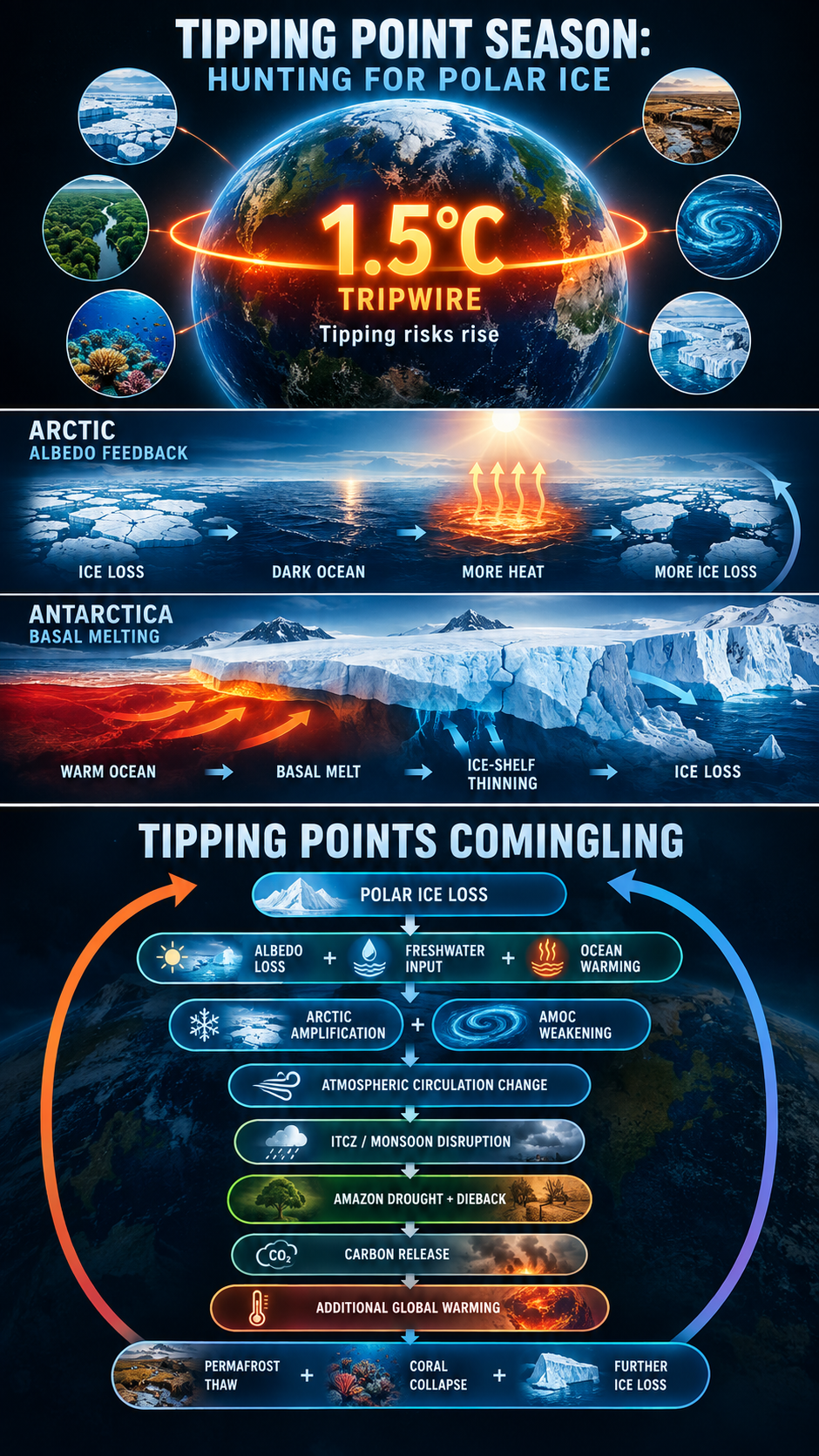
The first sustained period in which global temperatures repeatedly exceeded 1.5°C above the pre-industrial baseline occurred during the extraordinary heat of 2023–2024. The significance of 1.5°C is not simply the number itself. It is what happens to the Earth system as warming pushes individual components toward critical thresholds.
At approximately this level of warming, multiple climate tipping elements become increasingly vulnerable. Ice sheets destabilize. Permafrost thaws. Ocean circulation weakens. Tropical forests lose resilience. Coral reefs approach thermal limits. These systems do not operate independently. Once one begins to change, it can alter the conditions experienced by another. Feedbacks become coupled, tipping elements begin to interact, and the result can be a system in which climate change no longer progresses linearly with the forcing imposed by human emissions. It accelerates.
That is the danger of a tipping point season. And the polar regions are at the head of the parade.
2023–2024: The Ice Begins to Behave Differently
The Antarctic cryosphere provided one of the clearest warnings.
During 2023, Antarctic sea ice reached an extraordinary low. The February 2023 summer minimum was the lowest in the satellite record, followed by a September winter maximum that was also a record low. The loss was not simply a matter of seasonal variability. The magnitude of the departure raised the possibility that Antarctic sea ice was entering a fundamentally different regime.
The anomaly continued into 2024. Antarctic sea ice reached a winter maximum of approximately 17.16 million square kilometers on September 19, 2024, the second-lowest maximum in the 46-year satellite record. Two consecutive years of exceptionally low sea ice suggested that the system was capable of occupying a state substantially different from the historical range in which it had operated for decades.
A regime shift does not mean Antarctic sea ice suddenly disappears forever. It means that the statistical behavior of the system changes. Extremes that were once rare can become more common, recovery can become less complete, and the system can begin fluctuating around a new baseline.
This distinction is critical because sea ice and land ice are not the same thing. Sea ice floats and primarily affects albedo, ocean-atmosphere exchanges, and regional climate dynamics. The Antarctic ice sheet is land-based, and when it loses mass, that water ultimately contributes to global sea-level rise.
The Antarctic ice sheet continued to lose mass even as regional snowfall temporarily offset some losses, particularly in East Antarctica. The fundamental concern remains concentrated in West Antarctica, where warm ocean water can attack ice shelves from below. The stability of the ice sheet therefore depends not simply on how much snow falls on its surface, but on the interaction among ocean temperatures, ice shelves, grounding lines, glacier flow, atmospheric circulation, and the geometry of the Antarctic continental shelf.
The Arctic was changing at the same time.
The September 2023 Arctic sea-ice minimum was approximately 4.23 million square kilometers, the sixth-lowest minimum in the satellite record. More importantly, the Arctic has lost much of its older, thicker multiyear ice. The remaining ice is younger and thinner, making it more vulnerable to subsequent warming and summer melt.
The thinning of the Arctic ice cover is especially important because thickness represents stored resilience. Ice that is only a fraction of its former thickness can disappear much more rapidly under the same atmospheric and oceanic forcing. The Arctic is therefore not simply losing ice. It is losing ice resilience.
The delayed autumn freeze-up adds another feedback. When open ocean remains exposed later into the year, it absorbs additional solar energy and releases additional heat into the atmosphere during the cold season. Less ice means more exposed dark ocean. More exposed dark ocean means more absorbed energy. More stored heat can delay refreezing. The result is a feedback loop that reinforces the original loss.
2026–2027: A Much Stronger El Niño Meets a Changed Cryosphere
The next phase of the experiment is already underway.
The 2026–2027 El Niño has rapidly intensified, with NOAA identifying a substantial probability of an historically exceptional event. The World Meteorological Organization has likewise described the developing event as very strong, with the likelihood of persistence through the Northern Hemisphere winter approaching certainty.
The significance is not simply that El Niño produces global warmth. It is that this El Niño is occurring against a cryosphere that has already been altered by decades of warming.
This is the experiment nature is conducting: What happens when an exceptionally strong El Niño encounters an already destabilized cryosphere?
The answer will depend on the interaction of multiple systems. El Niño changes atmospheric circulation, precipitation patterns, ocean temperatures, and the distribution of heat around the planet. The polar regions respond to those changes through complex atmospheric and oceanic pathways.
In Antarctica, El Niño can interact with the Amundsen Sea Low and atmospheric circulation patterns that influence the transport of warm, moist air toward West Antarctica and the Antarctic Peninsula. At the same time, changes in ocean circulation can transport relatively warm water onto continental shelves, where it can reach the undersides of floating ice shelves.
That basal melting is particularly dangerous because ice shelves act as buttresses. They help restrain the inland flow of glaciers. When they thin, fracture, or retreat, that buttressing effect can weaken. Glaciers such as Thwaites and Pine Island can then accelerate, increasing the rate at which land-based ice enters the ocean.
The result is a potential chain reaction: warmer ocean water promotes ice-shelf melting; weakened ice shelves provide less resistance to glacier flow; faster glacier flow causes grounding-line retreat; and grounding-line retreat can expose thicker ice to ocean water, potentially accelerating further retreat.
The Arctic is simultaneously being subjected to another set of interacting forces. El Niño can influence planetary-scale atmospheric waves and the distribution of heat between the tropics and higher latitudes. During the winter of 2026–2027, changes in the polar vortex could further alter the exchange of cold Arctic air and warmer mid-latitude air.
The resulting pattern can produce extreme weather whiplash: unusually warm conditions in the Arctic occurring alongside severe cold outbreaks farther south, or abrupt transitions between contrasting weather regimes. These events are not necessarily evidence of a single simple cause. They are manifestations of a climate system whose circulation is being reorganized by increasing energy and altered temperature gradients.
The question is not simply whether 2027 becomes the hottest year ever recorded. The more important question is whether the combined forcing produces persistent state changes in the cryosphere.
A record year can be followed by a cooler year. A record low can recover. But if the system repeatedly establishes new extremes without returning to its former state, something more fundamental may be occurring.
Tipping Points Comingling
The most important characteristic of climate tipping points is that they do not have to wait for one another.
A tipping element does not necessarily need to completely collapse before it begins affecting another system. A weakening ice sheet can alter freshwater input. Freshwater can alter ocean circulation. Ocean circulation can change atmospheric circulation and rainfall. Rainfall changes can stress tropical forests. Forest loss can release carbon. Carbon release can increase warming and place additional stress on ice, permafrost, and ecosystems.
This is where tipping points begin comingling.
Consider the Atlantic Meridional Overturning Circulation, or AMOC. Large-scale melting of Greenland and other ice reservoirs adds freshwater to the North Atlantic. Freshwater makes surface water less dense and can interfere with the sinking of cold, salty water that helps drive the overturning circulation.
A weakened AMOC can then alter heat transport and atmospheric circulation. It can shift rainfall patterns, including the position and strength of the Intertropical Convergence Zone, or ITCZ. That creates the possibility of major consequences for tropical rainfall, including rainfall over the Amazon basin.
The Amazon is particularly important because it is not simply a passive victim of climate change. It is part of the climate system itself. Forests recycle enormous quantities of water through evapotranspiration. When drought, heat, deforestation, and altered rainfall reduce forest resilience, that moisture-recycling system can weaken.
The sequence becomes self-reinforcing: AMOC weakening alters atmospheric circulation; atmospheric circulation alters rainfall; reduced rainfall increases Amazon drought stress; drought and heat increase forest mortality; forest loss reduces moisture recycling and releases carbon; additional carbon increases atmospheric warming; and additional warming further stresses the forest.
Under severe conditions, Amazon dieback could release enormous quantities of stored carbon, potentially on the order of 140 gigatons of carbon. That would transform the Amazon from a major carbon sink into an additional source of atmospheric carbon.
The same principle applies in the Arctic.
Loss of sea ice reduces the reflective surface of the planet. Dark ocean absorbs more solar radiation than bright sea ice. That additional absorbed energy contributes to Arctic amplification, which increases regional warming. Warmer Arctic conditions accelerate permafrost thaw.
Permafrost contains enormous quantities of organic carbon accumulated over thousands of years. As frozen ground thaws, microbial activity can release carbon dioxide and methane. Those greenhouse gases increase atmospheric warming, which promotes further permafrost thaw.
The feedback therefore becomes another amplification loop: ice loss increases absorbed energy; absorbed energy increases warming; warming thaws permafrost; thaw releases greenhouse gases; greenhouse gases increase warming; and warming drives additional ice loss.
West Antarctica presents another powerful feedback.
Warm ocean water reaches the underside of ice shelves. Ice shelves thin. Their buttressing effect declines. Glaciers accelerate. Grounding lines retreat. As grounding lines retreat into deeper water, the geometry of the ice sheet can become increasingly unstable.
This is the fundamental concern behind marine ice-sheet instability. Once retreat becomes self-sustaining, the loss of West Antarctic ice could continue for centuries even if atmospheric temperatures eventually stabilize. The ultimate consequence would be meters of global sea-level rise.
Coral reefs provide another example of interacting stresses. Rising ocean temperatures produce increasingly frequent and severe marine heatwaves, while increasing atmospheric carbon dioxide drives ocean acidification. Heat stress causes coral bleaching and mortality, while acidification makes it more difficult for corals to build and maintain their skeletons.
These stresses do not simply add together. They compound one another.
The Emerging Cascade
The larger system can therefore be represented as a chain of interacting feedbacks:
POLAR ICE LOSS → ALBEDO LOSS + FRESHWATER INPUT + OCEAN WARMING → ARCTIC AMPLIFICATION + AMOC WEAKENING → ATMOSPHERIC CIRCULATION CHANGE → ITCZ / MONSOON DISRUPTION → AMAZON DROUGHT + DIEBACK → CARBON RELEASE → ADDITIONAL GLOBAL WARMING → PERMAFROST THAW + CORAL COLLAPSE + FURTHER ICE LOSS
The Earth system contains multiple interacting feedbacks capable of reinforcing one another. As global warming increases, the probability that these feedbacks interact also increases.
That changes the way we should interpret climate extremes. The critical signal may not be the next record. It may be the failure to recover from the last one. A single extreme can be weather. Repeated extremes can become climate. Persistent extremes can indicate a regime shift.
We are therefore not simply watching individual records being broken. We are watching whether the underlying system continues to return toward its previous state after each disturbance.
The links exist. The feedbacks are physically real. And as warming increases, the probability that several of them interact increases as well. They already are interacting. The question is no longer whether these feedbacks will interact, but how strongly they will amplify one another.
We are not simply watching the ice melt. We are watching to see whether the climate system can still return to its previous state.
It is no longer enough to ask: How much warming are humans causing?
The more consequential question becomes: How much additional warming is the Earth system beginning to cause for itself?
That is the real meaning of a tipping point season.
And right now, we are hunting for the answer in the ice.
Read the full hunting manual: This is Tipping Point Season
Easy-to-Read Resources