Jump to: Addendum "Climate Responsibility and Accountability"
The Problem
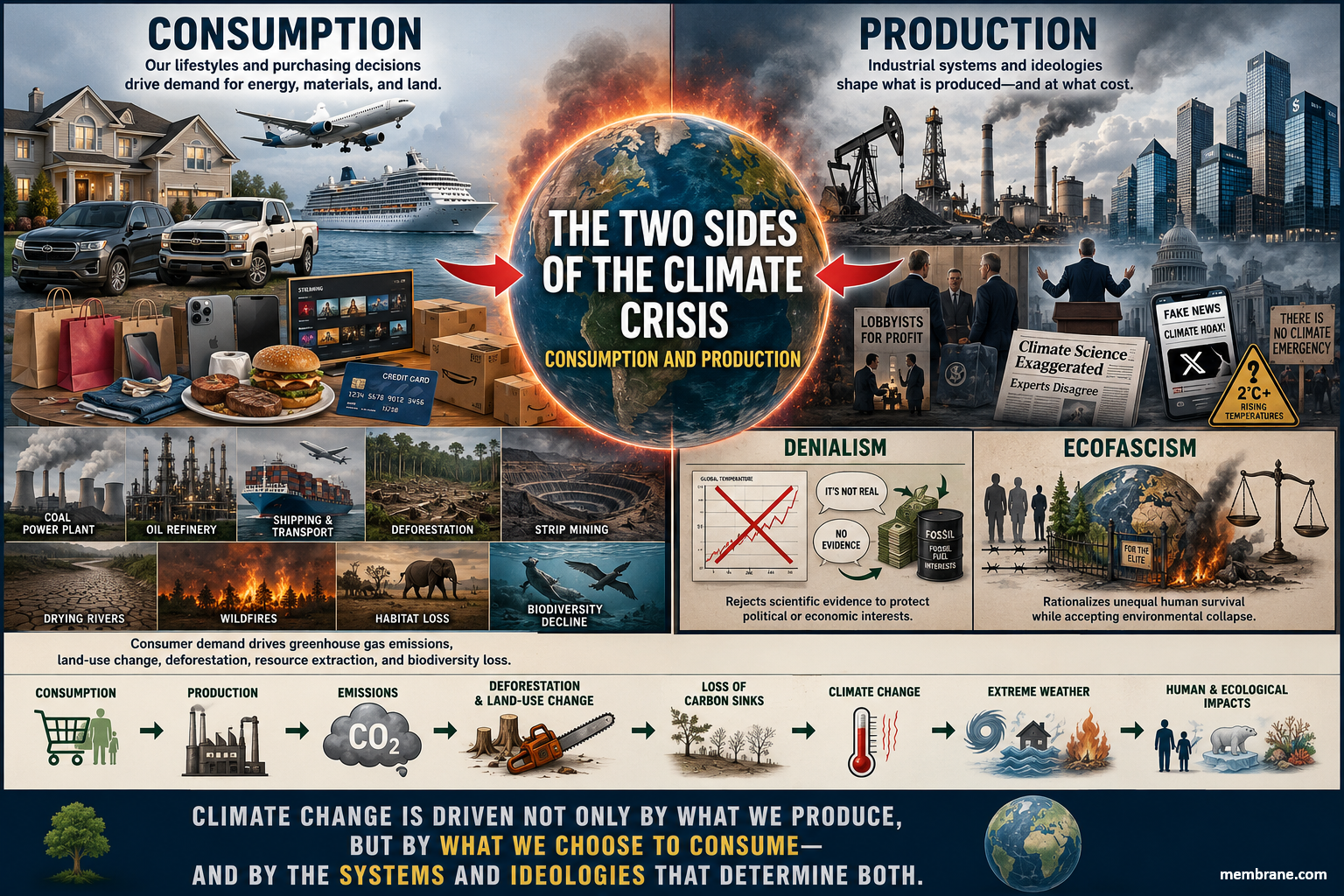
Climate change is often discussed as a problem of emissions, but emissions are the result of two interconnected forces: consumption and production.
Q: What are the greatest drivers of climate change?
A: Consumption and production.
At present, I would rank our addiction to consumption and ecofascism as the two most significant drivers of the climate crisis. While they operate in different ways, both reinforce the systems that accelerate environmental degradation.
The Consumption Problem
The United States, Western Europe, Canada, and Australia represent some of the world’s most consumption-driven economies. When self-interest, materialism, and short-term economic incentives dominate decision-making, consumer demand becomes one of the primary drivers of climate change, influencing not only greenhouse gas emissions but also land-use change, deforestation, habitat destruction, water consumption, resource depletion, and biodiversity loss.
This is why consumption-based accounting provides a more accurate picture of climate responsibility than production-based accounting alone.
For example, if a smartphone is manufactured in Asia using coal-generated electricity and then shipped across the Pacific to a consumer in Los Angeles, the emissions from mining, manufacturing, transportation, and delivery are ultimately driven by the purchasing decision. Under consumption-based accounting, those emissions are attributed to the American consumer rather than solely to the country where the phone was manufactured.
Read the full explanation and view the rankings here:
The Carbon We Own: Why Consumption Matters More
and
Production-Based Climate Burden Per Capita
The Production Problem
The production side of the equation is likewise influenced by self-interest and economic incentives, but it is also shaped by ideological movements that obstruct effective climate action.
Two distinct, though sometimes overlapping, ideologies are particularly important:
Denialism is characterized by the rejection of scientific evidence, refusal to engage with empirical data, and reliance on misinformation or rhetorical distraction. Its primary objective is often the protection of political, ideological, or economic interests by undermining the scientific consensus.
Ecofascism combines elements of denialism with authoritarian, exclusionary, or extremist beliefs. In its most extreme forms, it portrays environmental collapse as acceptable—or even desirable—because it is viewed as reducing populations or preserving resources for groups considered more deserving than others. This ideology has historically been associated with racist, xenophobic, or eugenicist beliefs and rejects principles of equality and shared human responsibility.
The distinction is important. Traditional denialism primarily seeks to delay or prevent climate policy. Ecofascism goes further by framing unequal human survival as an acceptable or even desirable outcome — eliminationist logic.
Why This Matters
Climate change is not simply a technological or economic challenge. It is also a question of values.
On one side, excessive consumption drives demand for fossil fuels, resource extraction, and emissions. On the other, ideologies that reject science or rationalize unequal human suffering weaken society’s ability to respond effectively to the crisis.
Both sides must be addressed if meaningful progress is to be made.
Further Reading
While investigating climate change denialism, I examined material that I believe illustrates the intersection between denialist narratives and extremist environmental ideologies. A summary of that research is available here:
Introduction to Solutions
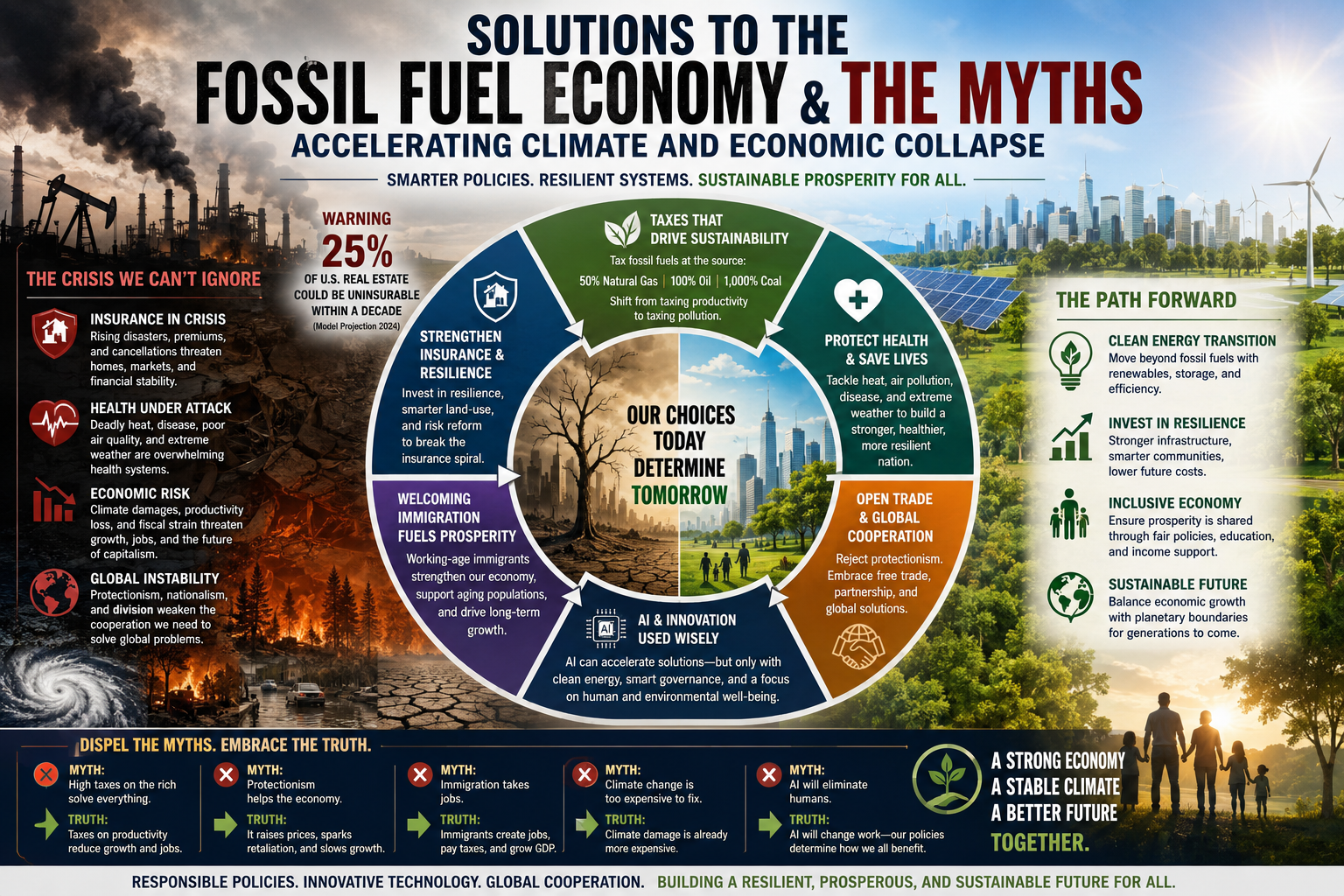
In today's political climate, economic debates are increasingly dominated by short-term wins, emotional appeals, and zero-sum thinking. From the standpoint of fundamental economic principles, many widely supported policies—such as high taxation on productivity, nationalism, protectionism, populism, and anti-immigration sentiment—carry long-term consequences that ultimately harm everyone, regardless of class or ideology.
Even more urgent is the systemic threat posed by climate change. As climate-driven disasters grow in frequency and severity, the costs are beginning to overwhelm the financial infrastructure that underpins modern economies. Gunther Thallinger of Allianz SE has warned that accelerating climate losses threaten to break the insurance sector’s ability to function. If insurance falters, cascading impacts could destabilize markets, investment systems, and the viability of capitalism itself.
The State of the Union: Insurance
Homeowners and property insurance are the canary in the coal mine—and the canary is dying.
In high-risk states including Florida, Louisiana, California, Texas, Arizona, Colorado, Washington, and others, rising premiums, frequent disasters, and declining property values are creating a compounding financial crisis. In several states, taxpayer-backed insurers now serve as insurers of last resort as private companies withdraw from unsustainable risk exposure.
As hurricanes, wildfires, floods, and extreme heat intensify, the economic strain on insurers and taxpayers grows. Hurricane Ian (2022) exposed the scale of potential liability. Continued bailouts and premium spikes divert resources from public services and increase fiscal instability.
In 2024, our model projected that 25% of U.S. real estate could become uninsurable within the next decade. By 2025, insurers had already canceled at least 10% of policies in the most vulnerable zip codes. As former California Insurance Commissioner David Jones stated, “We are marching toward an uninsurable future.”
Agriculture, transportation, and infrastructure insurance costs are also rising as climate risk becomes central to underwriting. Without systemic reform—including resilience investments and smarter land-use policy—the insurance spiral will continue.
Climate and Public Health
Health feedback loops, violent rain, and deadly humid heat are driving an exponential rise in climate-related mortality. This interaction between disease spread, extreme heat, air quality degradation, and infrastructure stress is no longer theoretical—it is measurable.
All 50 U.S. states are experiencing deadly humid heat advisories. Wet-bulb temperatures are approaching 31°C (87.8°F)—a physiological threshold beyond which sustained human survival outdoors becomes impossible. Meanwhile, intensified rainfall events cause billions in damage annually.
Climate-driven health feedback loops are destabilizing healthcare systems and increasing insurance costs nationwide. Addressing climate change is now an economic and public health necessity.
Taxes and Productivity
Taxes are necessary to fund public goods—but taxes on productivity, such as income taxes, reduce incentives for labor, investment, and innovation. In contrast, taxes that discourage pollution or overconsumption of finite resources can align markets with long-term sustainability.
Rather than traditional carbon taxes tied to offsets and net-zero narratives, a more direct approach would tax fossil fuels at the point of extraction or sale. A phased system—50% on natural gas, 100% on oil, and 1,000% on coal—would send a clear price signal and accelerate energy transition.
Air pollution alone contributes to approximately 7 million premature deaths globally each year. Climate-driven disease burdens are straining public and private healthcare systems, raising premiums and threatening fiscal sustainability.
Trade, Nationalism, and Immigration
Protectionism and nationalist economic policy historically increase consumer costs and reduce global competitiveness. Tariffs trigger retaliation, suppress growth, and undermine cooperation needed to address global crises.
Immigration, particularly of working-age individuals, remains essential for sustaining workforce growth and supporting aging populations. As birth rates decline, economic math requires either expanded immigration or systemic fiscal reform.
Over the past five years, immigration has contributed substantially to U.S. GDP growth. Restricting it risks long-term stagnation.
AI, Immigration, and Productivity
Protectionist, nationalist, and anti-immigration economic policies are interacting with — and in some cases accelerating — the rapid deployment of artificial intelligence and automation technologies. Trillions of dollars in public and private capital are now being directed toward AI infrastructure, robotics, machine learning systems, and computational hardware. These investments are fundamentally reshaping labor markets.
Since 2025, both the supply of and the demand for human labor have undergone systemic structural change. On the supply side, immigration restrictions, demographic aging, and declining labor force participation in some sectors have constrained available workers. On the demand side, firms are increasingly substituting capital for labor, deploying AI systems capable of performing cognitive, analytical, logistical, and even creative tasks once thought uniquely human.
Paradoxically, aggregate productivity has continued to rise. Automation has reduced marginal labor costs, accelerated production cycles, optimized logistics, and expanded scalable digital services. In macroeconomic terms, output per worker has increased even as the total demand for certain categories of labor has stagnated or declined. Economic expansion, therefore, is increasingly decoupled from broad-based employment growth.
This structural shift raises critical distributional questions. When capital deepening replaces labor, the gains from productivity growth tend to accrue disproportionately to asset owners, technology firms, and high-skill workers, while mid- and low-skill labor markets face displacement pressures. Anti-immigration policies may temporarily tighten certain labor markets, but in combination with automation incentives, they also encourage firms to accelerate capital substitution strategies.
The result is not the literal “elimination” of humans, but the progressive redefinition of human economic value within production systems. Entire sectors — transportation, customer service, finance, logistics, manufacturing, and portions of professional services — are undergoing rapid task automation. The long-term trajectory suggests a restructuring of work itself, with fewer routine roles and a growing premium on adaptability, creativity, and system-level oversight.
The central economic question is no longer whether productivity will increase — it already has — but whether policy frameworks will adapt to manage labor displacement, income concentration, and social stability in an era where technological capital scales faster than human employment.
Artificial intelligence adds another layer of complexity to the climate system—not physically, but socio-economically. AI development is energy-intensive, requiring vast data centers powered by electricity that, in many regions, is still generated from fossil fuels. Training large-scale models can consume significant amounts of electricity and water for cooling, contributing to emissions and local resource strain. At the same time, AI can accelerate climate solutions by optimizing grid management, improving energy efficiency, enhancing climate modeling, and supporting precision agriculture. The net impact depends on governance, energy sourcing, hardware efficiency, and deployment priorities. In other words, AI is neither inherently climate-positive nor climate-negative; it is a force multiplier whose trajectory will amplify either decarbonization efforts or fossil-fuel dependence, depending on how intelligently—and ethically—it is integrated into the global energy system.
Why Do Scientists Use AI?
The only effective way to stop the acceleration of climate change is through the reduction of fossil-fuel combustion.
However, the most likely way of reversing the trajectory of climate change is through people using AI to develop previously unthought-of methods and technologies that can fundamentally change how we produce, consume, and manage resources—and potentially remove greenhouse gases from the atmosphere.
Read the full report: Why Do Scientists Use AI? From Computational Efficiency to Climate Innovation
Beyond Data Centers: AI, Sustainability, and the Future of Work
From an economic perspective, I’ve found AI to be extraordinarily productive. One of our economic models projects that AI-driven automation could reduce the demand for human labor by as much as 90% over the next decade. Whether that estimate proves accurate or not, the broader trend points toward substantial productivity gains.
That means the bigger societal question isn’t simply whether to build AI infrastructure. It’s how we prepare for an economy where productivity increasingly comes from intelligent systems. Issues like universal basic income, negative income taxes, wage subsidies, or other forms of national or global income support may become some of the most important policy discussions of the coming decades.
Technology itself isn’t inherently good or bad. The challenge is ensuring we deploy it in ways that improve both human well-being and environmental sustainability.
New Data Center Designs and the Evolving Environmental Footprint of AI InfrastructureAddendum: Climate Responsibility and Accountability
Introduction
The original purpose of Solutions to the Fossil Fuel Economy and the Myths Accelerating Climate and Economic Collapse was to focus on practical solutions rather than assigning blame. Since its publication, however, many readers have interpreted that emphasis as minimizing the responsibility of fossil fuel companies. This addendum clarifies that both interpretations can be true simultaneously.
I began my career as an economist specializing in risk management before turning my attention to humanity’s largest systemic risk—climate change. My work spans economics, systems science, statistics, and climate physics. Together with physicist Sidd Mukherjee, I co-originated the Nonlinear Acceleration Hypothesis, a framework describing how interacting physical, ecological, health, and socioeconomic feedbacks can accelerate climate impacts beyond traditional linear projections.
My work has consistently argued that climate change is both a physical and an economic problem. It cannot be understood through atmospheric science alone, nor through economics alone. Rather, it emerges from the interaction of nonlinear Earth-system processes and human decision-making.
Shared Responsibility Does Not Eliminate Corporate Accountability
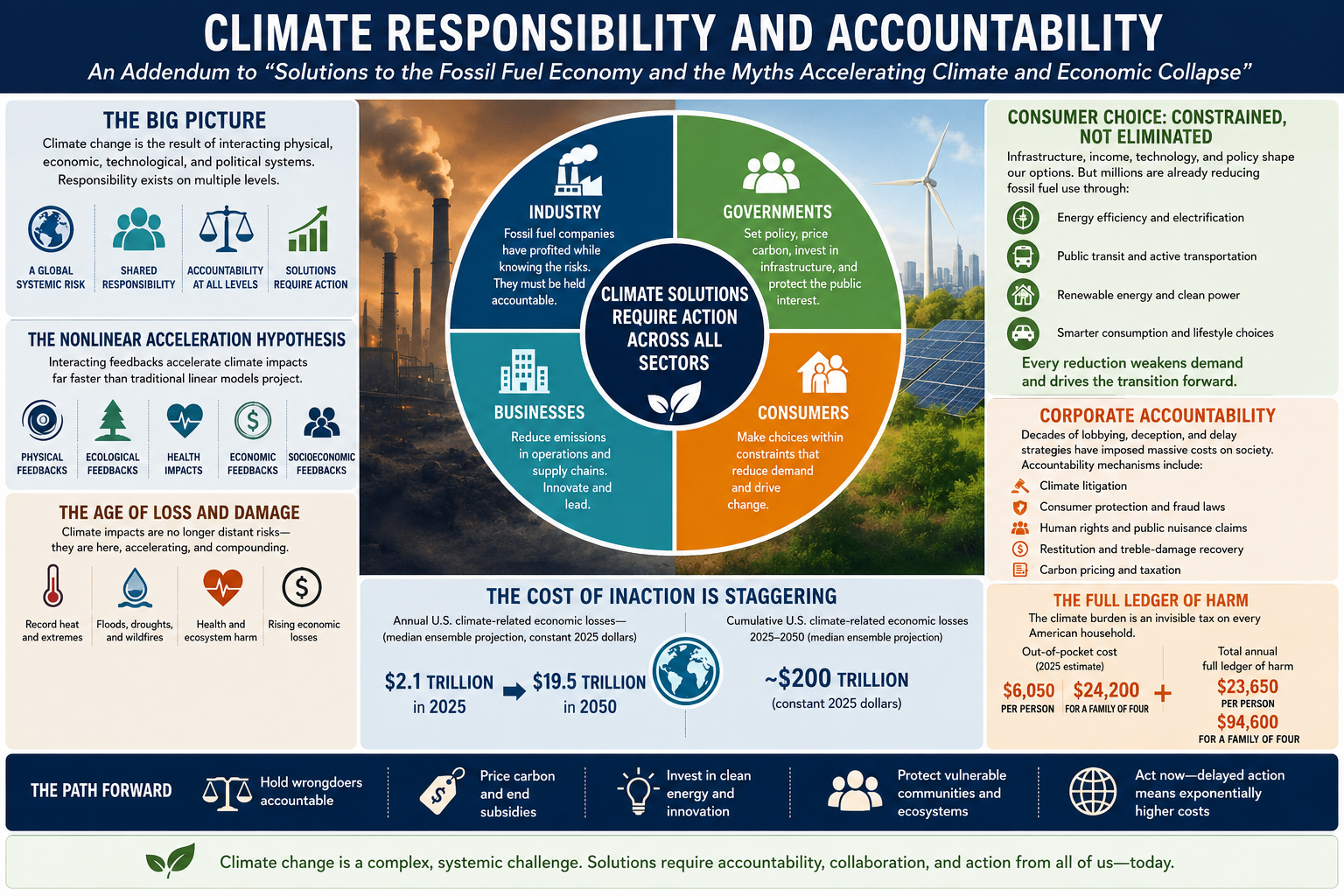
Fossil fuel consumption is fundamentally a supply-and-demand system. Producers cannot exist without consumers, and consumers cannot purchase what is not supplied. Responsibility therefore exists on multiple levels.
Recognizing consumer responsibility does not absolve fossil fuel companies of their own responsibilities.
Oil and gas companies have exercised enormous influence through lobbying, political advocacy, public relations campaigns, strategic communications, and efforts to delay or weaken climate policy. Those actions deserve careful scrutiny and, where appropriate, legal accountability.
At the same time, it is equally inaccurate to argue that consumers possess no agency whatsoever. While choices are often constrained by infrastructure, income, geography, and available technology, millions of individuals, businesses, and governments have successfully reduced fossil fuel dependence through efficiency improvements, electrification, renewable energy adoption, and changes in consumption patterns.
The issue is therefore not one of assigning exclusive blame to either producers or consumers. Climate change is the product of interacting economic incentives, political institutions, technological development, consumer behavior, and physical climate feedbacks.
Understanding that complexity is essential if society intends to solve the problem rather than merely redistribute blame.
Corporate Accountability
My work has also extensively examined legal and economic mechanisms for holding fossil fuel companies accountable, including:
- climate litigation,
- consumer protection law,
- human rights frameworks,
- carbon pricing and taxation,
- restitution,
- treble-damage recovery, and
- broader climate liability frameworks.
Those topics are discussed in detail throughout the following papers, which complement the original economics article rather than contradict it.
The Fossil Fuel Industry
Oil and gas companies unquestionably bear significant responsibility for the climate crisis. Decades of internal research, lobbying, public relations campaigns, political influence, and efforts to delay emissions reductions have been extensively documented. Protecting market share and shareholder value frequently took precedence over communicating known climate risks or accelerating the transition to lower-carbon energy sources.
Those actions deserve public scrutiny and, where appropriate, legal accountability.
However, acknowledging corporate misconduct does not eliminate the role of consumer demand. Energy markets function through supply and demand. Producers extract, refine, and distribute fossil fuels because governments, businesses, and consumers continue to purchase them across transportation, electricity generation, manufacturing, agriculture, aviation, shipping, and residential heating.
This is not a moral judgment; it is an economic reality.
Consumers often operate within real constraints. Infrastructure, housing, public transportation, income, local utility policies, and technology availability all influence individual choices. Some households possess far greater flexibility than others. Nevertheless, constrained choice is not the same as no choice. Millions of households and businesses have reduced fossil fuel consumption through energy efficiency, electrification, renewable energy, improved building design, vehicle selection, and changes in consumption patterns. Each reduction weakens demand at the margin.
Likewise, governments influence both supply and demand through regulation, taxation, subsidies, infrastructure investments, and public procurement. Climate policy therefore operates across every level of society rather than through a single actor.
The climate crisis emerged from interacting physical, economic, technological, and political systems. Effective solutions require addressing each component simultaneously.
Existing Work on Corporate Accountability
Contrary to claims that emphasizing consumer responsibility somehow absolves fossil fuel producers, much of my work focuses specifically on legal and economic accountability for corporate misconduct.
The following papers examine those issues in detail.
Climate Change and Accountability
This paper examines the legal foundations for climate litigation, including consumer fraud, public nuisance, deceptive marketing, human rights claims, restitution, and the application of legal principles similar to those successfully employed against the tobacco industry.
The Economics of Climate Change
Climate change is fundamentally different from most economic shocks.
Traditional recessions eventually recover. Financial crises stabilize. Commodity shortages resolve. Climate change does not naturally return to equilibrium within human timescales because excess greenhouse gases and accumulated ocean heat continue influencing the climate system for decades to centuries.
As University of Cape Town researcher Christopher Trisos observed:
“For people, other species, ecosystems, and the world we live in, we’ve entered the Age of Loss and Damage, but we’re just at the start.”
Likewise, following the record-breaking Northern Hemisphere summer of 2023, United Nations Secretary-General António Guterres warned:
“Climate breakdown has begun.”
These statements reflect a growing recognition that climate damages are no longer primarily future risks—they have become ongoing economic realities.
The Age of Loss and Damage
Climate economics must therefore evolve beyond traditional Integrated Assessment Models (IAMs), many of which assume smooth, gradual damage functions that underestimate systemic risk.
My work argues that climate damages arise from interacting nonlinear feedbacks operating simultaneously across physical, ecological, health, financial, insurance, agricultural, infrastructure, and geopolitical systems.
Understanding those interactions requires integrating:
- economics,
- systems science,
- statistics,
- atmospheric physics,
- ecology,
- public health, and
- risk management.
The resulting framework is consistent with the Nonlinear Acceleration Hypothesis, which recognizes that climate impacts increasingly reinforce one another through cascading feedback loops rather than simple linear cause-and-effect relationships.
Accounting for Climate Damages
One objective of climate economics is not merely estimating annual losses, but accounting for the full societal burden imposed by delayed mitigation and continued emissions.
Quantifying the Climate Tax
Quantifying the Climate Tax: The Full Ledger of Harm
This paper estimates the annual economic burden currently imposed by climate change on American households.
The analysis concludes that the direct annual climate burden already approaches $6,000 per person, while the broader long-term burden—including infrastructure degradation, ecosystem loss, health impacts, insurance instability, productivity losses, and deferred damages imposed on future generations—is substantially larger.
Climate change is therefore functioning as an invisible tax already embedded throughout the economy.
The Legal Foundation for Treble Damages
American law has long recognized that ordinary compensation is insufficient when misconduct is deliberate, deceptive, or socially destructive.
Treble damages appear throughout U.S. law, including:
- Sherman Act antitrust litigation,
- RICO actions,
- False Claims Act enforcement, and
- numerous state consumer protection statutes.
Their purpose extends beyond compensation. They deter future misconduct while recognizing that direct damages frequently underestimate total societal harm.
A comparable framework may be appropriate when evaluating climate-related damages if plaintiffs establish that institutions knowingly delayed mitigation while externalizing foreseeable risks onto the public.
Justice, Restitution, and Climate Liability
Applying a justice framework to climate economics raises three related questions:
- Did organizations knowingly externalize foreseeable climate damages?
- Have those damages fallen disproportionately upon vulnerable populations and future generations?
- Should legal remedies reflect deterrence as well as compensation?
These questions extend beyond economics into ethics, law, and public policy, but they are increasingly becoming central to climate litigation worldwide.
The Cost of Inaction
The companion paper,
The Full Economic Burden: An Ensemble-Based Probabilistic Framework
develops an ensemble-based probabilistic framework for estimating the long-term economic consequences of accelerating climate change.
Under the median ensemble projection, annual U.S. climate-related economic losses increase nearly tenfold, rising from approximately $2.1 trillion in 2025 to $19.5 trillion by 2050 (constant 2025 dollars).
Rather than projecting a steady increase in damages, the analysis demonstrates how interacting physical, ecological, health, financial, and socioeconomic feedbacks can transform climate change into an accelerating systemic economic burden.
Under the median ensemble scenario, cumulative U.S. climate-related losses between 2025 and 2050 approach $200 trillion (constant 2025 dollars).
These projections illustrate a central conclusion of the Nonlinear Acceleration Hypothesis: delayed responses, thermal inertia, interacting feedbacks, and tipping cascades can produce economic impacts that grow substantially faster than traditional linear or quadratic damage models anticipate.
Conclusion
Climate responsibility should never be framed as an either-or proposition.
Corporations that knowingly delayed climate action should be held accountable through transparent governance, appropriate regulation, and where justified, legal remedies.
Governments bear responsibility for designing policies that correctly price externalities, accelerate innovation, and remove barriers to decarbonization.
Businesses bear responsibility for reducing emissions throughout their operations and supply chains.
Consumers also retain agency through the choices they make within the constraints they face.
Climate change emerged from the interaction of all of these systems. Lasting solutions will require accountability and action across all of them.
Consumer Agency
-
We determine the future today. Choose wisely.
How long do you think it takes to make six-million-year-old ice?
How hard will our generation make the struggle to thrive become a struggle merely to survive?
We determine the future today. Choose wisely. -
Climate Change: What Can I Do?
One of the most important factors is reducing unnecessary consumption. Consumerism is a primary driver of climate change, fueling energy demand, resource extraction, pollution, and habitat destruction. The less we consume, the less pressure we place on both the climate and the ecosystems that support us.
Systemic Risk and Accelerating Warming
* Our probabilistic, ensemble-based climate model — which incorporates complex socio-economic and ecological feedback loops within a dynamic, nonlinear system — projects that global temperatures are becoming unsustainable this century. This far exceeds earlier estimates of a 4°C rise over the next thousand years, highlighting a dramatic acceleration in global warming. We are now entering a phase of compound, cascading collapse, where climate, ecological, and societal systems destabilize through interlinked, self-reinforcing feedback loops.
We examine how human activities — such as deforestation, fossil fuel combustion, mass consumption, industrial agriculture, and land development — interact with ecological processes like thermal energy redistribution, carbon cycling, hydrological flow, biodiversity loss, and the spread of disease vectors. These interactions do not follow linear cause-and-effect patterns. Instead, they form complex, self-reinforcing feedback loops that can trigger rapid, system-wide transformations — often abruptly and without warning. Grasping these dynamics is crucial for accurately assessing global risks and developing effective strategies for long-term survival.