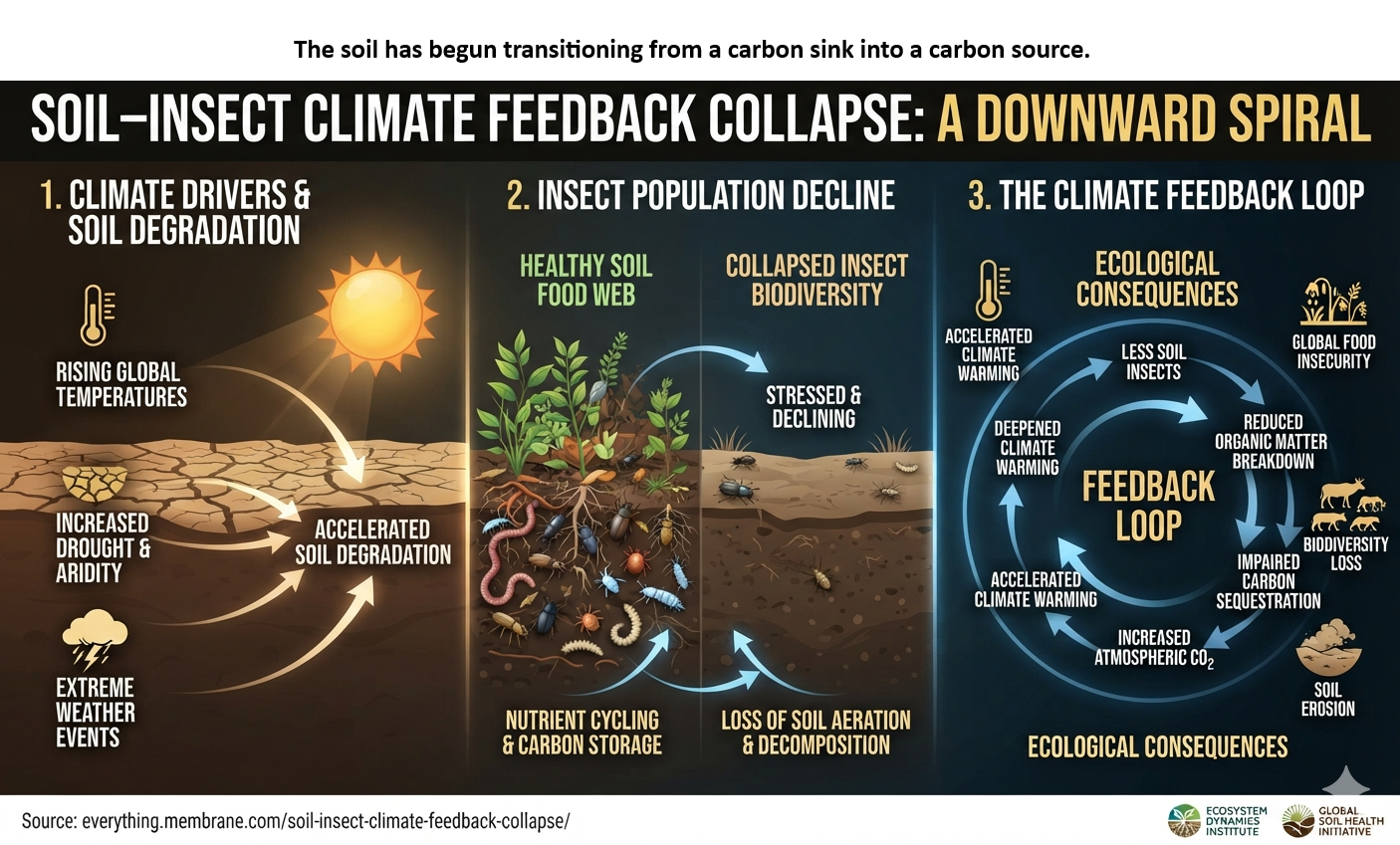
Climate change is not only transforming the atmosphere, oceans, and visible landscapes of Earth; it is also disrupting one of the planet’s most important hidden systems—the living soil ecosystem beneath our feet. Soil and insects exist in a highly interconnected relationship where insects regulate decomposition, nutrient cycling, carbon storage, water movement, and the physical structure of the ground itself.
As global temperatures rise and extreme weather becomes more intense, this relationship is being pushed beyond its natural limits. Soil insects, particularly ectothermic organisms whose body temperatures are controlled by their environment, are highly vulnerable to rising temperatures, drought, flooding, and ecological instability. At the same time, soil itself becomes increasingly degraded as biological processes that maintain its structure and fertility begin to fail.
This creates a destructive climate feedback loop:
Climate warming → insect decline → soil degradation → carbon release → amplified warming → further insect decline
The collapse of soil-insect systems represents more than a biodiversity crisis. It is a systemic disruption of one of Earth’s largest carbon reservoirs and one of humanity’s most important life-support systems. As subterranean ecosystems deteriorate, the consequences extend upward into agriculture, wildfire behavior, atmospheric processes, food security, and human health.
Climate change acts as the primary trigger for the collapse of the soil-insect system. Rising temperatures, changing precipitation patterns, drought, and extreme rainfall events place intense pressure on organisms that have evolved within relatively stable environmental conditions.
Increasing drought conditions dry out the upper layers of soil, eliminating critical habitat for many soil organisms. Moisture-dependent insects and other decomposers experience increased mortality as soils become too dry to support biological activity.
Dry soils also:
As moisture disappears, many soil insects are forced deeper underground to escape unfavorable surface conditions, leaving the upper soil layers biologically depleted.
Climate change is also increasing the frequency of intense rainfall events. These sudden floods disrupt underground ecosystems by:
The increasing combination of drought and extreme rainfall creates a climate “whiplash” effect, forcing soil organisms to survive rapidly shifting and increasingly hostile environments.
Elevated soil temperatures place ectothermic organisms under direct physiological stress. Because insects rely on environmental temperatures to regulate metabolism, warming can push them beyond their thermal limits.
The consequences include:
The result is a progressive breakdown of the underground biological network that supports healthy soils.
As climate pressures intensify, soil insect communities begin experiencing widespread ecological disruption. The impacts are not limited to population decline but include changes in behavior, body size, timing, and species composition.
Macrofauna such as ants, beetles, termites, and other large decomposers are essential for processing organic matter and maintaining soil structure.
Under increasing heat and drought stress:
The loss of surface-level decomposer activity weakens the entire soil food web.
Rising temperatures accelerate insect development rates. However, faster growth often results in smaller adult insects.
This reduction in body size decreases:
Smaller insects are less capable of performing critical roles such as decomposition, soil mixing, and nutrient movement.
Climate disruption alters the timing relationships between organisms.
Examples include:
These mismatches weaken ecosystem stability and reduce the ability of soil communities to adapt.
Specialized soil insects are among the most vulnerable organisms during rapid environmental change.
Localized extinctions of sensitive species result in:
As biodiversity declines, the soil ecosystem becomes less resilient and more vulnerable to additional climate stress.
The decline of soil insect communities causes cascading failures throughout the underground ecosystem. Without healthy insect populations, soils lose many of the biological processes required to maintain fertility, structure, and climate regulation.
Soil insects are fundamental to the breakdown of organic material.
Without macrofauna:
The biological recycling system that sustains terrestrial ecosystems begins to fail.
Burrowing insects act as ecosystem engineers by creating tunnels and channels throughout the soil.
These structures provide:
As tunneling organisms disappear:
The soil loses its ability to function as a living, dynamic system.
Healthy soils represent one of Earth’s largest carbon reservoirs. Soil insects help protect carbon by shredding organic matter and mixing it into deeper layers where it can become stabilized.
When insect communities collapse:
The soil has begun transitioning from a carbon sink into a carbon source.
Once soil degradation begins, the damage feeds back into the climate system, accelerating the original disruption. The loss of soil insects transforms a biological decline into a broader Earth-system feedback mechanism.
As soil structures fail and organic matter becomes exposed, large quantities of stored soil carbon are released into the atmosphere.
Healthy soils function as long-term carbon storage systems by protecting organic matter within complex soil structures. When insect activity declines:
As more carbon enters the atmosphere, additional warming occurs, intensifying the environmental pressures already affecting soil organisms.
The combined loss of soil biodiversity and soil structure can transform productive ecosystems into degraded landscapes.
Without healthy insect communities:
The landscape gradually loses its capacity to support biological productivity, creating conditions favorable for permanent desertification.
The release of additional greenhouse gases creates a reinforcing climate feedback.
The sequence becomes:
Rising temperatures → insect decline → soil degradation → carbon release → increased atmospheric warming → greater ecological stress
The original disturbance is therefore amplified through the collapse of a critical biological system.
This destructive feedback loop is no longer only a theoretical projection. It is actively documented across multiple ecosystems worldwide. Field experiments, long-term ecological monitoring, and regional surveys reveal visible breakdowns where insect declines directly affect soil stability, carbon cycling, and ecosystem function.
Tropical ecosystems contain some of the most biologically diverse soil communities on Earth. However, tropical insects often live close to their maximum thermal tolerance, making them particularly vulnerable to even modest increases in temperature.
Controlled whole-profile soil warming experiments in tropical forests have demonstrated:
As specialized macro-decomposers such as larger beetles and millipedes decline:
Without a diverse insect community controlling microbial processes, microbes can accelerate the breakdown of organic matter, increasing carbon dioxide emissions from tropical soils.
Agricultural ecosystems are experiencing a compounding crisis as climate stress combines with intensive land management practices.
Major pressures include:
Long-term ecological monitoring indicates that heavily managed agricultural regions experience accelerating declines in insect abundance and species richness as climate pressures increase.
When croplands experience extreme heat:
As biological soil engineers disappear, farmers increasingly rely on mechanical intervention to break apart hardened soils.
However, increased tillage:
This creates a reinforcing cycle:
Climate stress → soil insect loss → soil degradation → increased tillage → further soil ecosystem destruction
Dryland ecosystems depend heavily on ecosystem-engineering insects such as ants and termites. These organisms regulate water movement, nutrient distribution, and soil structure in some of the planet’s most water-limited environments.
Increasing temperatures and prolonged drought have altered grassland soil communities, causing significant declines in moisture-sensitive soil organisms.
Deep-dwelling insects are increasingly affected as underground moisture disappears.
Without deep-tunneling insects:
When intense rainfall events occur, degraded soils cannot absorb water effectively.
Instead:
The loss of vegetation further reduces organic matter inputs, reinforcing the decline of soil insects and accelerating desertification.
The soil-insect collapse feedback does not occur independently. It connects directly with major Earth-system processes involving carbon storage, methane regulation, wildfire intensity, and extreme weather.
The destruction of subterranean biodiversity transforms a microscopic ecological disruption into a planetary-scale climate amplifier.
Soils contain roughly three times more carbon than terrestrial vegetation. Soil insects function as biological gatekeepers that determine how carbon is processed and stored.
Healthy soils depend on insects to:
Global environmental changes reduce the feeding and burrowing activity of soil detritivores, weakening this carbon protection system.
Without insects physically incorporating and protecting carbon:
Long-term warming experiments show that stressed soils can begin consuming persistent, centuries-old organic matter, releasing additional carbon dioxide into the atmosphere.
This converts soils from climate stabilizers into climate amplifiers.
Upland soils represent a major global methane sink because they contain methane-consuming microorganisms called methanotrophs.
Methanotroph activity depends on proper soil gas exchange.
This balance is maintained by:
When heat and drought drive tunneling insects away:
As the methane sink weakens:
The soil shifts from actively filtering methane toward becoming a weaker climate-regulating system.
The collapse of soil decomposer communities fundamentally changes the physical characteristics of forests, grasslands, and other terrestrial ecosystems. When insects responsible for breaking down organic material decline, landscapes accumulate larger quantities of dry, undecomposed biomass.
Healthy populations of millipedes, woodlice, beetles, and other macro-insects rapidly process fallen leaves, dead plant material, and organic debris.
When these decomposers decline:
The result is the transformation of biologically active landscapes into increasingly combustible environments.
When climate-driven wildfires ignite these ecosystems:
Intense fires also damage the remaining plant-soil-microbe relationships that allow ecosystems to recover.
Following severe burns:
This creates a reinforcing cycle:
Climate warming → insect decline → reduced decomposition → increased fuel accumulation → larger wildfires → ecosystem degradation → further insect loss
Healthy soils and their insect communities function as a natural climate buffer. Soil organisms help regulate water movement, maintain moisture storage, and reduce the severity of environmental extremes.
When this biological infrastructure collapses, landscapes lose their ability to absorb climate shocks.
Without insect-driven bioturbation—the natural mixing and restructuring of soil—the upper layers of soil become increasingly compacted and degraded.
The consequences include:
The soil becomes hardened and less capable of functioning as a living water-management system.
When extreme rainfall events occur:
The landscape loses its ability to store water, increasing drought stress after storms and creating conditions that intensify future heat waves.
The cycle becomes:
Soil degradation → reduced water storage → stronger drought impacts → greater heat stress → further ecosystem decline
The effects of soil-insect collapse extend directly into human systems. Because human civilization depends on productive soils for agriculture, the degradation of underground ecosystems represents a direct threat to food security, economic stability, and public health.
Humans depend on healthy soils for approximately 95% of the food consumed globally. As soil biological systems decline, the consequences move from ecological disruption into human survival systems.
As temperatures rise and insect communities decline, agricultural soils lose critical biological functions.
When fields lose tunneling macrofauna:
During drought:
During extreme rainfall:
The same degraded soil becomes vulnerable to both drought and flooding, creating increasingly unstable agricultural conditions.
Food production depends not only on crop quantity but also on nutritional quality.
The relationship between insects, microbes, and plants maintains the movement of essential nutrients through ecosystems.
Soil insects:
These processes influence the availability of minerals such as:
When insect macro-decomposers decline:
Crops grown in degraded soils may experience reduced nutrient density, increasing the risk of “hidden hunger”—micronutrient deficiencies that impair human development and immune function.
As native insect diversity collapses, agricultural ecosystems become increasingly vulnerable to pests and disease.
The loss of beneficial insects removes important ecological controls over:
To maintain production:
Greater chemical dependence contributes to:
The agricultural system becomes trapped in a cycle of ecological decline and increasing dependence on external inputs.
Healthy soils contain complex biological communities that naturally regulate harmful organisms.
A diverse soil ecosystem acts as a biological defense system by limiting the expansion of opportunistic pathogens.
High biodiversity helps suppress harmful organisms, including pathogens such as:
When soil biodiversity declines:
As soil ecosystems become increasingly disrupted:
The soil-insect feedback loop connects directly to human respiratory health through increased wildfire intensity.
When insect decomposers decline:
These severe fires release:
Smoke exposure can contribute to:
As wildfire seasons intensify, the loss of soil biodiversity becomes connected to increasingly widespread air-quality threats.
The final stage of soil collapse occurs when degraded landscapes lose their ability to maintain stable vegetation and soil structure.
When insect populations decline:
Wind can then transport large quantities of fine soil particles across broad regions.
Chronic exposure to dust can increase risks of:
The degradation of soil ecosystems therefore creates direct human health consequences far beyond the original affected landscape.
The soil-insect relationship represents one of Earth’s most important biological feedback systems. Although insects are small organisms, their collective influence extends across planetary-scale processes involving carbon storage, water regulation, atmospheric chemistry, agriculture, and human health.
Climate change destabilizes this relationship by pushing soil organisms beyond their ecological limits. As insect communities decline, soils lose their ability to function as living ecosystems. Nutrient cycling slows, carbon storage weakens, water regulation declines, and landscapes become increasingly vulnerable to drought, flooding, wildfire, and erosion.
The resulting feedback loop transforms a biological disruption into a climate amplifier:
A warming climate damages insects.
Declining insects damage soils.
Damaged soils release carbon and lose resilience.
Carbon release and ecosystem degradation accelerate climate instability.
The collapse occurring beneath the surface is therefore not separate from global climate change—it is part of the same interconnected Earth-system response.
Protecting soil biodiversity is not only an effort to preserve insects. It is an essential component of protecting carbon storage, food production, ecosystem stability, and human civilization itself.
The future of climate stability depends not only on what happens in the atmosphere above us, but also on whether the living world beneath our feet continues to function.
Ecosystem Collapse and Extinction Risks | Insect Collapse | Soil
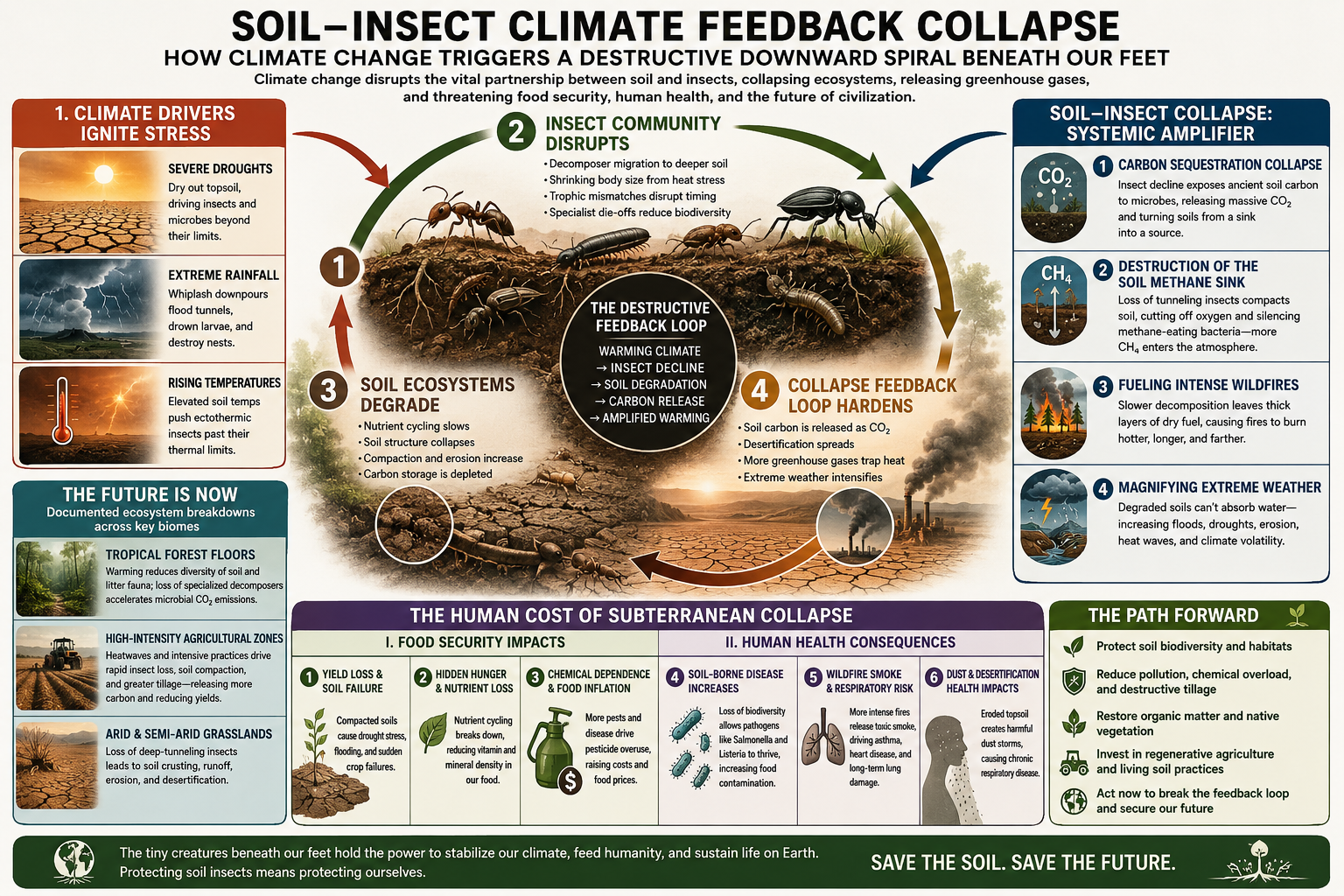
* Our probabilistic, ensemble-based climate model — which incorporates complex socio-economic and ecological feedback loops within a dynamic, nonlinear system — projects that global temperatures are becoming unsustainable this century. This far exceeds earlier estimates of a 4°C rise over the next thousand years, highlighting a dramatic acceleration in global warming. We are now entering a phase of compound, cascading collapse, where climate, ecological, and societal systems destabilize through interlinked, self-reinforcing feedback loops.
We examine how human activities — such as deforestation, fossil fuel combustion, mass consumption, industrial agriculture, and land development — interact with ecological processes like thermal energy redistribution, carbon cycling, hydrological flow, biodiversity loss, and the spread of disease vectors. These interactions do not follow linear cause-and-effect patterns. Instead, they form complex, self-reinforcing feedback loops that can trigger rapid, system-wide transformations — often abruptly and without warning. Grasping these dynamics is crucial for accurately assessing global risks and developing effective strategies for long-term survival.