The AMOC in a Coupled Earth System:
Weakening, Feedback Coupling, and the Emerging Risk of Cascading Climate Instability
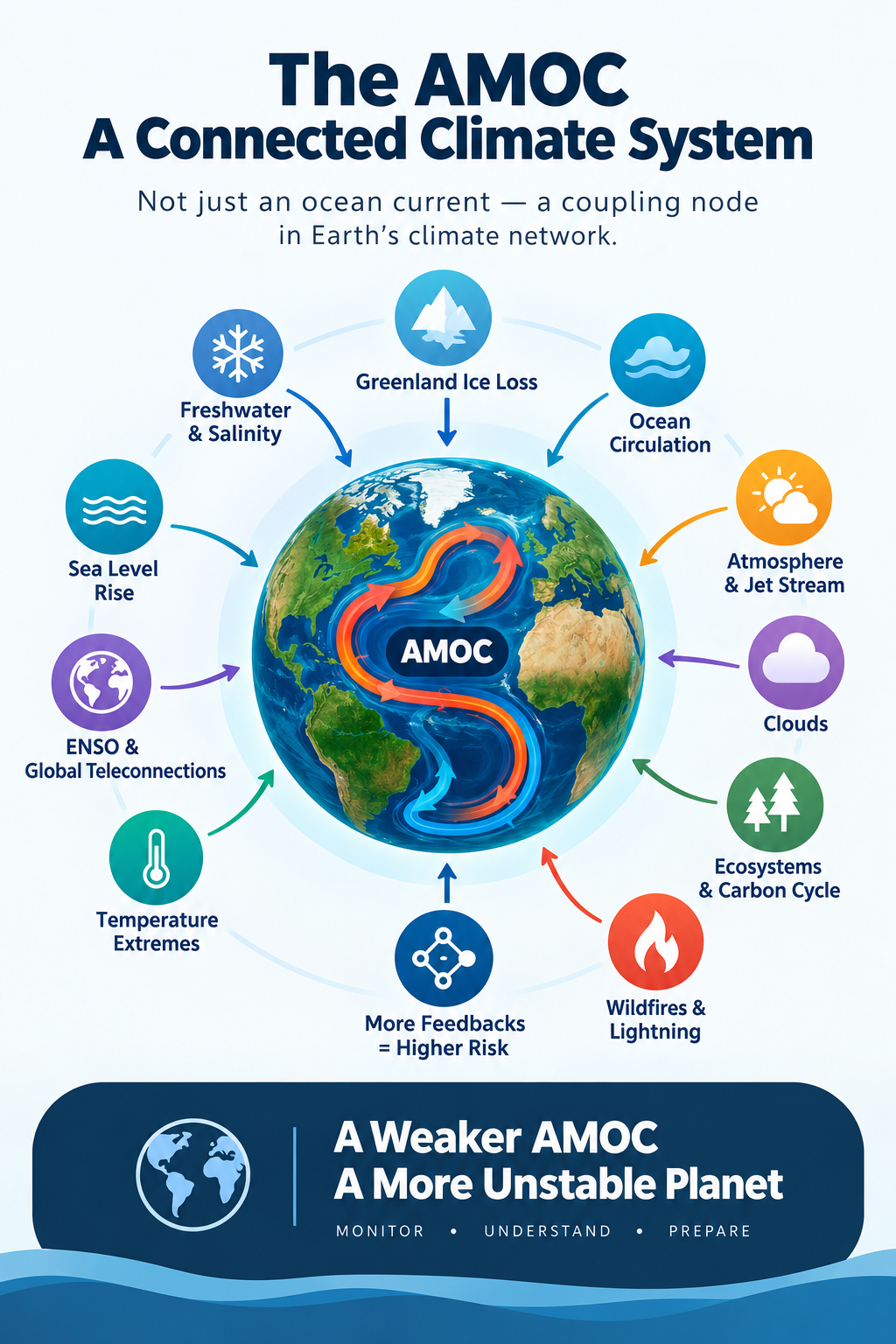
The AMOC may ultimately prove to be less important as an isolated “tipping point” than as a coupling node through which changes in the cryosphere, ocean, atmosphere, biosphere, and carbon cycle propagate.
Overview
The AMOC is weakening.
But the bigger climate story may be what happens when that weakening begins to interact with other parts of the Earth system.
AMOC weakening can interact with declining low-level clouds, tropospheric ozone, ocean warming, sea-ice loss, atmospheric circulation, wildfires, lightning, and other processes—creating pathways for feedbacks to become coupled rather than operating independently.
The concern isn’t simply that the AMOC may weaken.
It’s that a weakening circulation can become one link in a larger feedback cascade.
Climate change isn’t a collection of isolated problems.
It’s a coupled Earth system.
And when feedbacks begin coupling, the risk isn’t merely more warming.
It’s instability.
Read the paper:
Abstract
The Atlantic Meridional Overturning Circulation (AMOC) is one of Earth’s principal mechanisms for redistributing heat, carbon, freshwater, and nutrients between the tropics and the North Atlantic. Its future behavior has consequently become one of the most consequential uncertainties in climate science. Multiple observational reconstructions and model studies indicate that the AMOC has weakened or experienced substantial changes in recent decades, although the magnitude, timing, and attribution of that weakening remain debated. The Intergovernmental Panel on Climate Change (IPCC) assesses that the AMOC will very likely weaken during the twenty-first century but assigns medium confidence that an abrupt collapse will not occur before 2100.
This synthesis advances a broader systems perspective. Rather than treating AMOC weakening as an isolated oceanographic response to greenhouse-gas forcing, we examine it as a component of a coupled network involving Greenland ice loss, North Atlantic freshening, ocean stratification, atmospheric circulation, clouds, tropospheric ozone, the jet stream, Rossby waves, ENSO, the North Atlantic Oscillation, wildfires, carbon-cycle feedbacks, and other tipping elements. Within this framework, the critical scientific question is not simply whether the AMOC will “collapse,” but whether declining circulation resilience is increasing the probability of interactions among multiple climate feedbacks.
Evidence for early-warning behavior has been reported in observational AMOC indices, including changes in variance and autocorrelation interpreted as potential indicators of declining resilience. However, these indicators remain contested, and alternative analyses have demonstrated that some apparent early-warning signals can arise from changing observational coverage rather than an approaching tipping point. Similarly, a statistical analysis published by Ditlevsen and Ditlevsen estimated a likely transition during the twenty-first century under continued emissions, while emphasizing the uncertainty surrounding the underlying assumptions.
We therefore propose that AMOC risk should be evaluated using a coupled-feedback framework. A weakening AMOC may simultaneously alter North Atlantic heat transport, sea level, atmospheric circulation, precipitation, storm tracks, carbon uptake, and remote climate variability. Conversely, those altered conditions can feed back upon the AMOC itself. The result is potentially nonlinear behavior in which the significance of AMOC weakening cannot be inferred from circulation strength alone.
The AMOC may therefore represent not merely a tipping element, but a major coupling node within the planetary climate system.
1. Introduction
The Atlantic Meridional Overturning Circulation is often described as a giant conveyor belt transporting warm surface waters northward and returning colder, denser water southward at depth. Although this analogy is useful for public communication, it obscures the complexity of the actual system.
The AMOC is a three-dimensional circulation structure involving temperature, salinity, density, winds, ocean mixing, convection, freshwater fluxes, boundary currents, deep-water formation, and interactions between the ocean and atmosphere.
Its importance extends far beyond the Atlantic.
The circulation transports enormous quantities of heat toward the North Atlantic, influences European climate, affects tropical rainfall, interacts with atmospheric circulation, contributes to regional sea-level patterns, and participates in the global carbon and nutrient cycles.
Consequently, a substantial AMOC weakening represents more than a change in ocean current velocity.
It represents a redistribution of energy and mass throughout the Earth system.
The scientific literature increasingly supports the expectation that continued greenhouse-gas warming will weaken the AMOC. The IPCC concludes that the AMOC will very likely decline during the twenty-first century under continued warming. At the same time, the IPCC assigns medium confidence that an abrupt collapse will not occur before 2100 and emphasizes uncertainty in the magnitude of historical and future changes.
This distinction is fundamental.
AMOC weakening is not equivalent to AMOC collapse.
Yet the absence of certainty about an abrupt collapse does not imply the absence of risk.
The central question is whether a gradual weakening can itself destabilize other components of the climate system and thereby create pathways toward nonlinear change.
That is the focus of this synthesis.
2. The Physical Engine of the AMOC
The AMOC depends strongly on the formation and sinking of dense North Atlantic waters.
Warm, salty surface waters are transported northward. In the high-latitude Atlantic, cooling increases seawater density. Where sufficiently dense water forms, it sinks and contributes to the deep limb of the overturning circulation.
This creates an important relationship:
Temperature + salinity → density → sinking → overturning circulation
Global warming interferes with this mechanism through several pathways.
Warming increases the temperature of surface waters.
At the same time, increased precipitation, river runoff, Arctic freshwater export, and Greenland ice-sheet melt can reduce North Atlantic salinity.
The resulting freshwater input makes surface waters less dense.
Thus:
Greenhouse warming → ice loss + precipitation + runoff → North Atlantic freshening → reduced density → reduced deep-water formation → AMOC weakening
This is one of the most important feedback pathways in the AMOC system.
Recent research provides evidence that subarctic freshening has contributed to AMOC weakening since the mid-twentieth century, although the magnitude of historical AMOC change remains an active area of research.
3. Greenland as an AMOC Amplifier
Greenland occupies a uniquely important position within this system.
Warming increases surface melting and ice discharge from the Greenland Ice Sheet. The resulting freshwater enters the North Atlantic, where it can alter salinity and density.
The relationship is therefore potentially self-reinforcing:
Warming → Greenland ice loss → freshwater input → North Atlantic freshening → weaker convection → weaker AMOC
But the feedback does not stop there.
A weaker AMOC transports less heat northward.
That changes the distribution of ocean heat.
Changes in North Atlantic sea-surface temperature alter atmospheric pressure gradients, storm tracks, evaporation, precipitation, and heat exchange.
The atmosphere then acts back upon the ocean.
Thus the AMOC is embedded within a two-way ocean-atmosphere feedback system rather than operating as an isolated current.
4. The Labrador–Irminger Seas and the Subpolar Convection Problem
One of the most important regional components of the system is deep convection in the Labrador and Irminger Seas and surrounding subpolar North Atlantic.
Freshening can inhibit the formation of dense surface water and reduce convection.
This provides a potential regional pathway into larger-scale circulation change:
Greenland melt + Arctic freshwater
↓
Subpolar North Atlantic freshening
↓
Reduced convection
↓
Reduced deep-water formation
↓
AMOC weakening
The significance of this mechanism is that AMOC weakening does not necessarily require the entire Atlantic circulation system to change simultaneously.
A relatively localized disruption of deep convection can propagate through the circulation architecture.
This is characteristic of a complex coupled system: a regional perturbation can modify the operating conditions of a much larger system.
5. AMOC Weakening Is Not Necessarily a Single Event
A conventional tipping-point narrative often implies a sequence such as:
Stable → threshold → collapse
The physical climate system is unlikely to be so simple.
A more realistic representation is:
Stable regime → weakening → loss of resilience → increasing variability → feedback coupling → threshold behavior → possible transition
This distinction matters because a system can become increasingly unstable before an abrupt transition occurs.
Boers found statistically significant early-warning signals in eight independent AMOC indices derived from sea-surface-temperature and salinity observations. These included patterns consistent with increased variance and declining resilience. The study concluded that the AMOC may have evolved from relatively stable conditions toward a critical transition.
Ditlevsen and Ditlevsen subsequently used statistical early-warning methods to estimate a likely AMOC transition during the twenty-first century, with their central estimate falling around mid-century under continued high emissions. Their published confidence interval was broad, however, extending from approximately 2037 to 2109.
A major scientific objection is that changing observational coverage can itself create apparent increases in variance. Chen and Tung demonstrated that apparent early-warning signals can arise from increasing observational coverage, raising important questions about the reliability of proxy-based AMOC tipping indicators.
The appropriate conclusion is therefore not that AMOC collapse has been proven imminent.
The stronger conclusion is:
The AMOC exhibits enough evidence of weakening and possible loss of resilience that treating abrupt change as impossible would be scientifically unjustified.
6. The AMOC–Jet Stream Connection
The AMOC and atmosphere form a coupled climate system.
The North Atlantic ocean temperature field influences atmospheric pressure and circulation. Changes in the AMOC can therefore alter the distribution of heat between the ocean and atmosphere.
At the same time, atmospheric circulation affects the ocean through winds, evaporation, precipitation, and surface heat exchange.
This creates a feedback architecture:
AMOC weakening
↓
North Atlantic heat redistribution
↓
Sea-surface-temperature changes
↓
Atmospheric pressure-gradient changes
↓
Jet-stream and storm-track changes
↓
Changed surface winds and heat exchange
↓
Further ocean-circulation modification
The jet stream is particularly important because it provides a pathway through which ocean changes can influence weather far beyond the Atlantic.
Our earlier analysis of Rossby-wave behavior proposes that Arctic amplification and changes in ocean circulation are contributing to increasingly amplified and persistent atmospheric waves. Such behavior can promote blocking, stalled weather systems, prolonged heat, drought, and precipitation extremes.
The AMOC should therefore be considered part of a larger ocean-atmosphere circulation system.
7. AMOC, Rossby Waves, and Climatic Whiplash
The conventional view of climate impacts often focuses on changes in average temperature.
That approach misses an important characteristic of a destabilizing circulation system:
persistence.
A storm that moves normally through a region is fundamentally different from a storm that stalls.
A heat wave that lasts three days is different from one that lasts three weeks.
A flood followed by a normal return to dry conditions is different from a flood followed immediately by drought.
Changes in Rossby-wave amplitude and atmospheric blocking can increase persistence and produce these compound events.
The resulting sequence can be represented as:
AMOC / Arctic changes
↓
Altered North Atlantic temperature gradients
↓
Atmospheric wave amplification
↓
Blocking and stalled circulation
↓
Persistent heat / drought / precipitation
↓
Hydroclimatic whiplash
This does not mean that every extreme event is caused by AMOC weakening.
It means that AMOC changes can modify the background state in which atmospheric extremes develop.
8. AMOC and ENSO: The Planetary Connection
One of the most important developments in the AMOC framework is the recognition that the relationship is not confined to the Atlantic.
Recent work summarized in our AMOC synthesis indicates that AMOC weakening can alter the behavior of ENSO. In particular, a weakening AMOC has been associated in climate-model experiments with changes in eastern equatorial Pacific sea-surface-temperature variability and an increase in ENSO variability. Our synthesis has estimated an approximately 11% amplification under the modeled mechanism.
This creates a striking possibility:
AMOC weakening → altered Pacific variability
while the reverse pathway also exists:
El Niño → atmospheric circulation changes → North Atlantic circulation changes
The relationship is therefore potentially bidirectional.
El Niño reorganizes tropical convection and the Walker circulation.
That atmospheric disturbance can generate planetary-scale circulation responses affecting the Atlantic.
Changes in Atlantic winds can alter ocean upwelling and sea-surface temperatures.
Those changes can then influence atmospheric circulation again.
The climate system therefore contains a network rather than a chain.
9. The Pacific–Atlantic Atmospheric Bridge
The developing relationship between Pacific El Niño and Atlantic Niña provides a useful illustration of this network.
A simplified pathway is:
Pacific warming
↓
Shifted tropical convection
↓
Walker circulation reorganization
↓
Atmospheric pressure changes
↓
Atlantic trade-wind changes
↓
Ocean upwelling
↓
Atlantic sea-surface-temperature response
The important point is that the Pacific does not directly “cause” the Atlantic to cool.
The atmosphere provides the bridge.
This is an example of climate-energy redistribution through coupled circulation.
It also demonstrates why an AMOC-centered analysis cannot be restricted to the North Atlantic.
The AMOC exists inside a planetary circulation system.
10. The AMOC–Cloud Feedback Network
Clouds provide another potentially important coupling mechanism.
Clouds affect the radiation budget by reflecting incoming solar radiation and interacting with outgoing terrestrial radiation. Their net climate effect depends strongly on cloud altitude, optical properties, location, and type.
Changes in North Atlantic sea-surface temperatures and atmospheric circulation can alter cloud distributions.
Conversely, changes in cloud cover alter the amount of solar energy reaching the ocean.
A simplified feedback is:
AMOC change → SST change → atmospheric circulation → cloud change → radiative forcing → SST change
Declining low-level clouds are particularly important because their loss can reduce reflected shortwave radiation and increase solar absorption at the surface.
Thus cloud changes can transform an ocean-circulation perturbation into an additional radiative forcing.
This is an example of why feedbacks cannot necessarily be treated independently.
11. Tropospheric Ozone as a Potential AMOC Coupling Agent
Tropospheric ozone introduces another layer of complexity.
Ozone is both a greenhouse gas and a powerful ecological pollutant. Elevated ozone concentrations can damage vegetation, reduce photosynthetic productivity, alter stomatal behavior, and weaken terrestrial carbon uptake.
Within the broader feedback framework developed in our research, this creates a pathway connecting atmospheric chemistry to ocean circulation:
warming → wildfire + lightning + atmospheric chemistry → tropospheric ozone → vegetation damage → reduced carbon uptake → additional atmospheric CO₂ → additional warming
That warming can increase Greenland melt and North Atlantic freshwater input.
Thus a feedback that begins in the atmosphere and biosphere can eventually affect the AMOC.
The proposed connection is:
Ozone / ecosystem stress
↓
Reduced carbon uptake
↓
Additional greenhouse forcing
↓
Additional warming
↓
Greenland and Arctic ice loss
↓
North Atlantic freshening
↓
AMOC weakening
The AMOC therefore potentially becomes one downstream component of a much larger chemistry–biosphere–cryosphere–ocean feedback network.
This pathway requires further quantitative investigation. It should presently be treated as a research hypothesis rather than an established causal AMOC mechanism.
12. Wildfires and Lightning
Wildfires add another coupling pathway.
Warming increases the likelihood of heat and drought conditions conducive to wildfire.
Wildfires release carbon dioxide and other gases and aerosols. They also alter atmospheric chemistry and cloud formation.
Lightning can contribute to nitrogen-oxide production, which participates in tropospheric ozone chemistry.
The resulting network can be represented as:
Warming → drought → wildfire
↓
CO₂ + aerosols + reactive gases
↓
Atmospheric chemistry + cloud modification
↓
Ozone + radiation changes
↓
Vegetation stress
↓
Reduced carbon uptake
↓
Additional warming
At sufficiently large scales, the resulting forcing can feed back into cryospheric and oceanic processes.
The significance is not that wildfire “causes” AMOC collapse.
The significance is that a weakening AMOC can occur simultaneously with changes in several other feedback systems that alter the background forcing experienced by the Atlantic.
13. The Carbon-Cycle Connection
The AMOC also participates in the carbon cycle.
Ocean circulation transports dissolved carbon and nutrients through the ocean interior. Changes in vertical mixing and overturning can therefore alter ocean carbon uptake and storage.
A weakening circulation can reduce aspects of vertical transport and modify biological productivity and carbon sequestration.
This creates a potentially important feedback:
AMOC weakening
↓
Changed vertical mixing and nutrient transport
↓
Changed biological productivity / carbon uptake
↓
Atmospheric CO₂ response
↓
Additional warming
↓
Further pressure on the AMOC
The magnitude and sign of individual carbon-cycle responses depend on region and timescale, so this feedback should not be simplified into a universally positive AMOC–CO₂ loop.
Nevertheless, the possibility reinforces a central point:
AMOC dynamics cannot be separated cleanly from the global carbon cycle.
14. AMOC and Sea-Level Rise Along the U.S. East Coast
AMOC weakening also has a direct physical consequence for regional sea level.
A slower northward transport of Atlantic waters changes the distribution of ocean mass and dynamic sea level.
This can contribute to additional sea-level rise along portions of the North American Atlantic coast beyond the globally averaged rise produced by thermal expansion and land-ice melt.
Consequently:
AMOC weakening → altered ocean dynamics → regional sea-level rise
This creates an important societal feedback.
Higher coastal water levels increase the baseline upon which storms operate.
A storm that historically produced moderate coastal flooding can therefore produce major flooding under a higher sea-level baseline.
AMOC change thus interacts with another climate multiplier:
circulation change + sea-level rise + storm surge
rather than producing an isolated oceanographic consequence.
15. Why “Collapse” Is the Wrong Single Question
The scientific debate surrounding the AMOC frequently becomes a binary argument:
Will the AMOC collapse this century?
That question is too narrow.
A more useful sequence of questions is:
- Is the AMOC weakening?
- Is its variability changing?
- Is its resilience changing?
- Are North Atlantic freshwater inputs increasing?
- Is deep convection weakening?
- Are atmospheric responses changing?
- Are AMOC-linked feedbacks becoming more strongly coupled?
- Are changes in one subsystem increasing the probability of changes in another?
- Is the climate system approaching a regime in which small additional perturbations produce disproportionately large responses?
The IPCC provides strong support for the first question: the AMOC is expected to weaken under continued warming.
The remaining questions contain substantially greater uncertainty.
That uncertainty should motivate observation, not complacency.
16. From Tipping Element to Coupling Node
The most important conceptual contribution of this synthesis is a change in how the AMOC is represented.
The conventional framework is:
Climate warming → AMOC weakening → climate impacts
The coupled Earth-system framework is:
Greenhouse forcing
↓
Arctic amplification + Greenland melt + precipitation changes
↓
North Atlantic freshening
↓
Deep-convection changes
↓
AMOC weakening
↓
North Atlantic heat redistribution
↓
Atmospheric circulation changes
↓
Jet-stream / Rossby-wave changes
↓
Persistent weather extremes
↓
Ecosystem and carbon-cycle impacts
↓
Additional greenhouse forcing
↓
Further warming
↓
Additional cryosphere loss
↓
Additional freshwater
↓
Further AMOC stress
This is no longer a simple linear chain.
It is a feedback network.
And within that network, the AMOC functions as a coupling node.
17. The Domino Effect
The concept of cascading climate tipping points follows naturally from this framework.
One system does not need to completely collapse before affecting another.
Instead:
System A weakens
↓
Operating conditions for System B change
↓
System B becomes less resilient
↓
System B weakens
↓
System C is exposed to new forcing
↓
Feedback returns to System A
This can produce what we have termed the Domino Effect.
For the AMOC, one possible cascade is:
Global warming
→ Greenland melt
→ North Atlantic freshening
→ Labrador–Irminger convection weakening
→ AMOC weakening
→ North Atlantic temperature redistribution
→ atmospheric circulation changes
→ jet-stream/Rossby-wave amplification
→ persistent extremes
→ drought and wildfire
→ ecosystem degradation
→ reduced carbon uptake
→ additional greenhouse forcing
→ additional warming
→ additional Greenland melt
→ further North Atlantic freshening
This is not a prediction that every link will operate with equal strength.
It is a systems hypothesis identifying pathways that should be monitored together.
18. The Nonlinear Acceleration Hypothesis
The AMOC provides an especially useful test case for the Nonlinear Acceleration Hypothesis.
If climate impacts were purely linear, a gradual increase in forcing would produce a roughly proportional response.
But if feedbacks become activated as warming progresses, the response can change:
forcing → response → feedback → amplified response → additional feedback
The resulting trajectory may exhibit acceleration.
Our broader climate research describes this as a transition from:
change
to
accelerating change
to
acceleration of acceleration
or, mathematically, increasing higher-order derivatives of the climate trajectory.
For the AMOC, the critical question is not whether its strength is declining at a constant rate.
It is whether the rate of change itself is changing because the circulation is entering an increasingly constrained or unstable state.
This is where early-warning indicators, variance, autocorrelation, spatial fingerprints, freshwater forcing, deep convection, and direct observations become particularly important.
19. Reconciling the Scientific Disagreement
A credible AMOC synthesis must explicitly acknowledge the disagreement in the literature.
There are at least three broad positions.
Position 1: Gradual Weakening
The AMOC will weaken substantially as greenhouse-gas concentrations rise, but an abrupt twenty-first-century collapse remains unlikely.
This is broadly consistent with the IPCC assessment.
Position 2: Early-Warning Evidence
Observation-based indicators suggest that the AMOC may be losing resilience and approaching a critical transition.
This is supported by Boers and related work.
Position 3: Statistical Collapse Risk
Statistical inference from observed AMOC fingerprints indicates that a transition could occur during the twenty-first century, potentially around mid-century under continued high emissions.
This is the conclusion advanced by Ditlevsen and Ditlevsen, although the large uncertainty range and methodological assumptions are important.
Counterarguments demonstrate that some apparent early-warning behavior may result from observational artifacts and that a pending collapse cannot presently be established from observations alone.
These positions are not necessarily mutually exclusive.
A system can be weakening without being immediately on the verge of collapse.
A system can also become less resilient without the exact timing of a transition being predictable.
The scientifically defensible position is therefore:
AMOC weakening is a robust climate risk; the timing and probability of abrupt collapse remain uncertain; the consequences of substantial weakening justify treating nonlinear transition risk seriously.
20. What Should Be Monitored?
A coupled-AMOC early-warning system should monitor considerably more than AMOC strength.
Ocean
- North Atlantic salinity
- Greenland freshwater flux
- Labrador Sea convection
- Irminger Sea convection
- Subpolar gyre temperature
- Deep-water formation
- Ocean stratification
- Atlantic heat transport
- Vertical mixing
Atmosphere
- North Atlantic Oscillation
- Jet-stream position
- Rossby-wave amplitude
- Atmospheric blocking
- Storm-track displacement
- Atmospheric moisture transport
- Low-level cloud cover
Cryosphere
- Greenland mass balance
- Arctic sea-ice extent and thickness
- Glacier melt
- Arctic freshwater export
Biosphere and chemistry
- Tropospheric ozone
- Vegetation productivity
- Carbon uptake
- Wildfire activity
- Lightning-generated NOx
- Atmospheric CO₂
Global circulation
- ENSO behavior
- Atlantic Niño/Niña
- Walker circulation
- Pacific–Atlantic teleconnections
- Southern Ocean circulation
The purpose of such monitoring is not to search for a single magic number.
It is to determine whether multiple independent indicators begin moving coherently.
21. A Coupled AMOC Risk Index
The next generation of AMOC risk assessment could therefore move beyond a single circulation-strength metric.
A conceptual Coupled AMOC Risk Index (CARI) could combine normalized indicators of:
Freshwater forcing
- ocean stratification
- deep-convection decline
- AMOC strength
- AMOC variance
- autocorrelation
- Greenland mass loss
- North Atlantic SST structure
- jet-stream instability
- low-level cloud decline
- tropospheric ozone
- carbon-sink deterioration
- ENSO coupling
The purpose would not be to manufacture a false precision.
Instead, it would identify periods in which multiple components of the AMOC system simultaneously move toward conditions associated with reduced resilience.
The most significant signal would therefore not necessarily be:
AMOC = X Sverdrups
“AMOC = X Sverdrups” means the volume of seawater transported by the Atlantic Meridional Overturning Circulation (AMOC) is being expressed in Sverdrups (Sv).
- 1 Sverdrup (Sv) = 1 million cubic meters of water per second
- So 15 Sv = 15 million m³ of seawater transported per second.
- 20 Sv = 20 million m³/s.
- 10 Sv = 10 million m³/s.
It could be:
AMOC weakening + freshening + convection loss + atmospheric reorganization + rising variability
occurring simultaneously.
That would be evidence of coupling.
22. From Tipping-Point Hunting to System Monitoring
The emerging scientific challenge is therefore changing.
Early climate tipping-point research asked:
Where are the thresholds?
The next question should be:
How do systems interact as they approach those thresholds?
A tipping point viewed in isolation may appear remote.
The same tipping point embedded in a network of increasingly stressed systems may represent a substantially greater risk.
The AMOC is particularly important because it sits at the intersection of:
- ocean circulation,
- atmospheric circulation,
- cryosphere change,
- sea-level dynamics,
- carbon cycling,
- tropical climate,
- European climate,
- North American climate,
- and global energy redistribution.
It is therefore one of the most consequential coupling points in the Earth system.
23. Conclusions
The scientific evidence does not justify claiming that an abrupt AMOC collapse has already occurred or that its exact collapse date is known.
It does justify concern.
The AMOC is expected to weaken under continued global warming. Multiple observational studies have identified possible changes in its stability and resilience, while other analyses have challenged the interpretation of those signals. The timing and probability of an abrupt transition remain uncertain.
That uncertainty is precisely why the AMOC should not be treated as an isolated tipping point.
Greenland melt can freshen the North Atlantic.
Freshening can reduce density and deep convection.
Reduced convection can weaken the AMOC.
AMOC weakening can redistribute heat.
That redistribution can alter atmospheric circulation.
Atmospheric circulation can modify clouds, storm tracks, Rossby waves, precipitation, and the jet stream.
Those changes can influence ecosystems, wildfires, carbon uptake, and atmospheric chemistry.
Meanwhile, AMOC changes can interact with ENSO and other planetary circulation modes.
The resulting system is not a chain with one beginning and one end.
It is a network.
The critical scientific transition is therefore from asking:
“Will the AMOC collapse?”
to asking:
“Is the climate system becoming less resilient because AMOC weakening is coupling with other feedbacks?”
That is a much more consequential question.
A tipping point does not need to arrive as a single spectacular event.
It may first appear as a loss of stability:
more variability,
slower recovery,
stronger feedbacks,
altered teleconnections,
persistent atmospheric patterns,
and increasing interaction among previously separable climate processes.
The AMOC may ultimately prove to be less important as an isolated “tipping point” than as a coupling node through which changes in the cryosphere, ocean, atmosphere, biosphere, and carbon cycle propagate.
That perspective changes how the risk should be studied.
We should not wait for the conveyor belt to stop.
We should watch the entire system around it.
References
Boers, N. (2021). Observation-based early-warning signals for a collapse of the Atlantic Meridional Overturning Circulation. Nature Climate Change, 11, 680–688.
Brouse, D. (2025). The Accelerating Collapse of the AMOC–Jet Stream Feedback Loop. Membrane Institute.
Brouse, D., & Mukherjee, S. (2026). Rossby Waves, Climatic Whiplash, and the Nonlinear Destabilization of Atmospheric Circulation. Membrane Institute.
Brouse, D. (2026). Tipping Point Season: See the AMOC Sea. Membrane Institute.
Brouse, D., & Mukherjee, S. (2026). Tipping Point Season: Comingling Tipping Points and Proliferating Feedbacks. Membrane Institute.
Chen, X., & Tung, K.-K. (2024). Evidence lacking for a pending collapse of the Atlantic Meridional Overturning Circulation. Nature Climate Change, 14, 40–42.
Ditlevsen, P., & Ditlevsen, S. (2023). Warning of a forthcoming collapse of the Atlantic meridional overturning circulation. Nature Communications, 14, 4254.
IPCC. (2021). Climate Change 2021: The Physical Science Basis. Chapter 9: Ocean, Cryosphere and Sea Level Change.
Pontes, G. M., & Menviel, L. (2024). Weakening of the Atlantic Meridional Overturning Circulation driven by subarctic freshening since the mid-twentieth century. Nature Geoscience, 17, 1291–1298.
Yeager, S. et al. (2024). A pause in the weakening of the Atlantic meridional overturning circulation since the early 2010s. Nature Communications, 15, 10642.
AMOC DEEP DIVE
- The Global Feedback Cascade: Low-Level Ozone and Low-Level Cloud Feedback Coupling
- Atlantic Meridional Overturning Circulation Slowdown • AMOC Simplified
- Glacial Retreat and the AMOC Slowdown
- What Happens If the AMOC Stops?
- The Accelerating Collapse of the AMOC–Jet Stream Feedback Loop
- The Converging Collapse: AMOC, Jet Streams, and Deadly Wet-Bulb Temperatures
- East Coast Atmospheric Rivers and AMOC (Atlantic Meridional Overturning Circulation)
- Ignite a Domino Effect: Albedo, Brown Carbon, AMOC, Permafrost, Amazon Rainforest Dieback, SLR Pulses, Hydroclimate Whiplash, and Arctic Sea Ice
Feedback Loops →
Tipping Points →
Acceleration →
Domino Effect
Feedback loops amplify climate change and can push interconnected Earth systems past critical tipping points. As tipping points are crossed, they can trigger additional feedback loops and destabilize other climate systems. This cascading "Domino Effect" compresses timescales, accelerates change, and increases the risk of rapid, nonlinear climate transformations.
Easy-to-Read Resources