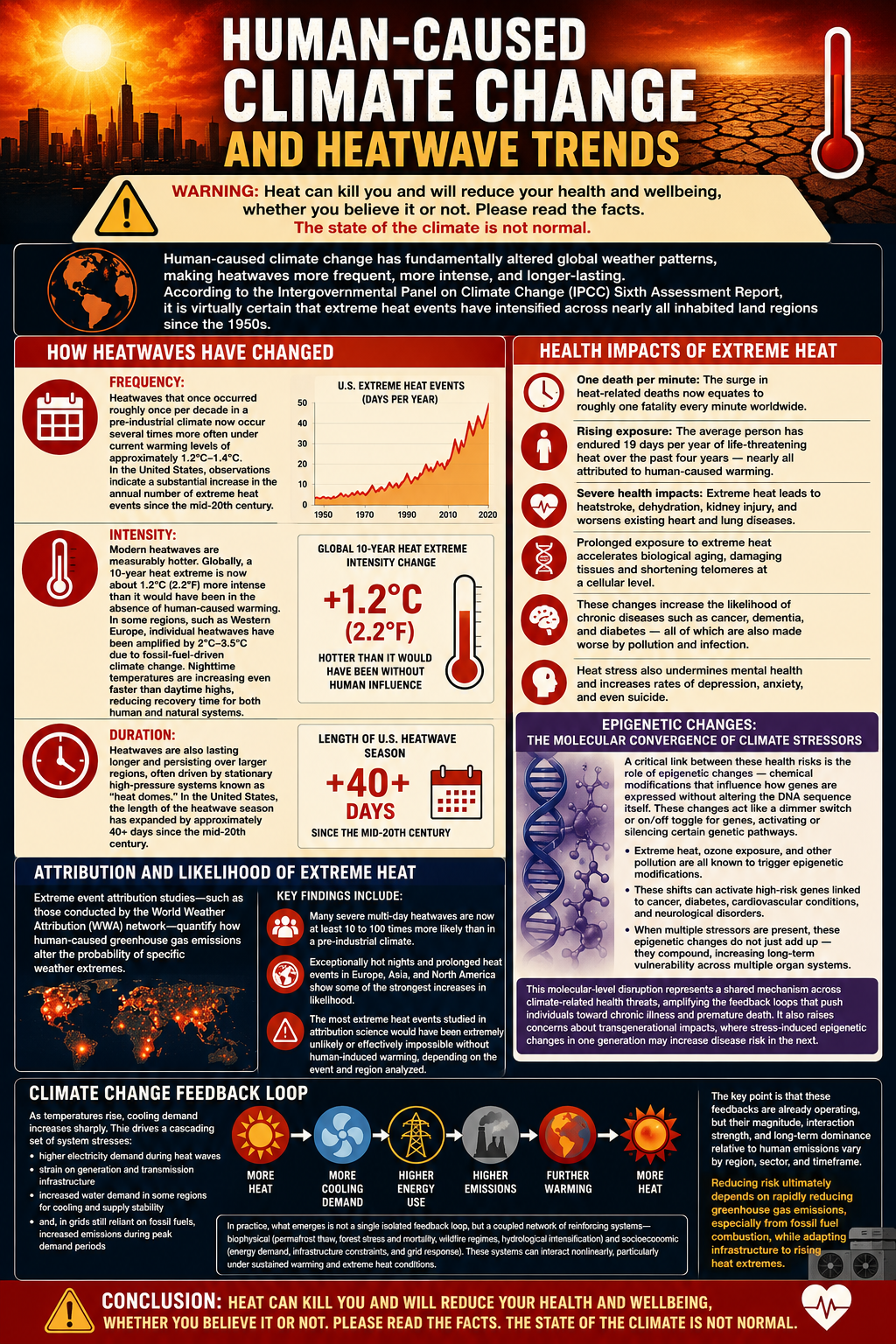
WARNING: Heat can kill you and will reduce your health and wellbeing, whether you believe it or not. Please read the facts. The state of the climate is not normal.
Human-Caused Climate Change and Heatwave Trends
Human-caused climate change has fundamentally altered global weather patterns, making heatwaves more frequent, more intense, and longer-lasting. According to the Intergovernmental Panel on Climate Change (IPCC) Sixth Assessment Report, it is virtually certain that extreme heat events have intensified across nearly all inhabited land regions since the 1950s.
Frequency:
Heatwaves that once occurred roughly once per decade in a pre-industrial climate now occur several times more often under current warming levels of approximately 1.2°C–1.4°C. In the United States, observations indicate a substantial increase in the annual number of extreme heat events since the mid-20th century.
Intensity:
Modern heatwaves are measurably hotter. Globally, a 10-year heat extreme is now about 1.2°C (2.2°F) more intense than it would have been in the absence of human-caused warming. In some regions, such as Western Europe, individual heatwaves have been amplified by 2°C–3.5°C due to fossil-fuel-driven climate change. Nighttime temperatures are increasing even faster than daytime highs, reducing recovery time for both human and natural systems.
Duration:
Heatwaves are also lasting longer and persisting over larger regions, often driven by stationary high-pressure systems known as “heat domes.” In the United States, the length of the heatwave season has expanded by approximately 40+ days since the mid-20th century.
Extreme event attribution studies—such as those conducted by the World Weather Attribution (WWA) network—quantify how human-caused greenhouse gas emissions alter the probability of specific weather extremes.
Key findings include:
Heat can kill—and even when it doesn’t, it steadily reduces health and wellbeing through thermal stress.
Climate Extremes & Cellular Breakdown
A critical link between these health risks is the role of epigenetic changes — chemical modifications that influence how genes are expressed without altering the DNA sequence itself. These changes act like a dimmer switch or on/off toggle for genes, activating or silencing certain genetic pathways.
This molecular-level disruption represents a shared mechanism across climate-related health threats, amplifying the feedback loops that push individuals toward chronic illness and premature death. It also raises concerns about transgenerational impacts, where stress-induced epigenetic changes in one generation may increase disease risk in the next.
As temperatures rise, cooling demand increases sharply. This drives a cascading set of system stresses:
This creates a reinforcing sequence:
more heat → more cooling demand → higher energy use → higher emissions → further warming → more heat
In practice, what emerges is not a single isolated feedback loop, but a coupled network of reinforcing systems—biophysical (permafrost thaw, forest stress and mortality, wildfire regimes, hydrological intensification) and socioeconomic (energy demand, infrastructure constraints, and grid response). These systems can interact nonlinearly, particularly under sustained warming and extreme heat conditions.
The key point is that these feedbacks are already operating, but their magnitude, interaction strength, and long-term dominance relative to human emissions vary by region, sector, and timeframe. Reducing risk ultimately depends on rapidly reducing greenhouse gas emissions, especially from fossil fuel combustion, while adapting infrastructure to rising heat extremes.
Heat can kill you and will reduce your health and wellbeing, whether you believe it or not. Please read the facts. The state of the climate is not normal.
Additional Sources
Climate Change, Gut Dysbiosis, the Human Microbiome, and Systemic Well-Being
Heat Stress, Environmental Stressors, and the Limits of Human Adaptability
Elevated Nighttime Minimum Temperatures: Climate Change, Feedback Processes, and Heat-Health Impacts
Heat Stress and the Emerging Physiological Limits of Climate Change
Climate Change and Deadly Humid Heat
Climate-Driven Health Collapse Overview
* Our probabilistic, ensemble-based climate model — which incorporates complex socio-economic and ecological feedback loops within a dynamic, nonlinear system — projects that global temperatures are becoming unsustainable this century. This far exceeds earlier estimates of a 4°C rise over the next thousand years, highlighting a dramatic acceleration in global warming. We are now entering a phase of compound, cascading collapse, where climate, ecological, and societal systems destabilize through interlinked, self-reinforcing feedback loops.
We examine how human activities — such as deforestation, fossil fuel combustion, mass consumption, industrial agriculture, and land development — interact with ecological processes like thermal energy redistribution, carbon cycling, hydrological flow, biodiversity loss, and the spread of disease vectors. These interactions do not follow linear cause-and-effect patterns. Instead, they form complex, self-reinforcing feedback loops that can trigger rapid, system-wide transformations — often abruptly and without warning. Grasping these dynamics is crucial for accurately assessing global risks and developing effective strategies for long-term survival.