by Daniel Brouse - July 2026
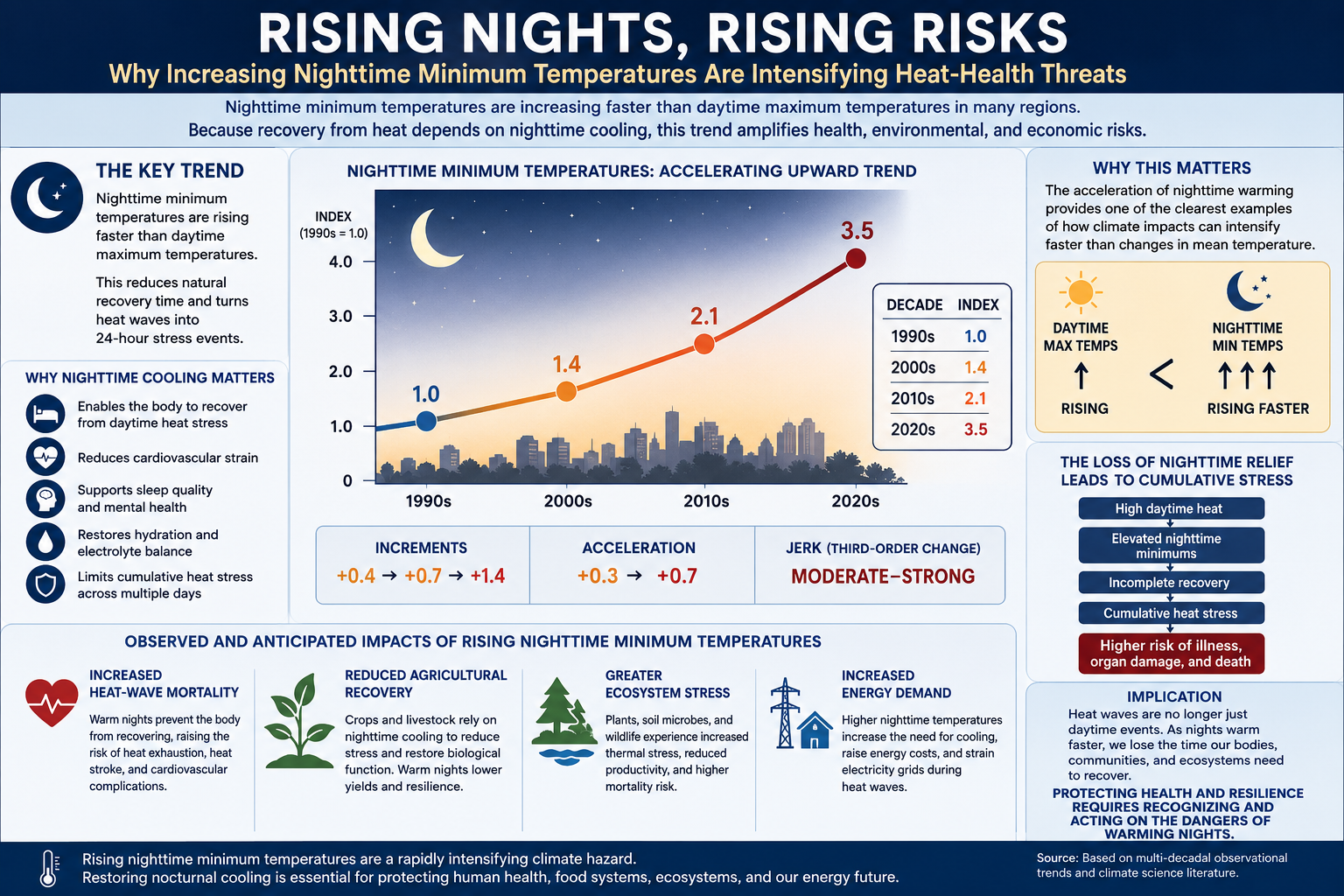
Nighttime minimum temperatures are increasing in many regions at a faster rate than daytime maximum temperatures, representing a critical but underappreciated dimension of climate change. Because human and ecosystem recovery from heat stress depends heavily on nocturnal cooling, this trend has important implications for health outcomes, agriculture, energy demand, and ecological stability. This paper examines the role of warming nights in transforming extreme heat from a diurnal hazard into a sustained 24-hour physiological stress regime.
Extreme heat is typically characterized using daytime maximum temperatures. However, increasing evidence indicates that nighttime minimum temperatures are rising more rapidly than daytime maxima in many regions. This shift is particularly significant because nighttime cooling is a primary mechanism through which biological systems recover from daytime thermal stress.
The loss of adequate nighttime relief effectively transforms heat waves from short-duration exposure events into sustained multi-day stress periods.
Nighttime warming has accelerated across multiple observational datasets. A simplified index representation illustrates the nonlinear increase in nighttime minimum temperature impacts:
| Decade | Index |
|---|---|
| 1990s (baseline) | 1.0 |
| 2000s | 1.4 |
| 2010s | 2.1 |
| 2020s | 3.5 |
This structure indicates not only rising nighttime temperatures, but also an acceleration in the rate at which those increases are occurring.
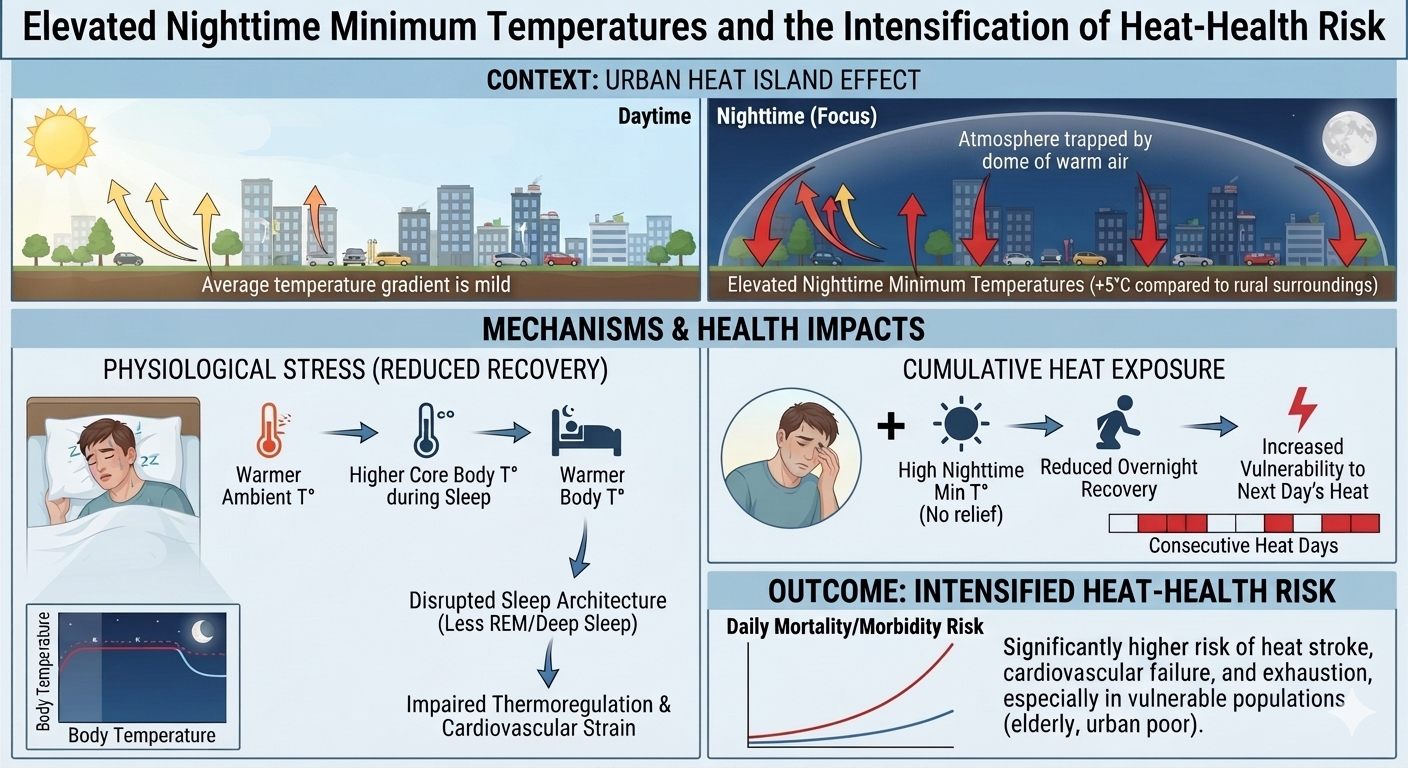
Several interacting mechanisms contribute to enhanced nighttime warming:
Together, these processes suppress nighttime energy loss and elevate minimum temperatures.
Biological recovery from heat stress depends strongly on nighttime temperature reduction. When nighttime minima remain elevated:
As a result, heat waves become continuous physiological stress events rather than discrete daytime exposures.
The acceleration of nighttime warming is associated with multiple observed and projected impacts:
These impacts highlight the systemic nature of nighttime temperature changes across human and natural systems.
The increasing divergence between nighttime minimum and daytime maximum temperature trends suggests a structural shift in the nature of heat extremes. Rather than being driven solely by peak daytime conditions, modern heat risk is increasingly determined by the loss of nocturnal recovery capacity.
This shift implies that heat extremes should be conceptualized as integrated 24-hour thermal stress regimes rather than isolated daytime events.
Nighttime minimum temperatures represent a rapidly intensifying component of climate change with disproportionate impacts on human health, agriculture, ecosystems, and energy systems. The observed asymmetry—where nighttime lows are increasing faster than daytime highs in many regions—highlights the importance of diurnal temperature structure in climate risk assessment. As nocturnal cooling declines, heat waves increasingly function less as short-lived peaks and more as sustained, cumulative thermal stress events.
As temperatures rise, cooling demand increases sharply. This drives a cascading set of system stresses:
This creates a reinforcing sequence:
more heat → more cooling demand → higher energy use → higher emissions → further warming → more heat
In practice, what emerges is not a single isolated feedback loop, but a coupled network of reinforcing systems—biophysical (permafrost thaw, forest stress and mortality, wildfire regimes, hydrological intensification) and socioeconomic (energy demand, infrastructure constraints, and grid response). These systems can interact nonlinearly, particularly under sustained warming and extreme heat conditions.
The key point is that these feedbacks are already operating, but their magnitude, interaction strength, and long-term dominance relative to human emissions vary by region, sector, and timeframe. Reducing risk ultimately depends on rapidly reducing greenhouse gas emissions, especially from fossil fuel combustion, while adapting infrastructure to rising heat extremes.
* Our probabilistic, ensemble-based climate model — which incorporates complex socio-economic and ecological feedback loops within a dynamic, nonlinear system — projects that global temperatures are becoming unsustainable this century. This far exceeds earlier estimates of a 4°C rise over the next thousand years, highlighting a dramatic acceleration in global warming. We are now entering a phase of compound, cascading collapse, where climate, ecological, and societal systems destabilize through interlinked, self-reinforcing feedback loops.
We examine how human activities — such as deforestation, fossil fuel combustion, mass consumption, industrial agriculture, and land development — interact with ecological processes like thermal energy redistribution, carbon cycling, hydrological flow, biodiversity loss, and the spread of disease vectors. These interactions do not follow linear cause-and-effect patterns. Instead, they form complex, self-reinforcing feedback loops that can trigger rapid, system-wide transformations — often abruptly and without warning. Grasping these dynamics is crucial for accurately assessing global risks and developing effective strategies for long-term survival.
The Climate Crisis: Violent Rain | Deadly Humid Heat | Health Collapse | Extreme Weather Events | Insurance | Trees and Deforestation | Soil | Rising Sea Level | Food and Water