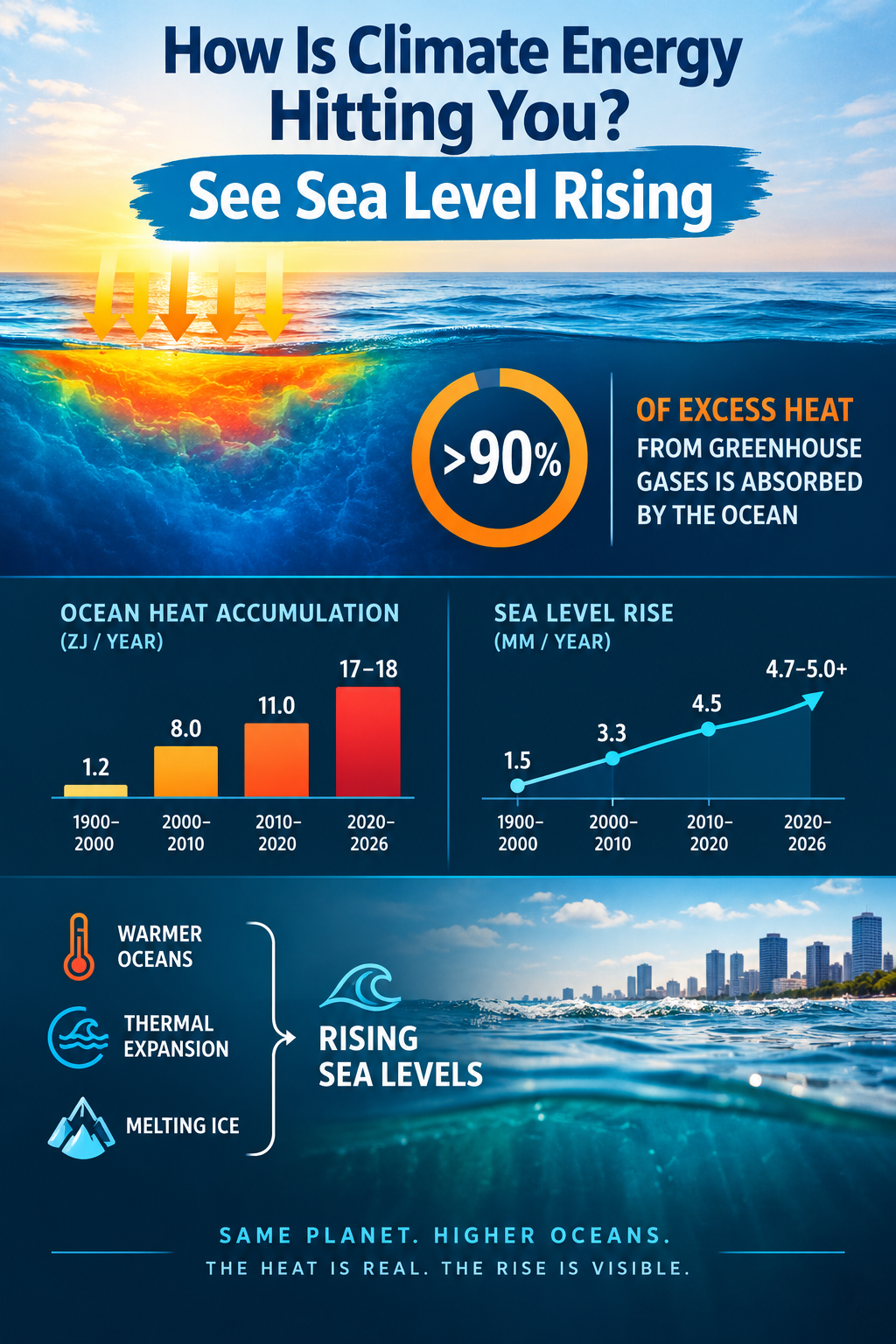
More than 90% of the excess heat trapped in Earth’s climate system by human-caused greenhouse gas emissions is absorbed by the ocean.
Because water has a much higher heat capacity than air, the global ocean acts as a massive climate buffer. Without this vast heat reservoir soaking up the energy from burning fossil fuels, the atmosphere and land surfaces would be warming at a drastically faster, potentially unlivable rate.
But the ocean’s ability to absorb heat does not make that energy disappear. It stores the energy and redistributes it throughout the climate system—with consequences that include rising sea levels, melting ice, changing ocean circulation, and increasingly energetic climate feedbacks.
| Period | Approximate Rate |
|---|---|
| 1900–2000 | ~1.2 ZJ/year |
| 2000–2010 | ~8.0 ZJ/year |
| 2010–2020 | ~11.0 ZJ/year |
| 2020–2026 | ~17.0–18.0 ZJ/year |
The 2020–2025 baseline average of approximately 16 ZJ/year was shattered by a massive, record-breaking surge reported in early 2026.
Peer-reviewed findings from the Institute of Atmospheric Physics (IAP/CAS) and Copernicus Marine revealed that the ocean absorbed an astonishing ~23 ZJ of excess heat in 2025 alone—up from ~16 ZJ in 2024.
That increase represents more than simply a large amount of additional heat. It is evidence of an accelerating rate of energy accumulation in the ocean.
Thermal expansion is responsible for roughly 40% to 50% of long-term global sea-level rise. Over the last few decades, the drivers of rising oceans have generally been split roughly down the middle between thermal expansion—the swelling of water as it heats up—and meltwater from glaciers and ice sheets.
The percentage can fluctuate dramatically from year to year because of global weather patterns.
For instance, according to a NASA analysis, a massive surge in ocean heat during the 2024 El Niño caused a temporary flip: two-thirds, or about 66%, of that year’s accelerated sea-level rise came from thermal expansion alone.
Because the ocean is so vast, it acts like a giant, slow-moving thermal battery. Even if global greenhouse gas emissions were to completely stop today, the heat already trapped in the climate system would continue to move into the deep ocean for centuries.
This means sea levels will continue to rise from thermal expansion long after surface temperatures stabilize. As global temperatures rise beyond 1.5°C to 2°C, the rate of ice sheet melt is projected to grow exponentially, drastically outpacing thermal expansion. By the end of the century, scientists expect melting ice sheets and glaciers to become the overwhelmingly dominant driver, shrinking thermal expansion’s proportional share well below its current 40%–50% baseline.
The ocean therefore provides a critical buffer against even faster atmospheric warming—but that buffer comes with a cost. The energy being absorbed by the ocean is physically expanding the water and helping drive sea-level rise.
| Period | Approximate Rate |
|---|---|
| 1900–2000 | ~1.5 mm/year |
| 2000–2010 | ~3.3 mm/year |
| 2010–2020 | ~4.5 mm/year |
| 2020–2026 | ~4.7–5.0+ mm/year |
Sea-level rise is not occurring at a constant rate.
The rate has increased substantially over the past century, from roughly 1.5 mm/year during 1900–2000 to approximately 4.7–5.0+ mm/year during 2020–2026.
In other words, sea-level rise is accelerating—and the acceleration itself is accelerating.
What happens in the ocean does not stay in the ocean.
The heat accumulating in the world’s oceans is becoming a physical signal we can see: sea level rising.
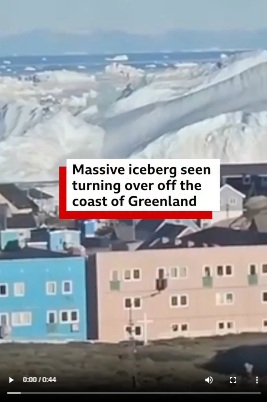
Dramatic iceberg rollovers in Greenland provide a powerful visual representation of how rapidly the climate system is changing. These events are not isolated spectacles; they are symptoms of a larger transformation occurring across the cryosphere. As ice sheets and glaciers lose mass, the impacts extend far beyond the Arctic through interconnected feedback loops that amplify warming, disrupt ocean circulation, alter freshwater systems, and increase risks for communities around the world.
The Arctic is warming far faster than the global average, creating a cascading climate response that reaches far beyond the polar region. Accelerating glacial retreat, a weakening Atlantic Meridional Overturning Circulation (AMOC), rising sea levels, and increasingly severe local impacts are reshaping ecosystems, economies, and communities worldwide. The loss of long-stable ice reserves represents not only a change in landscapes, but a fundamental shift in the Earth's climate balance.
As glaciers and ice sheets continue to retreat, one of the most consequential outcomes is the transfer of billions of tons of land-based ice into the oceans. This process is accelerating sea level rise (SLR), threatening coastal communities, infrastructure, and ecosystems across the planet. Understanding the mechanisms driving ice loss is therefore essential to understanding the future trajectory of global sea levels.

Sea level rise is one of the clearest indicators that Earth's climate system is undergoing a fundamental transformation. For decades, projections were based primarily on linear assumptions, treating ice sheets and oceans as slowly responding components of the climate system. However, observations from satellites, field studies, and ice-sheet modeling increasingly reveal a more complex reality: sea level rise is influenced by accelerating feedbacks, threshold behavior, and nonlinear changes in the cryosphere.
The loss of land-based ice from Greenland and Antarctica is not simply a gradual process. Ice sheets contain enormous stores of frozen water that interact with atmospheric warming, ocean circulation, surface melting, albedo changes, and internal fracture systems. As these processes accelerate, the rate of sea-level rise can change faster than traditional linear models anticipated.
Understanding sea level rise requires moving beyond the question of how much warming occurs and examining how quickly the Earth's climate system responds once critical thresholds are approached. The central issue is not only the amount of ice being lost today, but whether accelerating feedbacks can push ice-sheet systems into long-term instability.
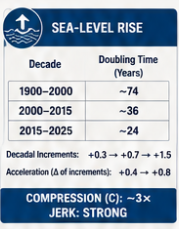
In 1995, I was convinced climate change was happening at an exponential rate; however, Sidd argued we needed more data over a longer time period. At the time, the dominant assumption was that global warming was largely linear and slow—offering centuries to respond.
By 2004, enough observational data had accumulated to confirm accelerating nonlinear behavior in the cryosphere and ocean systems. Greenland ice sheet dynamics, in particular, were no longer consistent with equilibrium assumptions.
Much of climate change can potentially be mitigated or slowed. Ice sheet collapse, however, is largely irreversible on human timescales once critical thresholds are crossed.
"And once we have destabilized these ice sheets, there will be no stable coastline for centuries."
Recent satellite and field studies confirm that Greenland is already committed to long-term sea-level rise, even under immediate emissions cessation scenarios.
The latest assessments show Greenland has lost thousands of gigatons of ice since the 1990s, contributing over 1.5 cm of global sea level rise, with accelerating loss rates in the 2000s and 2010s.
According to updated IMBIE-based reconstructions, Greenland mass loss is now occurring at roughly ~240 Gt/year in the 2010s, with continued interannual variability but no recovery trend.
The Greenland Ice Sheet contains enough water to raise global sea level by approximately 7 meters if fully melted.
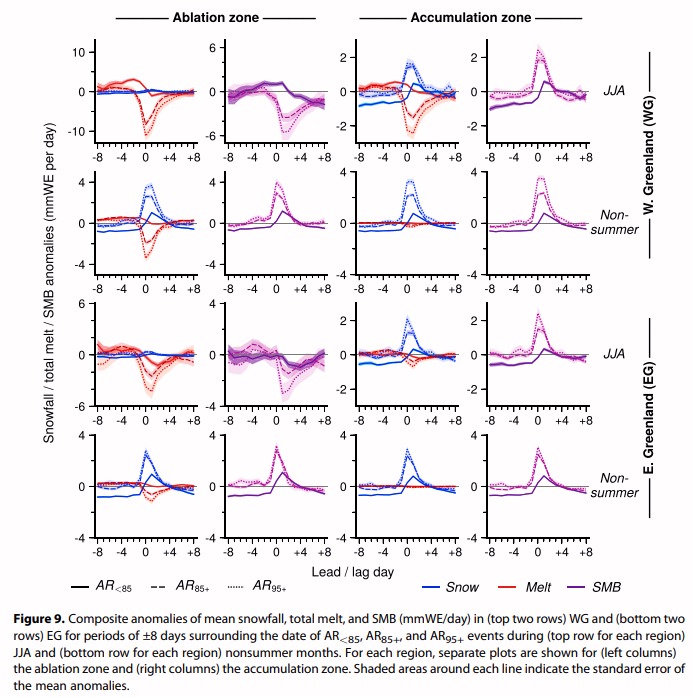
Atmospheric rivers, surface darkening (albedo feedback), and crevasse propagation have all been shown to significantly accelerate melt beyond earlier model expectations.
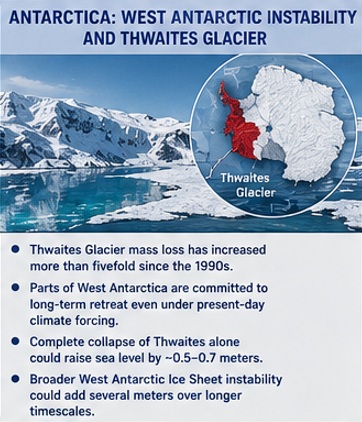
West Antarctica, particularly the Amundsen Sea sector (including Thwaites and Pine Island Glaciers), shows signs of sustained dynamic instability.
Recent modeling studies (2025–2026) indicate Thwaites Glacier mass loss has increased more than fivefold since the 1990s and may continue accelerating through mid-century.
Multiple independent observational and modeling studies now suggest that parts of West Antarctica are committed to long-term retreat even under present-day climate forcing.
Complete collapse of Thwaites alone could raise global sea level by ~0.5–0.7 meters (roughly 2 feet), with broader West Antarctic Ice Sheet instability contributing several meters over longer timescales.
One of the most powerful feedbacks in the polar regions is the albedo effect. As bright, reflective ice melts, it reveals darker land or ocean surfaces that absorb far more solar energy. This speeds up further melting. While melting sea ice mainly changes heat balance without directly raising sea levels, the melting of land-based ice--especially from Greenland and Antarctica--not only raises global seas but also changes ocean salinity and temperature, further destabilizing circulation systems like the AMOC.
These ice sheets hold vast "corks" of land ice restraining enormous reservoirs of meltwater. When these corks break, sudden sea level rise pulses--sometimes 1-3 feet per year for multiple consecutive years--could occur. The impacts on coastlines, global weather, and ocean currents would be both severe and unpredictable.

On September 16, 2023, a catastrophic climate-amplified event occurred in East Greenland when a massive section of the mountain Hvide Støvhorn collapsed into Dickson Fjord. Approximately 25 million cubic meters of rock and glacial ice plunged into the narrow fjord, displacing an enormous volume of water and generating a mega-tsunami estimated at 200 meters (650 feet) in height.
The collapse was not an isolated geological event but a consequence of a rapidly warming Arctic environment. Long-term warming caused progressive thinning and retreat of the glacier that had been supporting the base of the mountain slope. As the ice mass weakened, a formerly stable landscape became mechanically unstable, allowing gravity to trigger a sudden and massive failure. This represents a critical example of how climate change can transform slow environmental degradation into abrupt, high-energy events.
The unique geometry of Dickson Fjord amplified the impact. Unlike an open-ocean tsunami that disperses outward, the narrow fjord trapped the enormous wave energy. The displaced water began oscillating back and forth approximately every 90 seconds, creating a phenomenon known as a seiche. Each cycle repeatedly transferred the energy of the original collapse through the confined water column, allowing the wave system to persist far longer than would normally be expected.
The repeated movement of this immense mass of water acted like a planetary-scale resonator. Similar to a bell struck by an impact, the oscillating fjord generated an unusual ultra-low-frequency seismic signal that propagated through Earth's crust. Seismometers located around the world detected this unique signal for approximately nine consecutive days, revealing that a climate-driven surface event had produced a measurable global geophysical response.
The Dickson Fjord event demonstrates the nonlinear nature of climate impacts. A gradual process—glacial thinning caused by rising temperatures—created a threshold failure in a complex Earth system, producing a sudden cascade from ice loss, to mountain collapse, to mega-tsunami, to planetary-scale seismic detection. It provides a powerful example of how climate change can unlock previously rare events by destabilizing physical systems that have remained stable for thousands of years.
In a warming world, the significance of events such as the Dickson Fjord collapse extends beyond their immediate local damage. They reveal that climate change does not simply produce gradual environmental shifts; it can push interconnected systems toward tipping points where small additional changes trigger large, rapid, and unexpected responses. The Greenland mega-tsunami serves as a warning that the consequences of accelerating climate change may emerge not only through rising temperatures and sea levels but also through sudden failures in the Earth's frozen landscapes.
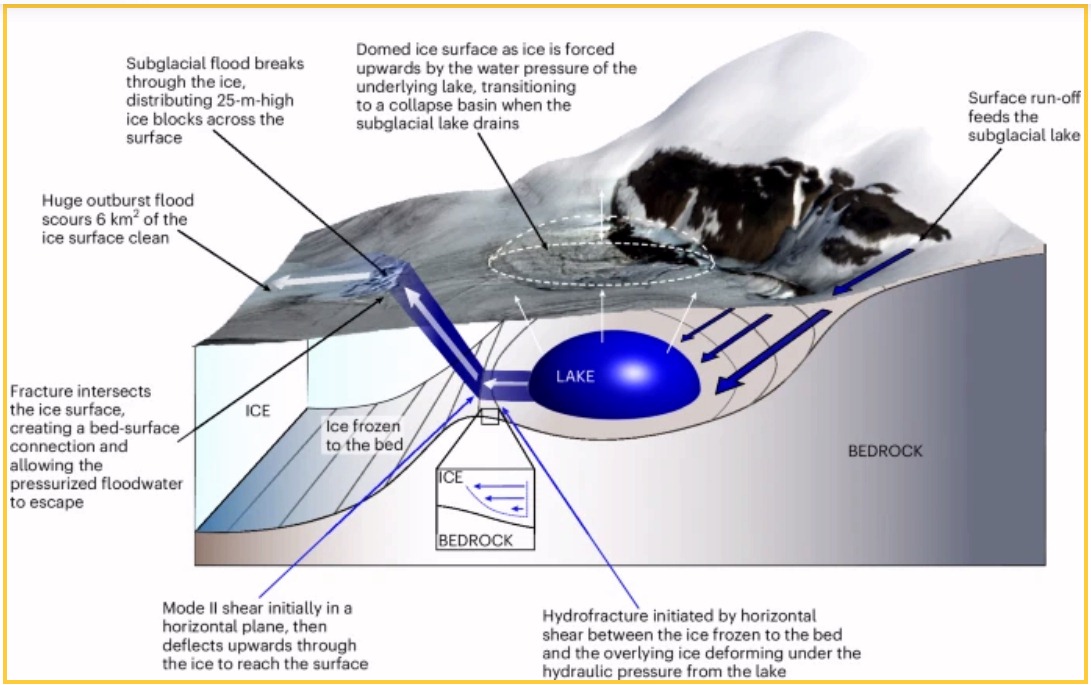
Recent research has identified a startling example of this process. In the paper Outburst of a subglacial flood from the surface of the Greenland Ice Sheet (2025), scientists documented a 90-million-cubic-meter flood that forced its way upward through the ice sheet, bursting out at the surface. This was caused by the rapid drainage of a subglacial lake in a region where the bed was thought to be frozen solid--an event that current ice sheet models do not account for.
The flood's upward path fractured the ice sheet, disrupting the downstream marine-terminating glacier and altering its flow. This bi-directional coupling between surface and basal hydrology highlights just how complex--and poorly understood--ice sheet dynamics truly are.
Over the last three decades, Greenland has lost roughly 169 billion tons of ice per year on average, contributing about 14 mm to global sea level rise. Roughly half of this loss comes from surface melting and runoff, which are projected to increase sharply as Arctic warming intensifies.
A massive upstream basin of rainwater and snowmelt, dammed by Alaska's Mendenhall Glacier, began releasing in August of 2025, prompting officials to urge residents in parts of Juneau to evacuate ahead of a potentially dangerous surge of floodwater.
A glacial outburst flood occurs when meltwater or rainwater accumulates behind a natural ice dam, creating a substantial reservoir of water under pressure. In the case of the Mendenhall Glacier, snowmelt and rainfall from the upstream basin -- ironically named Suicide Basin -- accumulate behind the glacier, which acts as a solid barrier, trapping the water in depressions known as proglacial lakes or subglacial reservoirs.
As the water volume increases, hydrostatic pressure builds against the ice dam. Ice behaves like a viscoelastic material--it can deform slowly under pressure but can fracture if stress exceeds its strength. The weight of the water eventually exceeds the ice's ability to hold it, particularly if crevasses or melt channels weaken the glacier structure.
Once the pressure exceeds the strength of the ice or underlying bedrock, cracks propagate rapidly, and water can exploit subglacial channels, forcing its way beneath or through the ice, a process known as hydraulic fracturing. When the dam fails, the water stored in the basin rushes downstream in a high-energy flood, converting potential energy into kinetic energy, generating destructive flow speeds and forces that can erode soil, uproot trees, damage infrastructure, and rapidly raise river levels.
Warming temperatures increase surface melt and rainfall, filling these basins faster, while ice thinning and increased meltwater lubricate the glacier bed, reducing friction and making outbursts more likely. In essence, a glacial outburst results from the buildup of pressure from trapped water, ice weakening or cracking, and the sudden release of gravitational energy, producing a high-speed, destructive flood downstream.
Before-and-after images of Suicide Basin "popping its cork." In the first, a small, fractured section of glacier holds back millions of gallons of water, both behind and beneath it. In the next, it is gone.
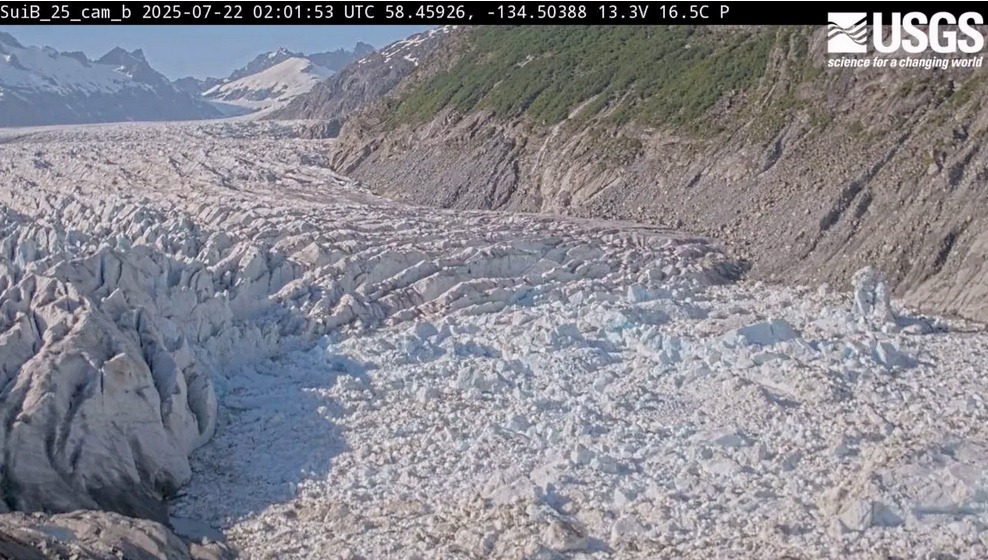
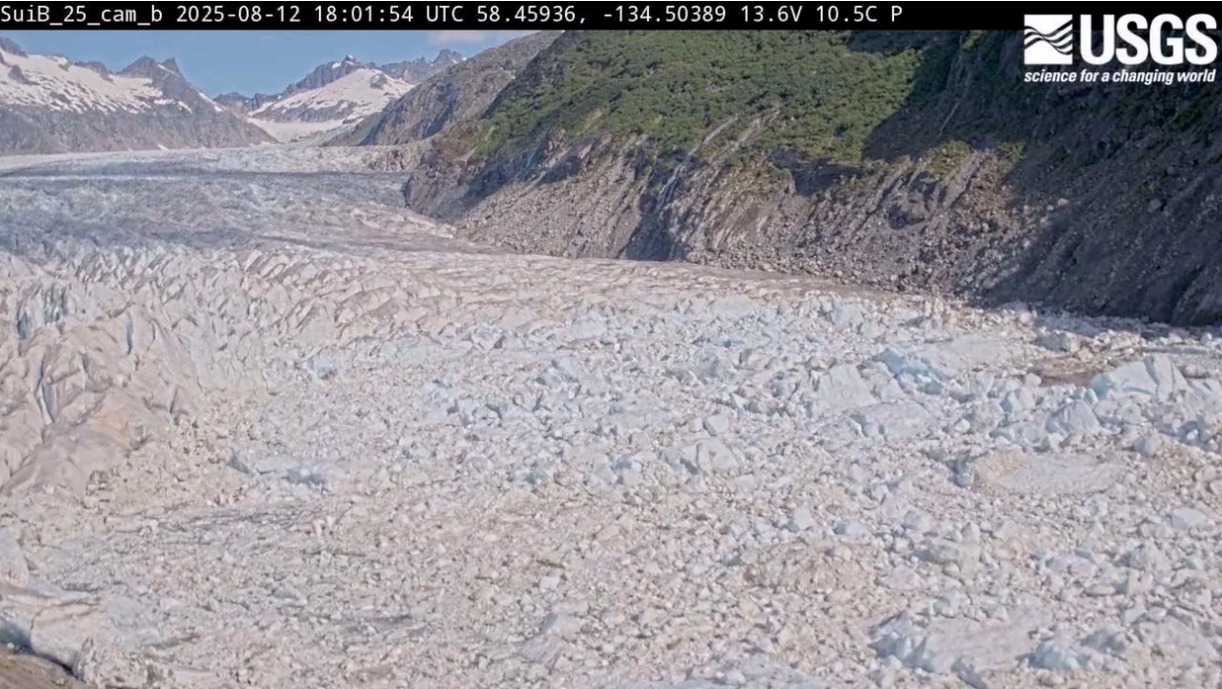
The Mendenhall River crested at a record-setting 16.65 feet deep.
Sea level rise is one of the clearest measurements of the changing energy balance of the Earth system. It represents the combined response of warming oceans, melting glaciers, and destabilizing ice sheets. Unlike a simple linear process, modern sea level rise is increasingly shaped by interacting feedbacks that can accelerate change over time.
The evidence from Greenland, Antarctica, and rapidly changing glacier systems demonstrates that the cryosphere is not responding as a passive reservoir of ice. Instead, it behaves as a dynamic system influenced by atmospheric warming, ocean heat, surface darkening, meltwater flows, and structural weakening.
The central challenge is not whether sea level will rise, but how rapidly the rate of change will increase. Once major ice-sheet thresholds are crossed, the resulting changes may continue for centuries because of the enormous inertia contained within the Earth's ice systems and oceans.
Future coastlines will be determined by decisions made today. The most effective action is to reduce the additional heat entering the climate system by rapidly decreasing the combustion of fossil fuels and limiting further greenhouse gas emissions.
The laws of physics cannot be negotiated. However, humanity still has the ability to influence how much additional warming occurs and how much future sea-level rise is ultimately committed.
Bottom line: The question is no longer how warm the planet becomes, but how life on Earth can endure when change outpaces our ability to adapt.
We cannot control the laws of physics, but we can control our pollution. The most effective action is to stop burning fossil fuels.