The Ozone Climate Feedback: Fossil Fuel Combustion, Methane Emissions, Wildfires, and Ecosystem Degradation as Drivers of Self-Reinforcing Global Warming
Daniel Brouse¹ and Sidd Mukherjee²
June 2026
¹Independent Climate Researcher, Economist
²Physicist
Tropospheric ozone is one of the most dangerous yet least understood environmental threats facing modern society. Invisible to the eye, it functions simultaneously as an air pollutant, a greenhouse gas, and a climate feedback amplifier. Ozone exposure is associated with millions of illnesses and premature deaths worldwide, while also damaging crops, forests, and other ecosystems that serve as critical carbon sinks. Emerging research suggests that ozone is an important component of several self-reinforcing climate feedback loops involving wildfires, forest decline, methane emissions, permafrost thaw, and so-called “zombie fires” that can smolder underground for months or even years, similar in some respects to the long-burning coal fires of Centralia, Pennsylvania. Because tropospheric ozone is produced through atmospheric reactions involving emissions from fossil fuel combustion, biomass burning, and methane oxidation, it serves as a critical link between atmospheric chemistry, ecosystem health, and climate change. Diesel combustion remains a major contributor to localized ozone formation through its emissions of nitrogen oxides (NOₓ), while natural gas systems, particularly those associated with electric power generation, contribute to a broader global ozone pathway through methane leakage, combustion-related methane slip, and the atmospheric chemical processes that convert methane into tropospheric ozone. Together, these processes position ozone not merely as a consequence of climate change, but as a significant multiplier of its impacts.
Introduction
Discussions about transportation fuels and electricity generation often focus almost exclusively on carbon dioxide (CO₂) emissions. While CO₂ remains the dominant long-lived greenhouse gas produced by human activities, evaluating fuels solely through a carbon dioxide lens overlooks important atmospheric processes that influence climate, air quality, ecosystem health, and public health.
Among these processes, tropospheric ozone (O₃) occupies a unique position. Ozone is both a harmful air pollutant and a significant short-lived climate forcer. It damages crops and forests, impairs human respiratory health, reduces carbon uptake by vegetation, and contributes directly to warming. Because ozone is formed through complex atmospheric chemistry rather than emitted directly, different fuels can produce dramatically different ozone-related impacts even when their carbon dioxide emissions appear similar.
The choice between diesel fuel and natural gas provides a useful example. Diesel and natural gas create distinct atmospheric signatures that influence local air pollution, global atmospheric chemistry, and climate feedbacks through different pathways. Understanding these differences reveals why the true environmental footprint of a fuel extends far beyond the carbon dioxide emitted at the point of combustion.
Ozone: A Secondary Climate Pollutant
Unlike carbon dioxide or methane, ozone is not emitted directly from vehicle tailpipes or power plant stacks. Instead, it is a secondary pollutant formed through photochemical reactions involving two primary ingredients:
- Nitrogen Oxides (NOₓ)
- Volatile Organic Compounds (VOCs)
When these compounds interact in the presence of sunlight, they produce ground-level ozone. The amount, location, and persistence of ozone formation depend heavily on the chemical composition of the emissions. As a result, fuel choice can significantly influence both local air quality and broader climate impacts.
Diesel: The NOₓ-Dominated Pathway
Diesel engines operate under extremely high pressures and combustion temperatures. These conditions promote the formation of large quantities of nitrogen oxides.
As a result, diesel exhaust typically contains:
- High concentrations of NOₓ
- Complex aromatic VOCs
- Fine particulate matter
- Black carbon (soot)
This combination creates highly reactive atmospheric chemistry that efficiently generates local ground-level ozone. In urban and industrial regions, diesel emissions can become a major driver of ozone pollution episodes and smog formation.
The climate impact extends beyond ozone. Diesel engines also emit black carbon, one of the most powerful short-lived climate pollutants. Black carbon absorbs solar radiation directly, warming the atmosphere while accelerating snow and ice melt when deposited on reflective surfaces. Consequently, diesel’s climate footprint includes not only carbon dioxide emissions but also localized ozone production and direct atmospheric heating from soot.
Natural Gas: The Methane Pathway
Natural gas combustion follows a very different atmospheric pathway. In transportation applications, natural gas vehicles generally emit substantially less nitrogen oxide pollution than comparable diesel engines, often reducing NOₓ emissions by 75% to 94%.This reduction can significantly decrease local ozone formation and improve urban air quality. However, natural gas introduces a different atmospheric challenge.
The primary hydrocarbon associated with natural gas is methane (CH₄). Unlike the highly reactive VOCs commonly associated with diesel exhaust, methane reacts slowly in the atmosphere. Rather than generating immediate local smog, methane can persist for more than a decade, circulating globally before participating in atmospheric reactions that contribute to tropospheric ozone formation.
As a result, natural gas may reduce local ozone pollution while simultaneously contributing to increases in global background ozone concentrations through methane-driven atmospheric chemistry.
Direct Greenhouse Emissions
When only tailpipe or stack emissions are considered, natural gas appears to offer a significant climate advantage.
Diesel is a carbon-dense fuel that produces relatively large quantities of carbon dioxide during combustion. Natural gas, composed primarily of methane, contains a higher hydrogen-to-carbon ratio and therefore releases approximately 20% to 30% less CO₂ per unit of energy produced.
Under a narrow carbon accounting framework, this makes natural gas appear to be the cleaner option.
However, direct combustion emissions represent only part of the overall climate footprint.
The Supply Chain Problem
The greatest climate risk associated with natural gas often occurs before the fuel reaches an engine, turbine, or boiler.
Methane is an extraordinarily potent greenhouse gas, possessing a global warming potential roughly 28 to 36 times greater than carbon dioxide over a 100-year timeframe and substantially higher over shorter periods.
Because natural gas must be extracted, processed, compressed, transported, stored, and distributed through extensive infrastructure networks, leakage can occur at numerous points throughout the supply chain.
Even relatively small leakage and slip rates can have significant climate consequences. Studies have shown that methane losses of only 1% to 2% can substantially reduce—or in some cases eliminate—the greenhouse advantage that natural gas enjoys through lower carbon dioxide emissions.
In effect, a fuel that appears cleaner at the point of combustion may produce a substantially larger overall climate footprint once upstream emissions are included.
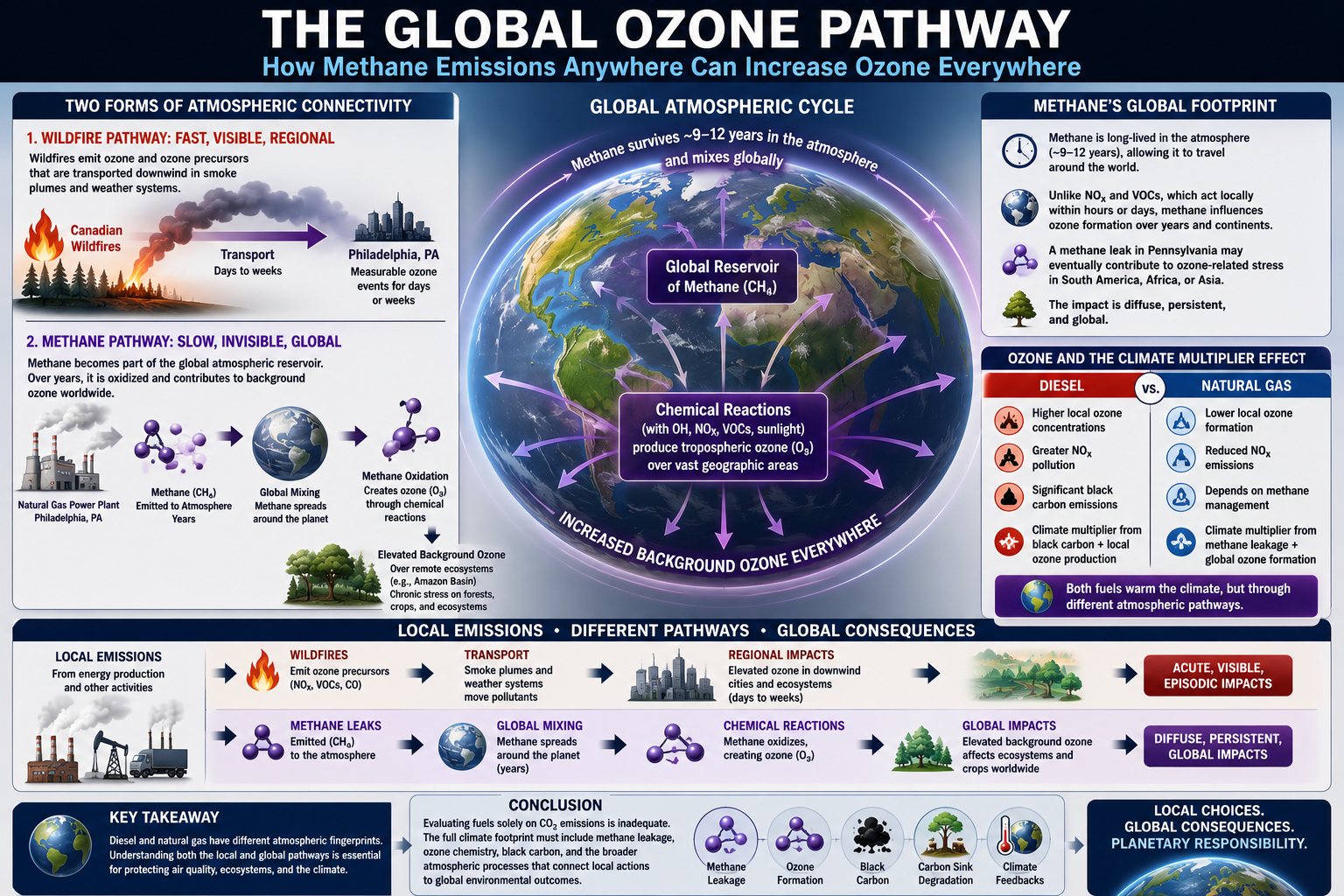
The Global Ozone Pathway
An often-overlooked consequence of methane leakage and slip is its contribution to the global background ozone burden.
Methane emissions are not confined to the regions where they are released. Once emitted, methane becomes part of the global atmospheric reservoir and circulates throughout the planet. During its atmospheric lifetime, methane undergoes chemical reactions that contribute to the formation of tropospheric ozone over vast geographic areas.
Unlike nitrogen oxides and highly reactive VOCs, which often generate ozone near their source within hours or days, methane influences atmospheric chemistry over years and across continents. The result is a diffuse but persistent increase in background ozone concentrations throughout much of the world’s atmosphere.
This distinction becomes clear when comparing methane-driven ozone formation with wildfire-related ozone transport. Ozone and ozone precursors generated by major Canadian wildfires can be transported into cities such as Philadelphia, creating measurable air-quality impacts for days or weeks. These events are visible, immediate, and regional.
Methane associated with natural gas used to generate electricity in Philadelphia follows a very different pathway. The methane does not travel directly to the Amazon rainforest as ozone. Instead, it becomes globally mixed in the atmosphere and later participates in chemical reactions that elevate ozone concentrations throughout the troposphere, including over remote ecosystems such as the Amazon Basin.
In this sense, wildfire smoke and methane represent two different forms of atmospheric connectivity. Wildfires transport ozone and ozone precursors directly across regions through smoke plumes and weather systems. Methane transport is slower, less visible, and more diffuse, yet potentially broader in scope. A methane leak in Pennsylvania may eventually contribute, in a small but measurable way, to ozone-related stress on forests in South America, crop productivity in Africa, or ecosystem health in Asia.
The wildfire impact is acute, visible, and episodic. The methane impact is diffuse, persistent, and global.
Ozone and the Climate Multiplier Effect
The distinction between diesel and natural gas is therefore not simply a comparison of carbon dioxide emissions.
Diesel tends to generate:
- Higher local ozone concentrations
- Greater NOₓ pollution
- Significant black carbon emissions
Natural gas tends to generate:
- Lower local ozone formation
- Reduced NOₓ emissions
- Greater dependence on methane management
- Increased potential for global background ozone formation through methane oxidation
Both fuels contribute to climate warming, but through different mechanisms.
Diesel’s climate multiplier arises primarily from black carbon emissions and localized ozone production. Natural gas’s climate multiplier emerges through methane leakage and slip, long-range atmospheric transport, and the gradual formation of background tropospheric ozone on a global scale.
Conclusion
The choice between diesel and natural gas is often framed as a simple comparison of carbon dioxide emissions. In reality, the decision involves fundamentally different atmospheric pathways that influence air quality, ecosystem health, and climate feedbacks.
Diesel generates substantial nitrogen oxide pollution, localized ozone formation, and black carbon emissions that contribute directly to warming and regional environmental damage. Natural gas reduces many of these local pollutants, but its dependence on methane creates a different set of risks. Methane leakage not only amplifies greenhouse warming directly but also contributes to a global increase in tropospheric ozone, extending the environmental consequences of natural gas use far beyond the point of combustion.
As climate science increasingly recognizes the importance of atmospheric feedbacks, carbon sink degradation, and short-lived climate pollutants, evaluating fuels solely on carbon dioxide emissions becomes increasingly inadequate. The full climate footprint must include methane leakage and slip, ozone chemistry, black carbon emissions, and the broader atmospheric processes that connect local energy choices to global environmental outcomes. Understanding these interconnected pathways is essential for developing energy policies that address not only carbon emissions but the full spectrum of climate-forcing mechanisms operating throughout the Earth system.
Addendum 1: Methane Slip, Combustion Limits, and the Hidden Ozone Pathway
One of the most frequently overlooked aspects of natural gas combustion is that complete combustion is physically unattainable. While modern power plants are remarkably efficient, engineering and thermodynamic constraints ensure that a small fraction of methane always escapes oxidation and enters the atmosphere. This phenomenon, known as methane slip, creates climate consequences that extend well beyond the direct carbon dioxide emissions typically used to evaluate natural gas.
Why Methane Escapes Combustion
Several physical processes limit combustion efficiency even in the most advanced systems:
Boundary Layer Effects (Flame Quenching)
The interior walls of combustion chambers must be actively cooled to prevent structural damage. As methane-air mixtures approach these cooler surfaces, flame temperatures can fall below the threshold required to sustain combustion. This process, known as flame quenching, creates microscopic regions where methane remains unburned and escapes into the exhaust stream.
Incomplete Turbulent Mixing
Efficient combustion requires methane (CH₄) and oxygen (O₂) molecules to mix at extremely small scales. Although modern burners are designed to maximize turbulence, high-velocity flows inevitably create localized pockets where fuel and oxygen concentrations are uneven. Some methane molecules therefore pass through the combustion zone without fully reacting.
Transient Operating Conditions
Methane slip increases substantially during startup, shutdown, load-following operations, and other transient conditions. As electric grids incorporate greater amounts of variable renewable generation, gas-fired plants are increasingly required to ramp output up and down rapidly. These operating conditions often reduce combustion stability and temporarily increase methane emissions.
How Much Methane Escapes?
Methane slip varies considerably depending on technology and operating conditions.
Modern Combined-Cycle Gas Turbines
Large utility-scale combined-cycle plants can achieve combustion efficiencies approaching 99.98% under steady-state operation. Methane slip is typically around 0.02% of fuel input, although rates may increase during startup and load transitions.
Reciprocating Internal Combustion Engines
Smaller gas-fired engines commonly used in peaker plants, compressor stations, and industrial facilities generally exhibit significantly higher methane slip rates. Emissions often range from 1.5% to 3% of fuel input and can be substantially higher under certain operating conditions.
Upstream Leakage
Combustion-related methane slip represents only part of the problem. Additional methane leakage occurs during extraction, processing, storage, transmission, and distribution. When these losses are included, total methane emissions from natural gas systems can become a significant contributor to climate forcing.
Climate and Ozone Implications
Methane is a highly potent greenhouse gas with a warming effect more than 80 times greater than carbon dioxide over a 20-year time horizon. Because methane exerts much of its influence during the critical decades immediately ahead, even relatively small leakage and slip rates can substantially erode the climate advantages often attributed to natural gas.
However, methane’s climate impact extends beyond its direct greenhouse effect.
Once released into the atmosphere, methane becomes globally distributed and persists for approximately a decade before being oxidized through reactions involving hydroxyl radicals (OH). These reactions produce a chain of atmospheric chemical processes that contribute to the formation of tropospheric ozone (O₃).
Unlike ozone generated directly downwind of urban pollution or wildfire smoke, methane-driven ozone formation occurs on a planetary scale. Methane emissions released in one location can influence background ozone concentrations thousands of miles away. Consequently, methane leakage and slip from a natural gas power plant in Pennsylvania can ultimately contribute to ozone formation over the Amazon rainforest, African tropical forests, agricultural regions, or remote ecosystems far removed from the original source.
This distinction is critical because tropospheric ozone is not merely an air pollutant. It is also a greenhouse gas, a phytotoxin, and an increasingly important driver of ecosystem decline.
Elevated ozone concentrations:
- Reduce photosynthesis.
- Damage plant tissues and stomatal function.
- Lower crop yields.
- Reduce forest growth rates.
- Weaken ecosystem resilience to drought, heat, insects, and disease.
- Decrease long-term carbon sequestration.
As ecosystems lose productivity, their ability to absorb atmospheric carbon dioxide declines. The resulting carbon sink failure allows additional greenhouse gases to accumulate in the atmosphere, amplifying warming and creating a reinforcing feedback loop.
In this way, methane slip represents far more than a simple fuel loss. It functions as a delayed, globally distributed climate multiplier that contributes simultaneously to greenhouse warming, tropospheric ozone formation, ecosystem degradation, and the weakening of natural carbon sinks. These interconnected effects illustrate why evaluating fuels solely on direct carbon dioxide emissions can underestimate their true climate impact.
Addendum 2: Wildfires, Zombie Fires, Ozone, Carbon Sink Failure, and the Climate Feedback Loop
One of the clearest examples of the Ozone Feedback Theory can be observed in the rapidly intensifying wildfire systems of North America and the Arctic.
Major Canadian wildfires routinely generate enormous quantities of smoke containing nitrogen oxides (NOₓ), volatile organic compounds (VOCs), carbon monoxide (CO), methane, and particulate matter. Under sunlight, these emissions participate in complex atmospheric reactions that produce large quantities of ground-level ozone.
Importantly, the impacts of wildfire smoke extend far beyond the visible plume. Atmospheric transport can carry ozone and ozone precursors hundreds or even thousands of miles from their source. Smoke generated in western Canada has repeatedly degraded air quality across the United States, exposing millions of people to elevated ozone concentrations long after the visible smoke has dispersed.
The consequences extend beyond human health.
Tropospheric ozone damages vegetation by impairing photosynthesis, disrupting stomatal regulation, accelerating oxidative stress, and reducing plant productivity. Forests exposed to elevated ozone often exhibit slower growth, increased susceptibility to drought and disease, and higher mortality rates.
As ozone concentrations rise, forests absorb less carbon dioxide from the atmosphere. This reduction in carbon sequestration weakens one of Earth’s most important natural climate-regulating systems.
The feedback loop then begins to accelerate:
- Warming temperatures increase wildfire frequency, duration, and intensity.
- Wildfires release carbon dioxide, methane, NOₓ, VOCs, and particulate matter.
- These emissions generate additional tropospheric ozone.
- Ozone damages forests, crops, and other ecosystems.
- Reduced ecosystem productivity lowers carbon sequestration.
- More carbon dioxide remains in the atmosphere.
- Additional warming increases the likelihood of future extreme fires.
- The cycle repeats and intensifies.
The Role of Zombie Fires and Permafrost Carbon
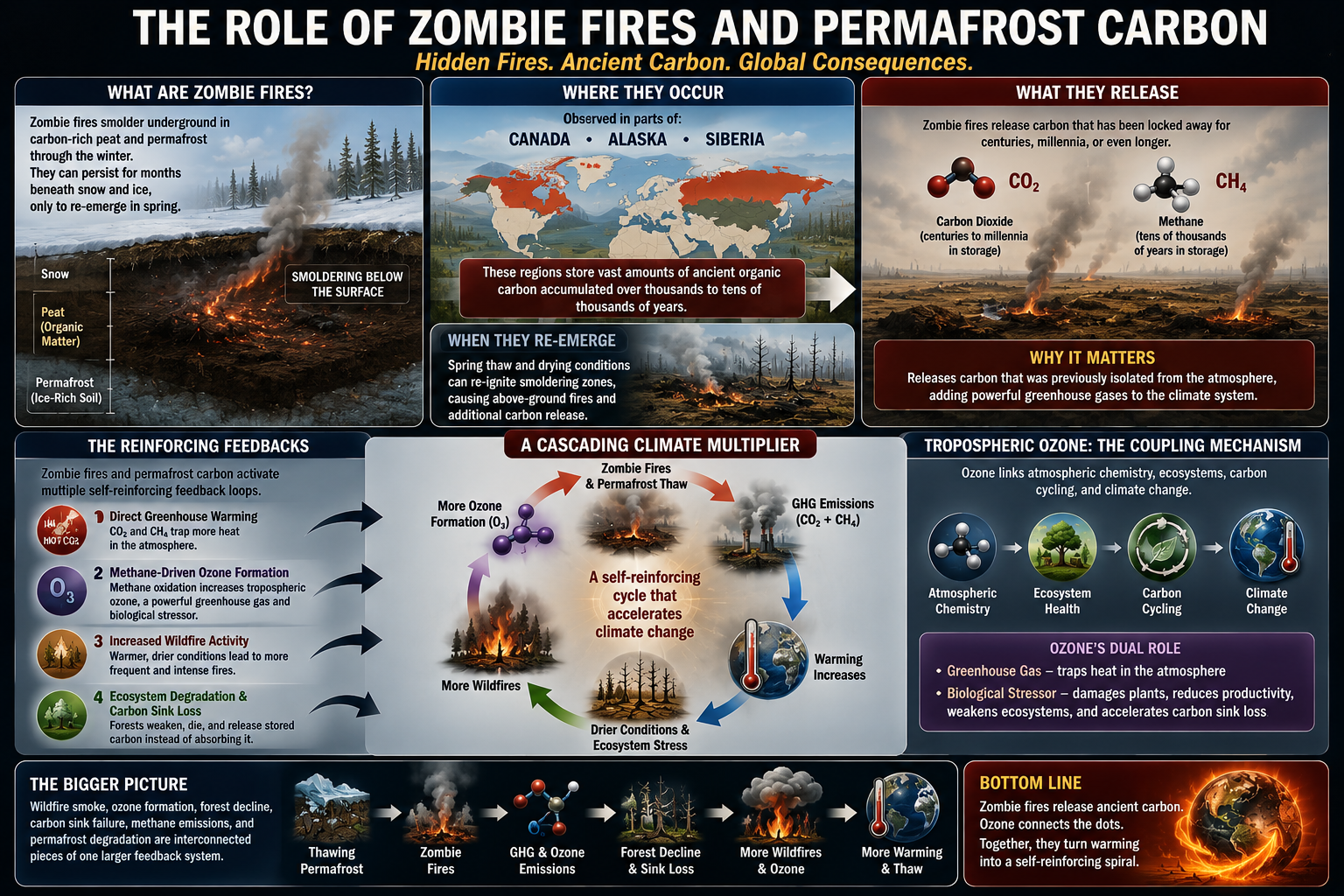
An additional and particularly concerning feedback involves so-called “zombie fires” found in portions of Canada, Alaska, and Siberia.
Unlike conventional surface fires, zombie fires can smolder underground within carbon-rich peat soils and thawing permafrost throughout the winter months. Hidden beneath snow cover, these fires may persist for months before re-emerging the following spring.
These systems are especially important because they release carbon that has been stored for centuries, millennia, or even longer.
Permafrost regions contain vast reservoirs of ancient organic carbon accumulated over thousands of years. When thawing and burning occur simultaneously, carbon dioxide and methane that were previously isolated from the atmosphere become available for rapid release.
The resulting emissions contribute to several reinforcing feedbacks:
- Direct greenhouse warming from carbon dioxide and methane.
- Additional methane-driven tropospheric ozone formation.
- Increased wildfire activity through warmer and drier conditions.
- Further ecosystem degradation and carbon sink loss.
A Cascading Climate Multiplier
Viewed collectively, wildfire smoke, ozone formation, forest decline, carbon sink failure, methane emissions, and permafrost degradation are not isolated phenomena. They represent interconnected components of a larger feedback system.
Tropospheric ozone serves as a particularly important coupling mechanism within this system because it links atmospheric chemistry, ecosystem health, carbon cycling, and climate change. By simultaneously acting as a greenhouse gas and a biological stressor, ozone helps transform warming-driven disturbances into broader ecological and climatic consequences.
This cascading interaction illustrates how climate change can become self-reinforcing. The concern is not merely that warming causes more fires. Rather, fires generate atmospheric pollutants and greenhouse gases that weaken natural carbon sinks, accelerate ozone formation, and create conditions that favor even greater warming in the future.
In this framework, wildfire-driven ozone production becomes both a symptom of climate change and a mechanism that contributes to its acceleration.
Important Reading:
The Ozone Feedback Theory: Tropospheric Ozone as a Driver of Ecosystem Decline, Carbon Sink Failure, and Climate Acceleration
* Our probabilistic, ensemble-based climate model — which incorporates complex socio-economic and ecological feedback loops within a dynamic, nonlinear system — projects that global temperatures are becoming unsustainable this century. This far exceeds earlier estimates of a 4°C rise over the next thousand years, highlighting a dramatic acceleration in global warming. We are now entering a phase of compound, cascading collapse, where climate, ecological, and societal systems destabilize through interlinked, self-reinforcing feedback loops.
Tipping points and feedback loops drive the acceleration of climate change. When one tipping point is toppled and triggers others, the cascading collapse is known as the Domino Effect.