Jerk-Behavior in Earth’s Rotation: Climate Change, the Third Derivative, and Emerging Risks to Precision Navigation
Polar amplification → weakened equator-to-pole temperature gradients → reduced thermal contrast that helps drive and stabilize large-scale atmospheric circulation → accelerated Greenland and Arctic ice melt → freshwater input into the North Atlantic and reduced salinity/density of surface waters → disruption and potential weakening of the Atlantic Meridional Overturning Circulation (AMOC) → reorganization of North Atlantic pressure fields and storm tracks → greater jet-stream waviness, slower progression, and amplified Rossby-wave behavior → more persistent blocking patterns, omega blocks, and meridional flow → stalled atmospheric rivers, prolonged heat domes, drought-flood swings, and other forms of hydroclimatic whiplash → destabilization of agriculture, infrastructure, ecosystems, and public health systems → accelerated land-ice loss and groundwater redistribution that shift mass across the planet → climate-driven mass redistribution sufficient to measurably alter Earth’s moment of inertia and contribute to changes in rotational dynamics, including a slight slowing of Earth’s rotation and changes in the length of day.
Daniel Brouse¹ and Sidd Mukherjee²
June 2026
¹Independent Climate Researcher, Economist
²Physicist
“Climate-driven changes in Earth’s rotation may be contributing to navigational uncertainties that negatively affect battlefield outcomes and increase the risk of civilian casualties in contemporary conflicts.”
by Daniel Brouse and Sidd Mukherjee
June 2026
Abstract
Climate change is increasingly altering the physical dynamics of Earth itself. Accelerating ice-sheet loss, sea-level rise, and large-scale redistribution of mass are changing the planet’s rotation rate, shifting its axis of rotation, and introducing increasingly nonlinear behavior into Earth system processes. Recent studies indicate that climate-driven ice melt is lengthening Earth’s day by approximately 1.33 milliseconds per century, making climate change a dominant driver of long-term rotational change. Beyond the slowing of rotation, the acceleration and third derivative (“jerk”) of these changes may represent a more significant concern because they reduce predictability within systems that depend on precise measurements of time, position, and motion. The consequences extend beyond geophysics into GPS accuracy, satellite operations, spacecraft navigation, autonomous systems, and potentially military guidance technologies. This paper examines the emerging science of climate-driven rotational change and places it within the broader context of accelerating Earth-system feedback loops and nonlinear climate dynamics.
Introduction
Earth’s rotation has never been perfectly constant. Variations occur naturally through interactions among the atmosphere, oceans, mantle, core, tides, and cryosphere. Historically, these fluctuations have remained within ranges that can be modeled and predicted through established geophysical processes.
Anthropogenic climate change is introducing a new forcing mechanism into this system. Accelerated melting of glaciers and polar ice sheets is redistributing trillions of tons of mass from high latitudes toward the oceans. This redistribution alters Earth’s moment of inertia and changes the speed and orientation of the planet’s rotation.
While changes in rotational velocity have attracted growing scientific attention, the acceleration and higher-order derivatives of those changes may prove even more significant. The third derivative, commonly referred to as “jerk,” measures how rapidly acceleration itself is changing. Increasing jerk-behavior is often a hallmark of nonlinear systems approaching new states of instability or unpredictability.
The significance of these changes extends far beyond the length of the day. Modern civilization depends upon precise timing, positioning, navigation, and reference-frame stability. Small changes in Earth’s rotational behavior can cascade through technologies that form the foundation of the modern world.
Climate Change and Earth’s Rotational Slowdown
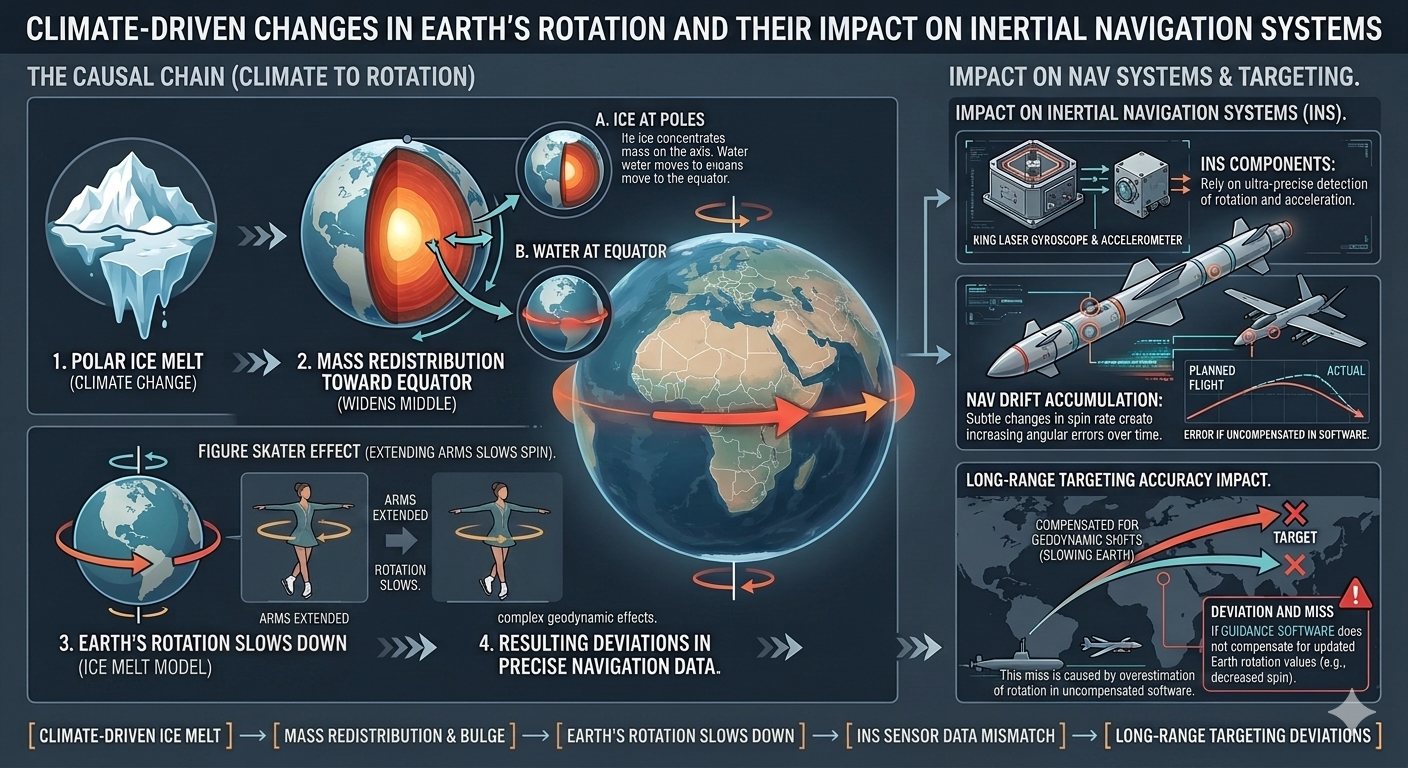
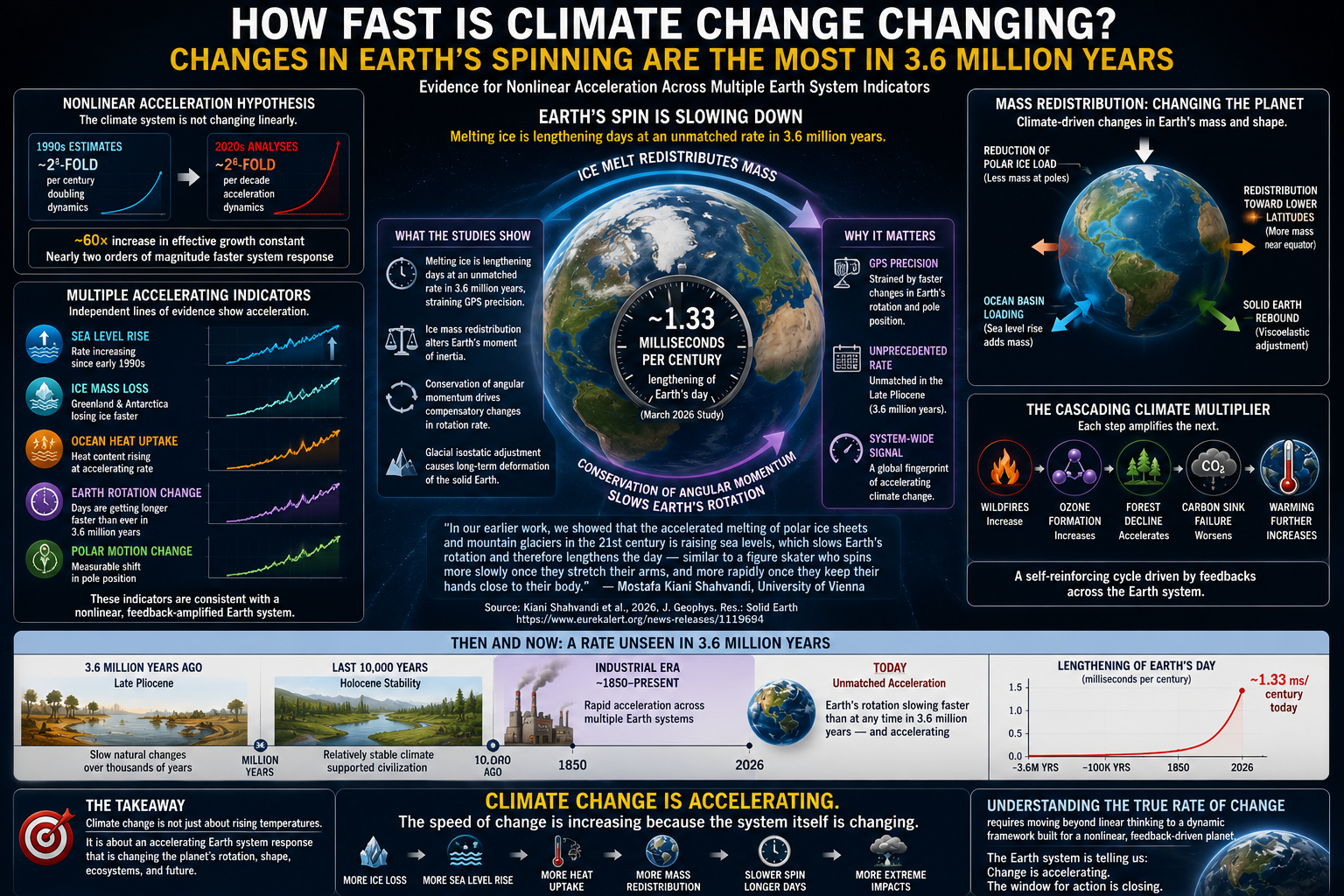
In 2024, researchers from ETH Zurich, NASA’s Jet Propulsion Laboratory, and collaborating institutions demonstrated that climate change has become an increasingly dominant influence on Earth’s rotation. Their work showed that melting ice sheets redistribute mass from the poles toward lower latitudes, increasing Earth’s moment of inertia and slowing the planet’s rotation in a manner analogous to a spinning figure skater extending their arms.
A March 2026 analysis published in the Journal of Geophysical Research: Solid Earth quantified the effect, estimating that climate-driven ice melt is lengthening Earth’s day by approximately 1.33 milliseconds per century. While seemingly small, this represents a measurable and accelerating alteration of one of the planet’s most fundamental physical properties.
Researchers further concluded that the climate-driven component of Earth’s rotational slowdown now exceeds many natural long-term influences and may represent the most rapid climate-related rotational change observed in millions of years.
Polar Motion and the Changing Shape of Earth
The effects of ice-sheet loss are not limited to rotational speed.
As glaciers and ice sheets melt, the redistribution of water mass changes Earth’s shape and alters the position of its rotational axis. Research published in Geophysical Research Letters found that global warming has accelerated the movement of Earth’s rotational pole since the 1990s.
Several mechanisms contribute to this phenomenon:
- Redistribution of meltwater toward lower latitudes.
- Gravitational migration of ocean mass.
- Centrifugal redistribution of water toward the equatorial bulge.
- Glacial Isostatic Adjustment (GIA), in which land previously compressed by massive ice sheets slowly rebounds upward as ice disappears.
Together, these processes alter both Earth’s moment of inertia and the orientation of its spin axis. The result is a planet whose rotational geometry is changing more rapidly than at any point during the modern observational era.
The Third Derivative: Jerk-Behavior in the Earth System
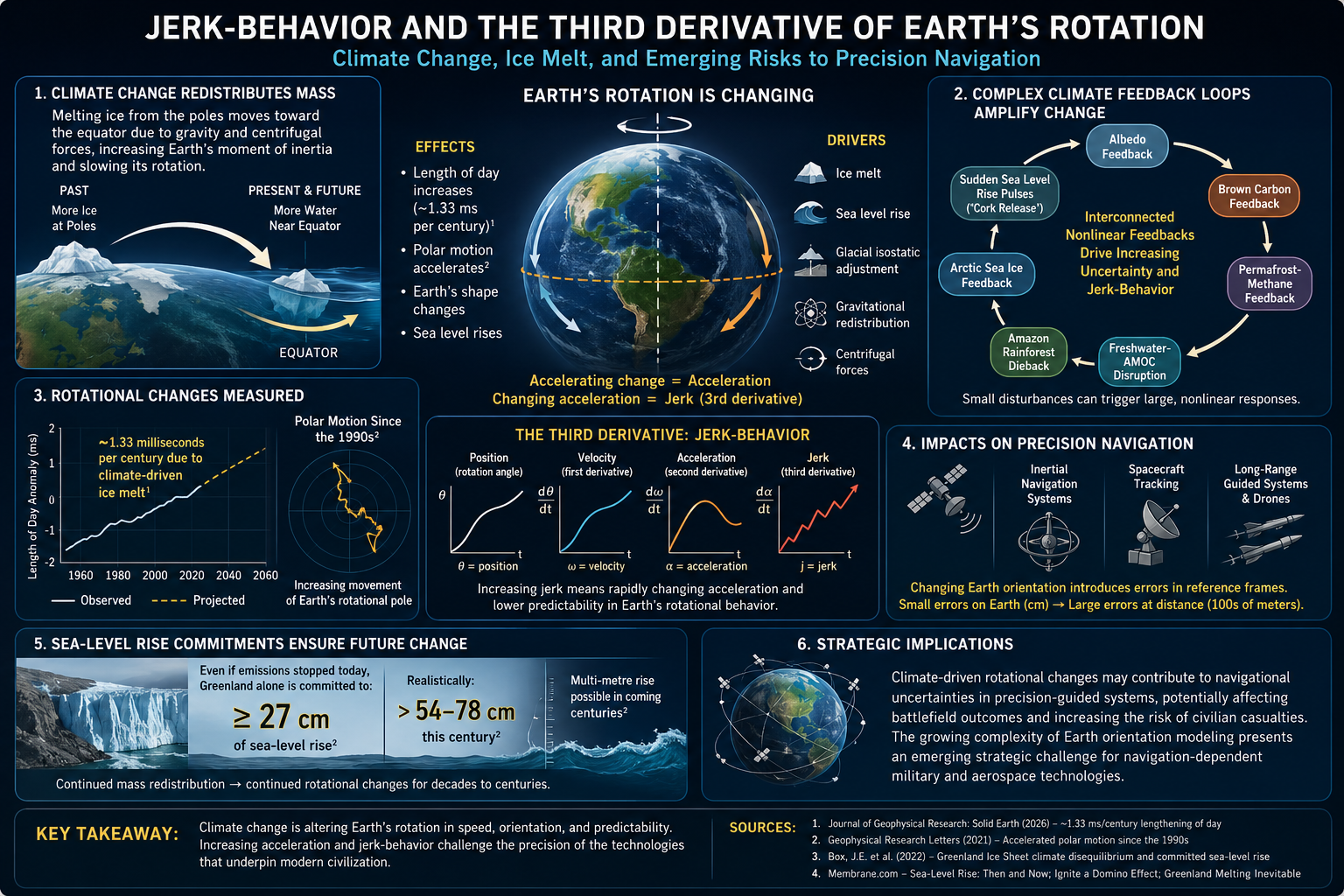
Velocity measures change.
Acceleration measures changing velocity.
Jerk measures changing acceleration.
In engineering, aerospace systems, and control theory, jerk is often more important than velocity because it determines how predictable a system remains under changing conditions.
Earth’s rotational system now appears to be exhibiting measurable jerk-behavior driven by climate-induced mass redistribution. This means that not only is Earth slowing, but the rate at which it is slowing is itself changing.
Such behavior introduces challenges for predictive models because assumptions based upon previous rates of change become increasingly unreliable. Systems must be updated more frequently, and uncertainty grows as the underlying dynamics become increasingly nonlinear.
The emergence of measurable jerk-behavior may represent one of the clearest physical indicators that climate change is influencing fundamental planetary-scale processes.
Earth Orientation Parameters and Navigation Systems
Modern navigation depends on the precise relationship between celestial and terrestrial coordinate systems.
The International Celestial Reference Frame (ICRF) provides a stable astronomical reference framework based on distant quasars. The International Terrestrial Reference Frame (ITRF) defines geographic coordinates fixed to Earth’s surface.
Earth Orientation Parameters (EOPs) connect these systems.
Organizations such as the International Earth Rotation and Reference Systems Service (IERS) continuously monitor changes in:
- Length of day
- Polar motion
- Axial orientation
- Precession
- Nutation
As climate-driven changes accelerate, EOP calculations become increasingly important. Even centimeter-scale errors in Earth’s reference frame can propagate into navigation errors measured in hundreds of meters across interplanetary distances.
The growing variability in Earth’s rotation increases the complexity of maintaining accurate coordinate transformations between space-based and Earth-based systems.
GPS, Spacecraft, and Inertial Navigation
Global Positioning System (GPS) satellites rely upon extremely precise timing and rotational models.
Unexpected changes in Earth’s orientation can create discrepancies between modeled and actual positions. These discrepancies must be corrected through continual updates to Earth orientation parameters.
The same challenge affects:
- Satellite tracking
- Spacecraft navigation
- Astronomical observations
- Geodesy
- Autonomous transportation systems
- Long-range communication networks
Inertial Navigation Systems (INS) face an additional challenge because they operate by integrating acceleration and rotational measurements relative to Earth itself.
As Earth’s rotational characteristics evolve, assumptions embedded within inertial guidance algorithms require more frequent recalibration. Small errors can accumulate over long distances and extended operational periods.
Sea-Level Rise Commitments and Long-Term Rotational Change
The rotational changes observed today are unlikely to stabilize quickly.
Research on the Greenland Ice Sheet has demonstrated that substantial future melting is already committed due to past greenhouse gas emissions. A study led by Jason Box and colleagues concluded that even if emissions ceased immediately, Greenland alone is committed to producing at least 27 centimeters of global sea-level rise.
Subsequent analyses suggest that realistic outcomes may substantially exceed this minimum estimate.
This committed melting implies continued redistribution of mass for decades and potentially centuries. As a result, climate-driven changes in Earth’s rotation, polar motion, and reference-frame stability are likely to continue long after greenhouse gas emissions peak.
The rotational consequences therefore represent not merely a current phenomenon but a long-term geophysical response that may unfold over generations.
Climate Feedback Loops and Nonlinear Dynamics
Understanding Earth’s changing rotation requires understanding the broader climate system in which it occurs.
Climate change is not a simple linear process. It is a dynamic system characterized by numerous interacting feedback loops, including:
- Albedo Feedback Loop
- Brown Carbon Feedback Loop
- Permafrost-Methane Feedback Loop
- Freshwater-AMOC Disruption Loop
- Arctic Sea Ice Feedback Loop
- Amazon Rainforest Dieback Feedback Loop
- Hydroclimate Whiplash
- Sudden Sea-Level Rise Pulses (“Cork Release” Events)
Each feedback influences the others through interconnected physical, biological, and social systems.
These interactions create nonlinear responses in which relatively small disturbances can trigger disproportionately large outcomes. The accelerating changes observed in Earth’s rotation may therefore be viewed as one manifestation of a broader planetary trend toward increasing systemic instability and complexity.
Defense and Strategic Implications
Modern military and aerospace systems depend heavily on precision navigation.
Long-range missiles, autonomous drones, hypersonic vehicles, spacecraft, and surveillance platforms all rely upon accurate reference frames and rotational models.
As Earth orientation becomes more variable, maintaining precision requires increasingly sophisticated updates and corrections.
Climate-driven changes in Earth’s rotation may be contributing to navigational uncertainties that negatively affect battlefield outcomes and increase the risk of civilian casualties in contemporary conflicts. As rotational variability increases, the growing complexity of Earth orientation modeling presents an emerging strategic challenge for navigation-dependent systems, including long-range guided munitions, autonomous drones, satellite operations, and other precision-targeting technologies.
Further research is needed to quantify these effects under operational conditions.
Conclusion
Climate change is altering not only Earth’s atmosphere, oceans, and ecosystems but also the planet’s physical rotation.
Accelerated melting of glaciers and ice sheets is slowing Earth’s rotation, shifting its axis, changing its shape, and introducing increasing levels of acceleration and jerk-behavior into planetary dynamics.
Recent research suggests that climate-driven rotational changes are now occurring at rates unprecedented in millions of years. These changes are becoming increasingly relevant to GPS systems, spacecraft navigation, Earth orientation modeling, geodesy, and other technologies dependent upon extreme precision.
Viewed within the larger framework of interacting climate feedback loops and nonlinear Earth-system dynamics, the changing rotation of Earth may represent one of the most fundamental indicators that anthropogenic climate change is affecting the physical mechanics of the planet itself.
Polar amplification → weakened equator-to-pole temperature gradients → reduced thermal contrast that helps drive and stabilize large-scale atmospheric circulation → accelerated Greenland and Arctic ice melt → freshwater input into the North Atlantic and reduced salinity/density of surface waters → disruption and potential weakening of the Atlantic Meridional Overturning Circulation (AMOC) → reorganization of North Atlantic pressure fields and storm tracks → greater jet-stream waviness, slower progression, and amplified Rossby-wave behavior → more persistent blocking patterns, omega blocks, and meridional flow → stalled atmospheric rivers, prolonged heat domes, drought-flood swings, and other forms of hydroclimatic whiplash → destabilization of agriculture, infrastructure, ecosystems, and public health systems → accelerated land-ice loss and groundwater redistribution that shift mass across the planet → climate-driven mass redistribution sufficient to measurably alter Earth’s moment of inertia and contribute to changes in rotational dynamics, including a slight slowing of Earth’s rotation and changes in the length of day.
Also see:
References
Box, J. E., Colgan, W., et al. (2022). Greenland Ice Sheet Climate Disequilibrium and Committed Sea-Level Rise. Nature Climate Change.
Dill, R., Soja, B., Chen, J., et al. (2024). The Increasingly Dominant Role of Climate Change on Length of Day. Proceedings of the National Academy of Sciences, 121(28).
ETH Zurich Geodesy and Geodynamics Group. Research on Earth Rotation, Climate Change, and Earth Orientation Parameters.
International Earth Rotation and Reference Systems Service (IERS). Earth Orientation Parameters Technical Bulletins.
NASA Jet Propulsion Laboratory (JPL). Climate-Driven Changes in Earth Rotation and Polar Motion.
Wang, J., et al. (2021). Climate-Driven Polar Motion Since the 1990s. Geophysical Research Letters.
Membrane.com. Sea Level Rise: Then and Now. http://membrane.com/global_warming/Sea-Level-Rise-Historic.html
Membrane.com. Ignite a Domino Effect: Climate Feedback Loops and Cascading Tipping Points. http://membrane.com/global_warming/Ignite-a-Domino-Effect.html
Membrane.com. Greenland Melting Inevitable. http://membrane.com/global_warming/notes/Greenland-Melting-Inevitable.html
Journal of Geophysical Research: Solid Earth. (2026). Climate-Driven Lengthening of Day Associated with Ice Melt and Sea-Level Rise.
Lambeck, K. (2005). The Earth’s Variable Rotation: Geophysical Causes and Consequences. Cambridge University Press.
Munk, W. H., & MacDonald, G. J. F. (1960). The Rotation of the Earth: A Geophysical Discussion. Cambridge University Press.
* Our probabilistic, ensemble-based climate model — which incorporates complex socio-economic and ecological feedback loops within a dynamic, nonlinear system — projects that global temperatures are becoming unsustainable this century. This far exceeds earlier estimates of a 4°C rise over the next thousand years, highlighting a dramatic acceleration in global warming. We are now entering a phase of compound, cascading collapse, where climate, ecological, and societal systems destabilize through interlinked, self-reinforcing feedback loops.
Tipping points and feedback loops drive the acceleration of climate change. When one tipping point is toppled and triggers others, the cascading collapse is known as the Domino Effect.