by Daniel Brouse
July 2026
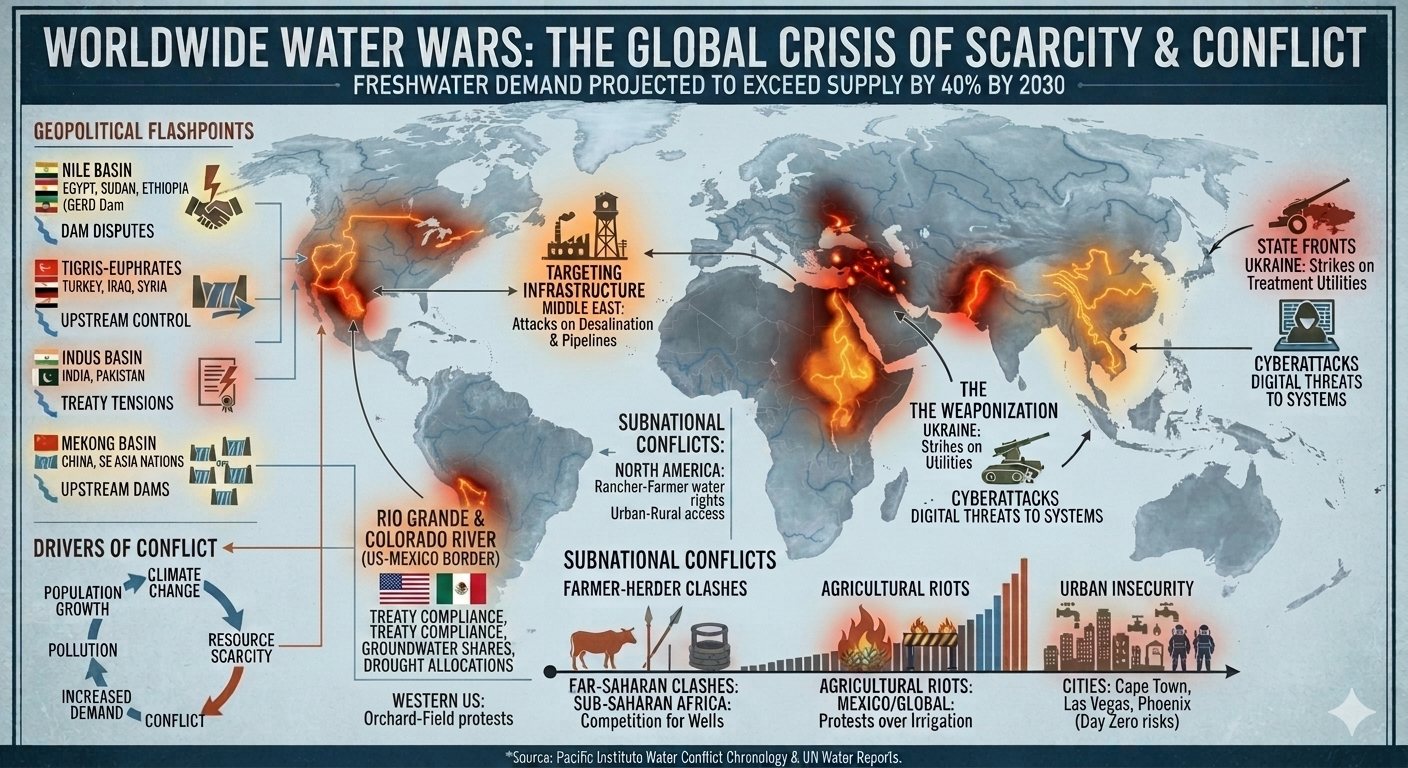
Water has become one of the defining geopolitical resources of the 21st century. Population growth, aging infrastructure, groundwater depletion, pollution, and climate change have pushed many of the world’s major river basins toward what researchers increasingly describe as global water bankruptcy—a condition in which demand permanently exceeds reliable supply.
While full-scale wars fought solely over water remain relatively uncommon, water has become an increasingly powerful geopolitical weapon. Governments use dams, reservoirs, and water diversions as strategic leverage. Armed groups target water infrastructure. Climate-driven droughts intensify existing political tensions, transforming long-standing disputes into national security crises.
Organizations such as the Pacific Institute have documented hundreds of water-related conflicts worldwide, with the frequency of violent incidents increasing as climate change accelerates.
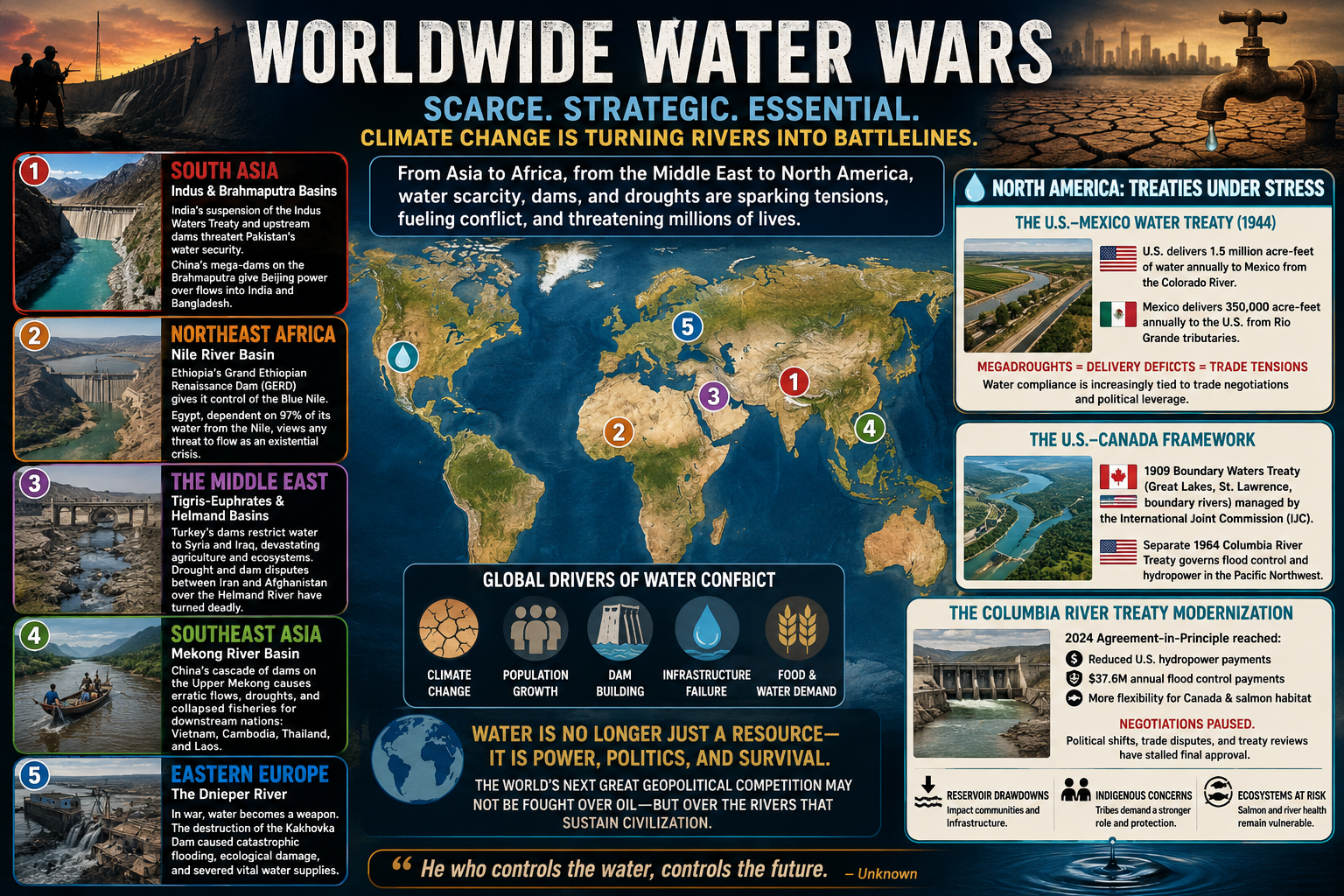
The Indus River remains one of the world’s most dangerous hydro-political flashpoints.
For more than six decades, the 1960 Indus Waters Treaty largely insulated water management from military conflict between India and Pakistan. However, deteriorating political relations have placed the agreement under unprecedented strain. India has accelerated construction of upstream hydroelectric projects and has suspended portions of treaty cooperation, while Pakistan has repeatedly warned that any deliberate interruption of water flows would be viewed as an existential threat.
Because the Indus supports the majority of Pakistan’s agriculture, even modest reductions in flow can have enormous economic and humanitarian consequences.
Farther east, China is constructing some of the world’s largest hydroelectric projects on the Yarlung Tsangpo—the upper reaches of the Brahmaputra River in Tibet.
Although Beijing maintains that the projects are designed primarily for power generation and flood management, India and Bangladesh remain concerned that upstream control could eventually allow China to manipulate downstream water availability during periods of drought or political tension.
As climate change alters Himalayan snowpack and glacier melt, these concerns continue to grow.
The Grand Ethiopian Renaissance Dam (GERD) has transformed regional politics.
Located on the Blue Nile, the dam gives Ethiopia significant influence over seasonal river flows. Ethiopia views the project as essential for economic development and electrification. Egypt, however, depends on the Nile for roughly 97 percent of its freshwater supply and considers uninterrupted downstream flows a matter of national survival.
Despite years of negotiations involving Ethiopia, Egypt, and Sudan, no permanent, legally binding agreement governing long-term operation of the dam has been reached.
Turkey’s Southeastern Anatolia Project (GAP) includes more than twenty major dams and numerous hydroelectric facilities.
While the project has expanded Turkish agriculture and electricity production, it has substantially reduced downstream flows into Syria and Iraq.
The consequences include:
Water shortages have also intensified conflict between Iran and Afghanistan.
Repeated droughts have strained implementation of existing water-sharing agreements, and disputes over upstream reservoirs and dams have contributed to armed clashes between Iranian border forces and Taliban-controlled Afghanistan.
China has built an extensive series of dams on the Upper Mekong (Lancang River).
Downstream nations—including Vietnam, Cambodia, Laos, and Thailand—have experienced increasingly erratic river levels, reduced sediment transport, declining fisheries, and unexpected drought conditions.
Millions of people depend upon the Mekong for food security and agriculture, making river management one of Southeast Asia’s most significant long-term geopolitical challenges.
The war in Ukraine has demonstrated how water infrastructure itself can become a military target.
The destruction of the Kakhovka Dam along the Dnieper River triggered catastrophic flooding, devastated ecosystems, destroyed farmland, disrupted drinking water supplies, and complicated cooling operations at the nearby Zaporizhzhia Nuclear Power Plant.
The event illustrated how modern warfare increasingly includes attacks on critical water infrastructure.
Unlike many international river systems, North America has long relied upon formal treaties to govern shared water resources. However, prolonged drought and climate change are placing these agreements under unprecedented stress.
The foundation of U.S.–Mexico water management is the 1944 Water Treaty, administered by the International Boundary and Water Commission (IBWC).
The treaty established a reciprocal exchange:
Persistent megadrought across the American Southwest and northern Mexico has severely strained compliance.
Mexico has accumulated significant delivery deficits under portions of the treaty, leading to growing frustration among Texas farmers and lawmakers.
Water has increasingly become intertwined with trade policy. Some U.S. officials have proposed incorporating treaty compliance into future reviews of the United States–Mexico–Canada Agreement (USMCA), potentially linking water deliveries to trade negotiations.
The United States has also denied certain Mexican requests for additional Colorado River deliveries during periods of domestic shortage, illustrating how climate stress is reshaping bilateral diplomacy.
Canada manages shared waters with the United States through the 1909 Boundary Waters Treaty, administered by the International Joint Commission (IJC).
This framework governs:
A separate agreement—the 1964 Columbia River Treaty (CRT)—governs flood control and hydropower operations throughout the Pacific Northwest.
For six years, negotiators from both countries worked to modernize the aging Columbia River Treaty.
Negotiators reached a tentative Agreement-in-Principle that included several major reforms.
The United States negotiated reductions in the long-standing Canadian Entitlement, under which U.S. utilities compensated British Columbia for upstream water storage used to generate downstream electricity.
Instead of relying upon the original prepaid flood-control system, the agreement would establish annual payments—approximately $37.6 million per year—for coordinated flood storage operations.
British Columbia would receive greater authority to manage reservoir operations to support local priorities, including salmon habitat restoration and Indigenous cultural resources.
Although negotiators reached broad agreement, final treaty language has not been ratified.
A change in U.S. presidential leadership placed many international agreements under broader policy review, delaying completion of the modernization process.
The negotiations have also become entangled in wider U.S.–Canada trade disputes, including tariff discussions and political rhetoric surrounding North American natural resources. Canadian officials have expressed concern that future treaty approval could become tied to broader trade negotiations rather than water management alone.
Because modernization remains incomplete, water managers have adopted temporary operational agreements.
These interim measures attempt to replicate portions of the proposed treaty but have produced localized consequences.
For example, Lake Roosevelt has experienced larger seasonal drawdowns to preserve flood-control capacity, affecting ferry operations, recreation, and infrastructure serving the Colville Reservation.
Many environmental organizations and Tribal Nations argue that modernization still falls short.
The original 1964 treaty focused almost exclusively on flood control and hydropower production.
Although Indigenous governments participated extensively in modernization negotiations, many advocacy organizations—including Save Our Wild Salmon—argue that ecosystem function should become a legally co-equal objective alongside flood protection and electricity generation.
With salmon populations already under severe stress from warming rivers, altered streamflows, and habitat loss, many conservation groups believe future treaty revisions must place ecological resilience at the center of water management rather than treating it as a secondary consideration.
The phrase water wars once sounded like science fiction. Today, it describes a rapidly emerging geopolitical reality.
Climate change is reducing snowpack, accelerating glacier loss, intensifying droughts, and making precipitation increasingly erratic. At the same time, populations continue to grow while agriculture, industry, and cities demand ever larger shares of finite freshwater resources.
Most future conflicts will not resemble conventional wars fought solely over rivers. Instead, they will involve economic pressure, treaty disputes, dam construction, infrastructure sabotage, cyberattacks, migration, and political coercion centered on water security.
From the Indus to the Nile, from the Mekong to the Colorado, and from the Columbia River to the Rio Grande, freshwater is becoming both an environmental challenge and a strategic resource.
The world’s next great geopolitical competition may not be fought over oil—but over the rivers that sustain civilization itself.
Bottom line: The question is no longer how warm the planet becomes, but how life on Earth can endure when change outpaces our ability to adapt.
We cannot control the laws of physics, but we can control our pollution. The most effective action is to stop burning fossil fuels.