1Climatologist, Economist
2Physicist
New to climate change? Explore the complexities of climate science through easy-to-understand graphics and explanations.
How Fast Is the Earth Warming?
What Are the Immediate Impacts?
What Causes Climate Change?
For answers to these and other important questions, investigate “Climate Change Simplified: What Is Global Warming?”
Confused by climate change? Overwhelmed by the science? Not sure where to begin? No matter your level of literacy—or your level of climate knowledge—this is your guide to finding your way through the global warming galaxy.
Explore the science, evidence, feedbacks, risks, and real-world impacts of a changing climate from a human perspective.
Grab your towel. The journey begins here.
The Geological Society of London—the UK’s professional association for geologists, founded in 1807—puts the rate of modern climate change into geological perspective:
“...the current speed of human-induced CO₂ change and warming is nearly without precedent in the entire geological record, with the only known exception being the instantaneous, meteorite-induced event that caused the extinction of non-bird-like dinosaurs 66 million years ago.”
Bottom line: The question is no longer how warm the planet becomes, but how life on Earth can endure when change outpaces our ability to adapt.
We cannot control the laws of physics, but we can control our pollution. The most effective action is to stop burning fossil fuels.
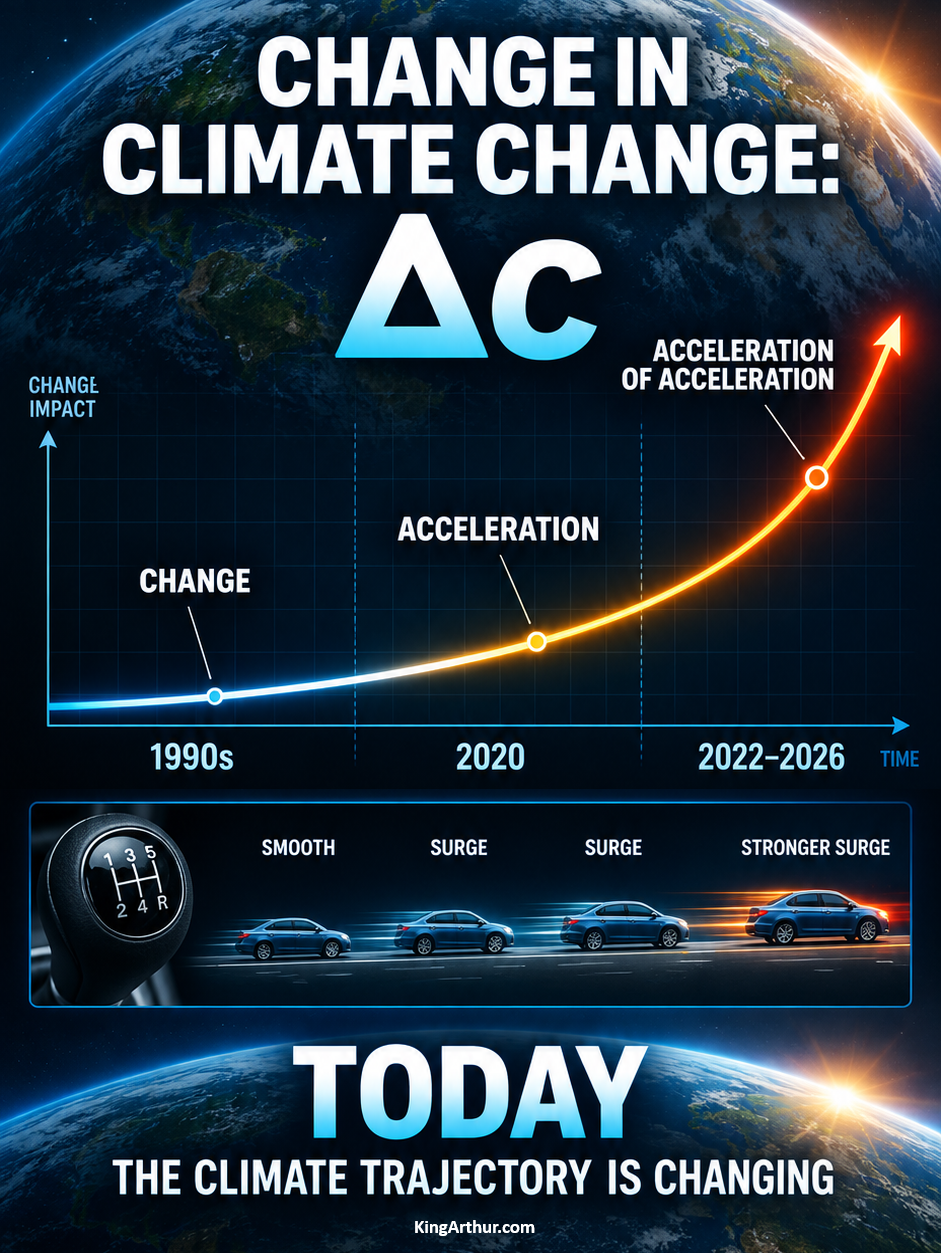
Since the ’90s, we’ve been in pursuit of change in climate change (Δc).
It took us about 10 years to recognize that the rate of change was doubling on roughly a 100-year timescale.
By 2020, the acceleration in acceleration had changed substantially: the doubling interval had compressed to roughly 10–20 years.
That represents a 5–10× increase in the rate of doubling—or, expressed on a centurial basis, a shift from 2¹ to roughly 2⁵–2¹⁰.
Beginning most notably around 2022, we began seeing something different happening in the climate system. Several major climate variables started changing together, in ways that were physically connected. It was no longer just a matter of the climate getting warmer—it was the parts of the climate system increasingly interacting with and reinforcing one another in real time.
At the same time, an extraordinary number of extreme climate events were being documented and rapidly shared through social-media platforms, providing additional real-world observations of climate-system behavior. Among the most striking examples was the Nepal–Tibet glacial collapse.
The models consistently produced similar results.
The period from 2022–2026 exhibits what mathematicians describe as third-derivative, or “jerk,” behavior: the rate of acceleration is itself changing at an accelerating rate, producing a nonlinear trajectory.
A simple analogy is sitting in the passenger seat while someone learns to drive a stick shift. Instead of a smooth increase in speed, you feel the repeated surges and lurches as the driver learns to coordinate the clutch, throttle, and gears. The acceleration is changing—and the rate at which that acceleration changes is changing as well.
That is the essential idea behind climate jerk: not simply that the climate system is changing faster, but that the acceleration of change is itself accelerating.
The recent shift in climate-system dynamics is being expressed not simply as continued warming, but as increasing synchronization among multiple radiative and thermal feedback pathways. The mathematical expression of this accelerating synchronization is approaching singularity.
For a closer look at feedbacks, climate acceleration, threshold behavior, and the Δc models, see: Climate Change Threshold Dynamics and Singularity
Much of the world is focused on 1.5°C.
One reason the public has become so focused on this number is its simplicity. A 1.5°C (2.7°F) increase sounds like a straightforward, easily understood concept. It also doesn’t sound particularly frightening. After all, what’s the big deal about a couple of degrees of warming? Some people even portray it as potentially beneficial.
Scientists take a very different view.
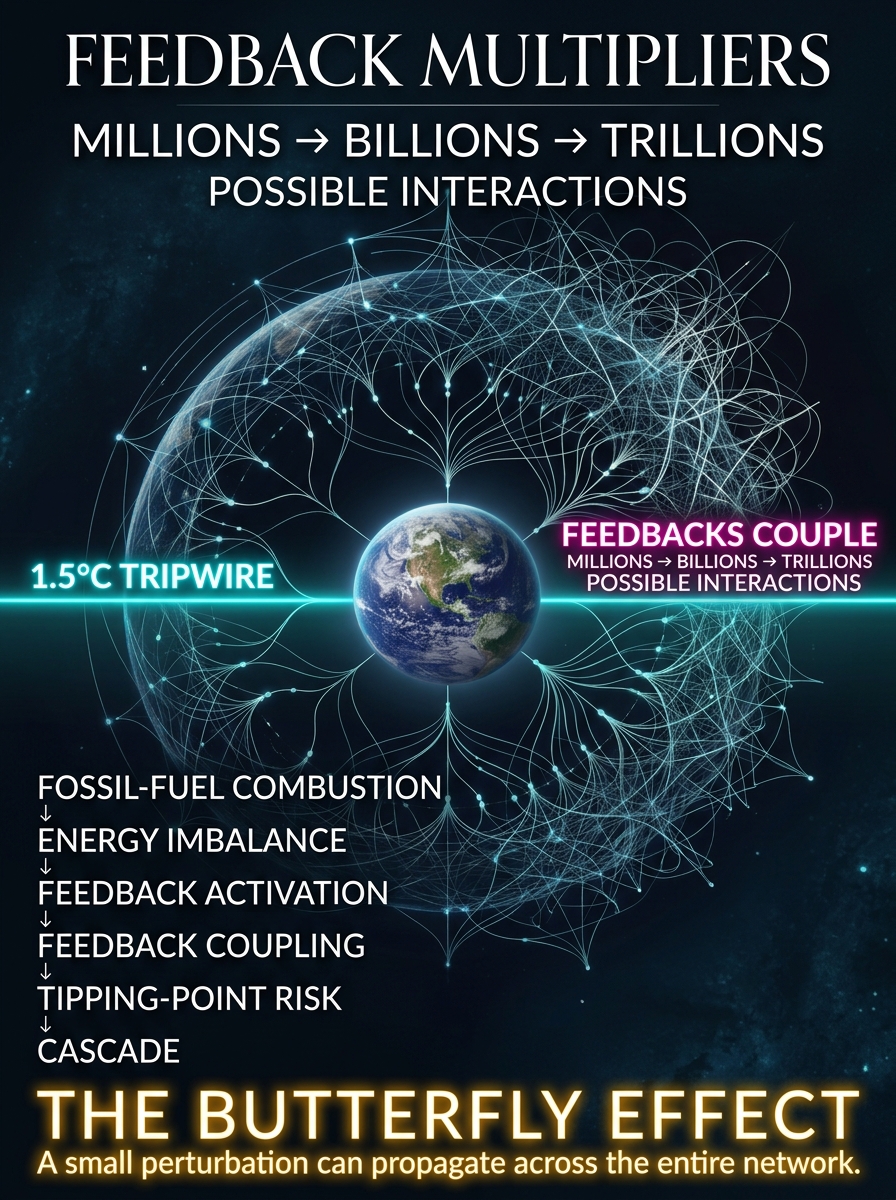
There are many ways to look at climate change. At the micro level, millions of individual feedbacks are operating throughout the Earth system—between the atmosphere, oceans, ice, land, ecosystems, and human systems. At the macro level, all of those interactions combine to form a single, interconnected climate system.
The critical question is not simply how much the planet warms, but what happens as warming changes the system itself.
Understanding how these feedbacks interact—and, more importantly, how they amplify one another—is at the bleeding edge of climate science. The climate system is not a simple thermostat in which each additional degree produces a proportionally larger but otherwise predictable effect. It is a complex, nonlinear system capable of crossing thresholds and shifting into fundamentally different states.
That is why 1.5°C matters.
The 1.5°C threshold identified in the Paris Agreement—and the roughly 2°C level generally regarded as an even more dangerous boundary—is not important because the difference between 1.4°C and 1.5°C is somehow magical. These numbers matter because increasing global temperatures raise the probability of triggering major climate tipping points.
And once tipping points begin to activate, the question of whether warming ultimately reaches 2°C, 3°C, or even 4–7°C becomes much less relevant for two fundamental reasons:
First, tipping points can initiate self-reinforcing feedbacks that continue driving change even after the original forcing changes.
Second, the impacts do not necessarily increase gradually with temperature. They can accelerate, compound, and cascade as interconnected systems begin to destabilize.
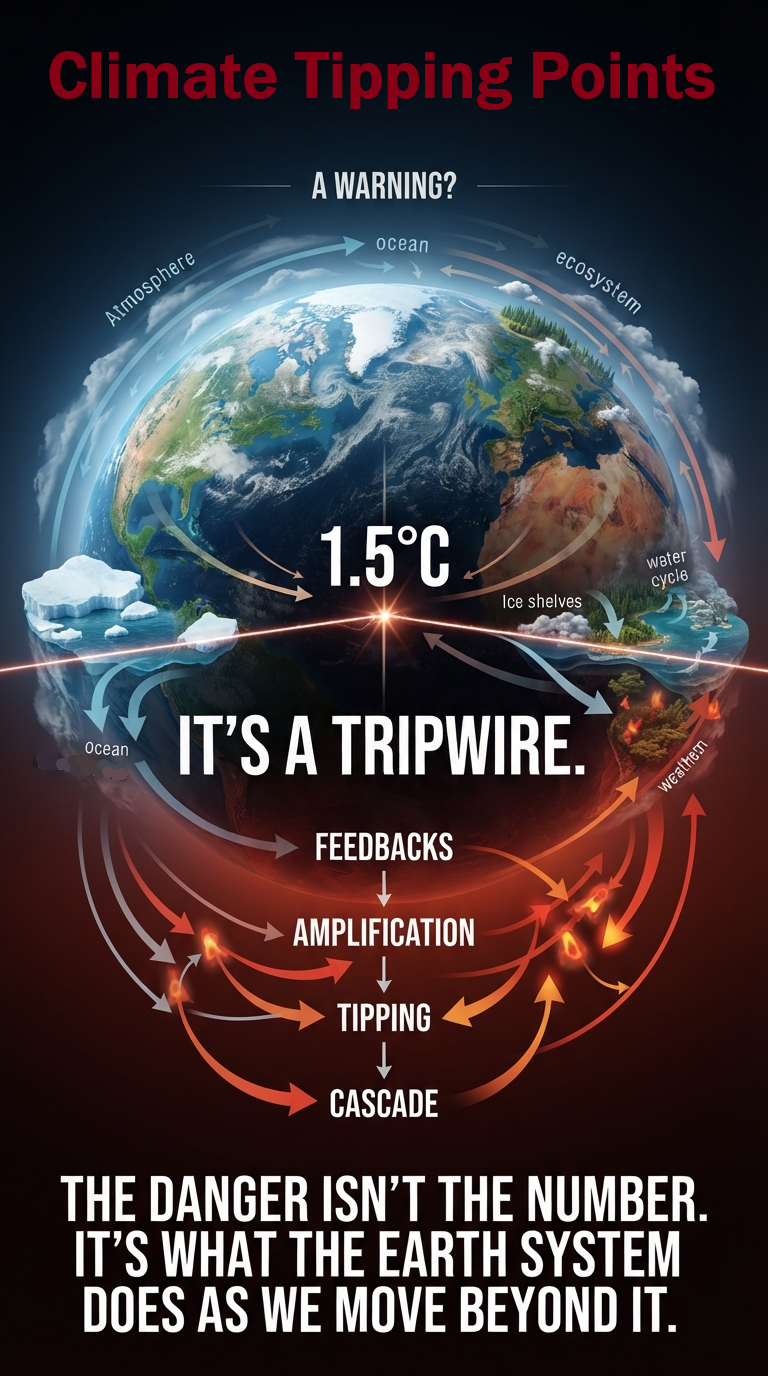
In other words, 1.5°C is not a destination. It is not merely a warning sign or an alarm. It is a tripwire.
A warning sign tells you that danger is ahead. An alarm tells you that danger may already be present. A tripwire is different: it marks a threshold at which crossing the line can trigger a chain of events that becomes increasingly difficult to control or reverse.
That is the critical distinction that can be lost when climate change is reduced to a single temperature number.
The real danger lies not in the number itself, but in what the Earth system is doing as we move beyond it.
We are not simply adding another fraction of a degree to a static planet. We are increasing the energy entering a dynamic, interconnected system—and that additional energy is altering the very processes that determine how the system responds.
The question, therefore, is not simply, “How many degrees warmer will Earth become?”
The more important question is:
“What happens as we cross the tripwires?”
Two interconnected processes are particularly important in determining how the climate system approaches and crosses these tripwires: 1) the enormous amount of excess energy stored in the oceans, and 2) the activation and coupling of tipping points that can amplify feedbacks and accelerate climate change.
The first determines how much energy is already loaded into the system. The second determines how that energy can be redistributed, amplified, and transferred through interconnected components of the Earth system.
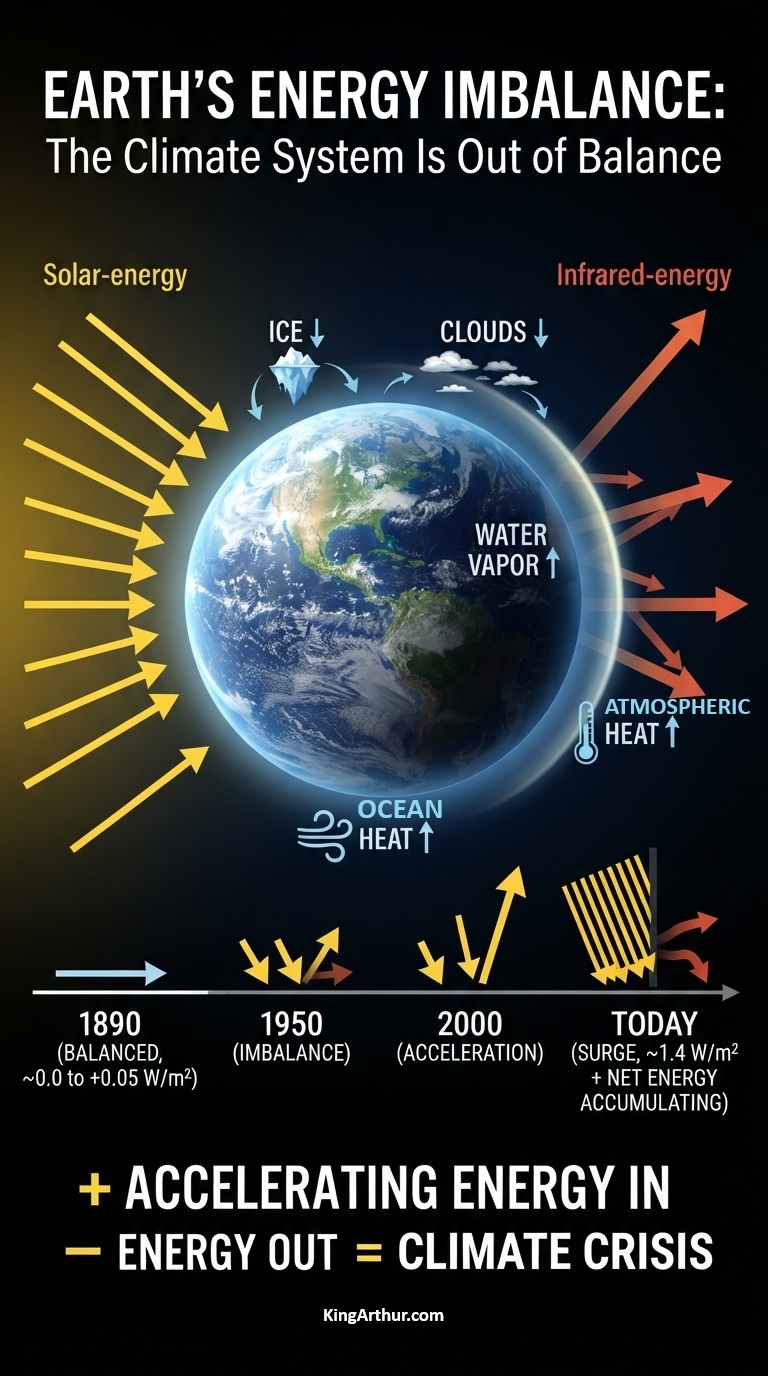
A simple way to understand climate change and global warming is through Earth’s energy balance—or, more precisely, the growing lack of balance known as Earth’s Energy Imbalance (EEI).
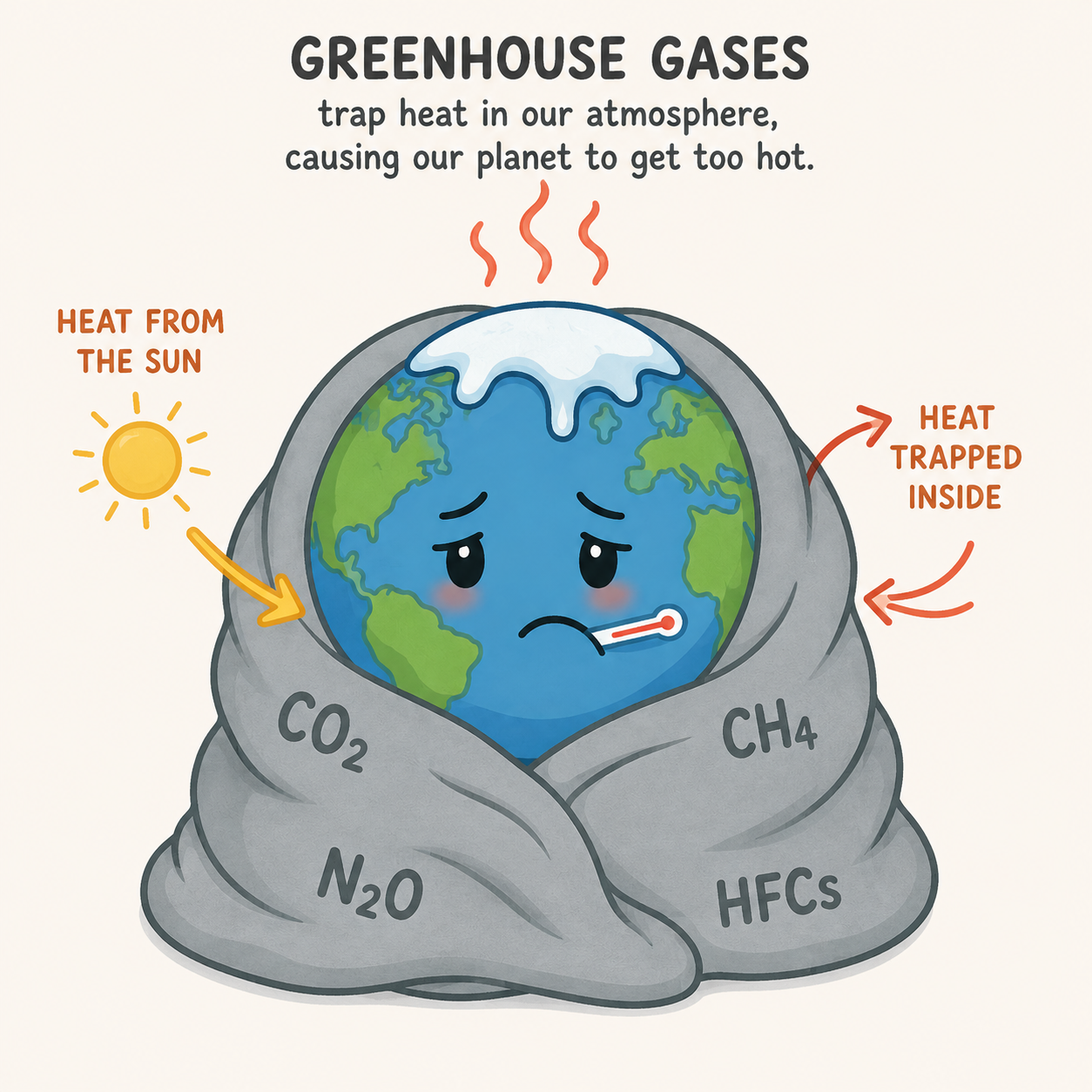
Earth’s climate is governed by a fundamental exchange: energy arrives primarily from the Sun, while Earth returns energy to space as reflected sunlight and outgoing infrared radiation. When incoming and outgoing energy are equal over the long term, the planet is approximately in energy balance. When more energy enters the Earth system than leaves it, the difference is stored within the climate system, producing warming.
2005–2019 (The First Acceleration)
The long-term EEI average effectively doubles compared to prior decades. Ocean heat content spikes dramatically as the oceans absorb roughly 90% of this excess energy.
2020–2023 (The Post-2020 Surge)
Slashed marine shipping pollution (IMO 2020 regulations) rapidly clears atmospheric haze over the oceans, forcing a massive, sudden spike in absorbed solar energy.
2024–Present (Nonlinear Feedback Phase)
EEI hits unprecedented, record-breaking territory. Strong climate feedbacks—such as collapsing Antarctic sea ice and thinning cloud decks—darken the planet, causing it to absorb immense amounts of solar radiation.
From ~0.0 to ~1.4 W/m²+
Read the full report Earth’s Energy Imbalance: The Climate System Out of Balance
The ocean holds most of the excess energy accumulating in the climate system. A deep-ocean study has revealed that even the deepest layers of the ocean are warming at a measurable rate.
The oceans absorb and store more than 90% of the excess heat trapped by greenhouse gases. In 2025, a tiny increase—one-tenth of a degree—was observed. That seemingly insignificant change represents an enormous amount of additional stored thermal energy. This represents an amount of stored thermal energy roughly equivalent to a 2°C increase in the atmosphere and surface system.
If the accumulated ocean heat were distributed across land surfaces, it would equate to an estimated 35°C increase in land temperatures—a level that would make much of the planet uninhabitable.
This illustrates how the oceans have been masking the full extent of the Earth’s energy imbalance, acting as a temporary thermal buffer while simultaneously undergoing changes of their own, including increased stratification, circulation changes, and ecosystem disruption.
The entire Pacific Ocean is running approximately 1.6°C above its long-term average—roughly six standard deviations above the mean. In climate science, deviations of this magnitude are virtually off the charts, underscoring just how far outside what we would consider normal variability the climate system has moved.
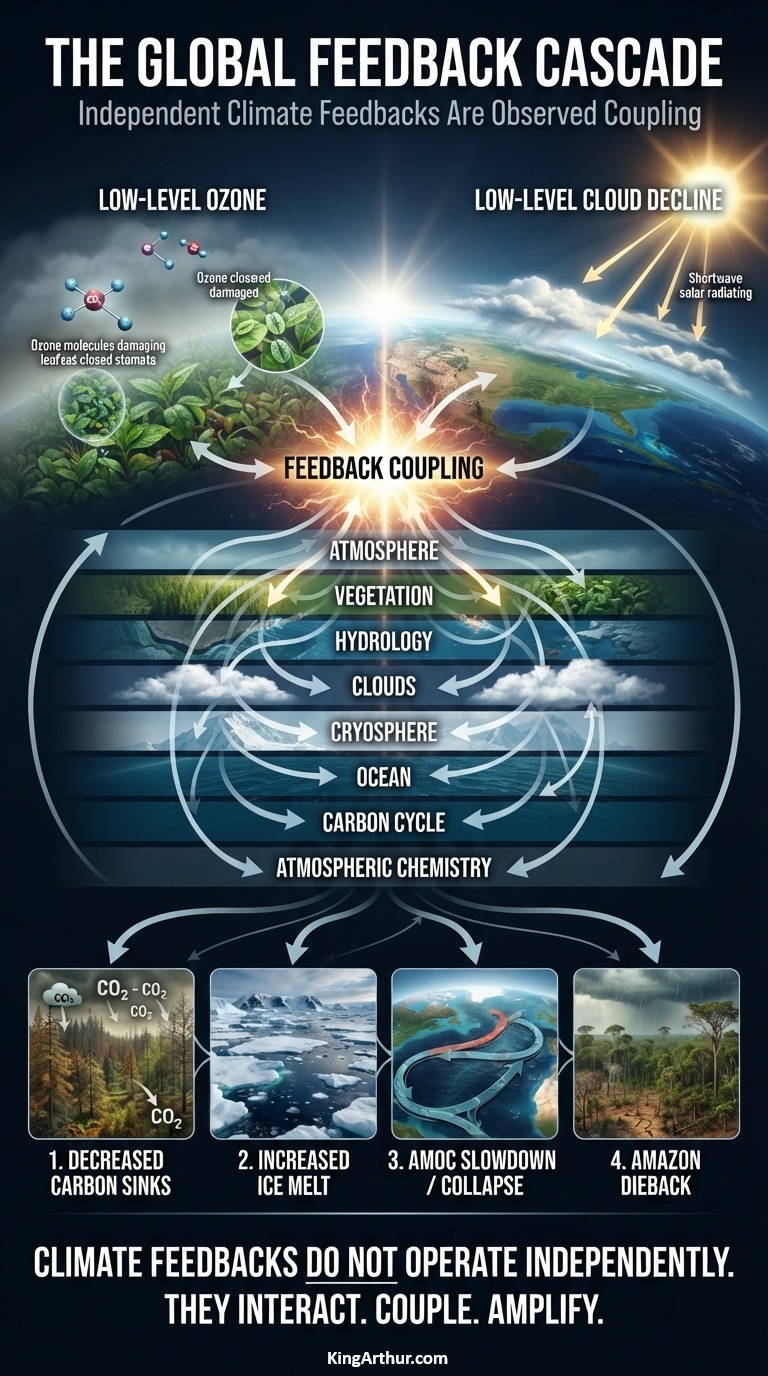
Tipping points can fundamentally change how the climate system responds by coupling positive and negative feedbacks across multiple components of the Earth system.
The overriding concern for humanity should not simply be the average surface temperature. It should be how the millions of interconnected feedbacks within the climate system will respond.
We have a pretty good understanding of some of these feedbacks. For many others, we don’t.
A landmark multi-institution study published in Environmental Research Letters established that warming-induced natural emissions from permafrost, wetlands, freshwaters, and wildfires are accelerating so fast that they will likely amplify human-caused global warming by 20% to 30% this century.
Climate feedbacks are combining—and accelerating climate change.
For a closer look at the feedbacks behind climate acceleration, see: Feedback Feedback
An example of what appears to be a simple feedback—the albedo effect—can actually be much more complicated and concerning.
The physics of albedo is straightforward: bright, reflective surfaces send a portion of incoming solar energy back into space, while darker surfaces absorb more of it. Less ice means more exposed dark surfaces, more absorbed energy, and therefore more warming.
But the system quickly becomes much more complicated.
How does changing albedo affect cloud formation, particularly over the tropics? And what happens to the climate if those clouds increase—or decrease?
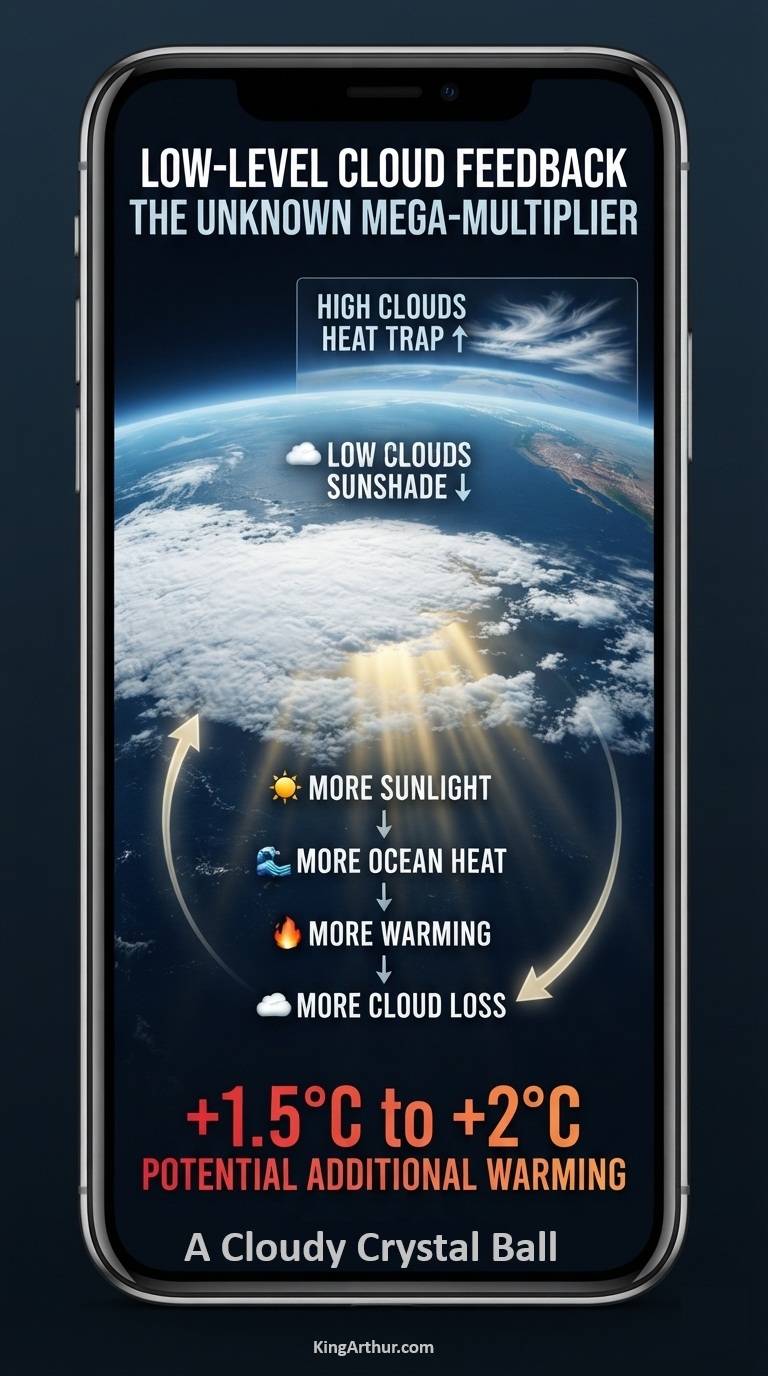
Low clouds are especially important because they can reflect substantial amounts of incoming sunlight back into space. If tropical low clouds diminish, the ocean could absorb significantly more solar energy, accelerating warming.
This is where the bleeding edge of climate science begins.
Clouds are arguably the largest remaining uncertainty in our understanding of climate sensitivity. Low-level clouds can reflect incoming solar radiation back into space, producing a cooling effect. In contrast, high, thin clouds can transmit much of the incoming sunlight while trapping outgoing infrared radiation, producing a warming effect.
Which effect dominates—and how that balance changes as the planet warms—is one of the great unanswered questions in climate science.
Leading research suggests that the loss of low-level cloud albedo could contribute an additional 1.5°C to 2°C of global warming.
That would not be a minor correction to the climate trajectory.
It may be The Mega-Multiplier. Under a tipping point scenario in which low-level clouds substantially break up, the resulting loss of their cooling effect could produce a catastrophic and potentially abrupt warming spike.
See: Low-Level Cloud Feedback: The Mega-Multiplier — An Additional 1.5°C to 2°C
And low-level cloud feedback would not operate in isolation. As multiple climate feedbacks become activated and increasingly interact, our expectation is that the climate system could eventually approach a new equilibrium around +4°C above the preindustrial baseline, perhaps this century.
The important point is that climate change is not a simple linear equation.
It is a massively interconnected system in which a change in one component can alter another, which then feeds back into the first.
Ice affects albedo. Albedo affects heating. Heating affects clouds. Clouds affect radiation. Radiation affects ocean temperatures. Ocean temperatures affect evaporation and atmospheric moisture. And the cycle continues.
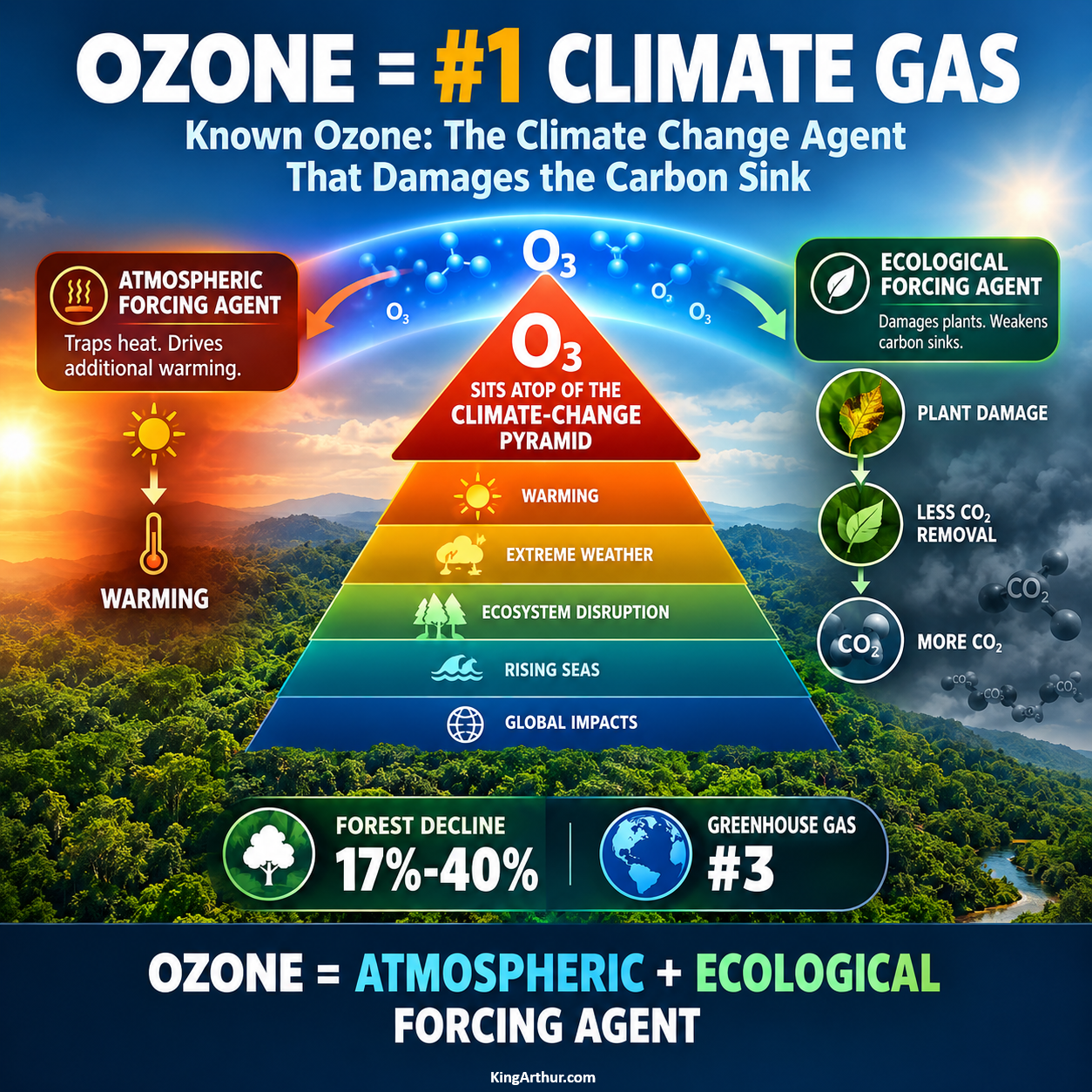
Ozone is usually overlooked as a greenhouse gas.
Actually, tropospheric ozone sits atop the climate-change pyramid.
Why? Because ozone is both an:
ATMOSPHERIC FORCING AGENT
→ traps heat
→ drives additional warming
and an:
ECOLOGICAL FORCING AGENT
→ damages plants
→ reduces photosynthesis
→ weakens carbon sinks
→ leaves more CO₂ in the atmosphere
→ drives additional warming
FOREST DECLINE: 17%–40%
GREENHOUSE GAS: #3
Ozone doesn’t just warm the atmosphere.
It can damage the biological systems that remove CO₂ from it.
OZONE = ATMOSPHERIC + ECOLOGICAL FORCING AGENT
That makes ozone one of the most important—and overlooked—climate-change agents.
Read Known Ozone: The Climate Change Agent That Damages the Carbon Sink.
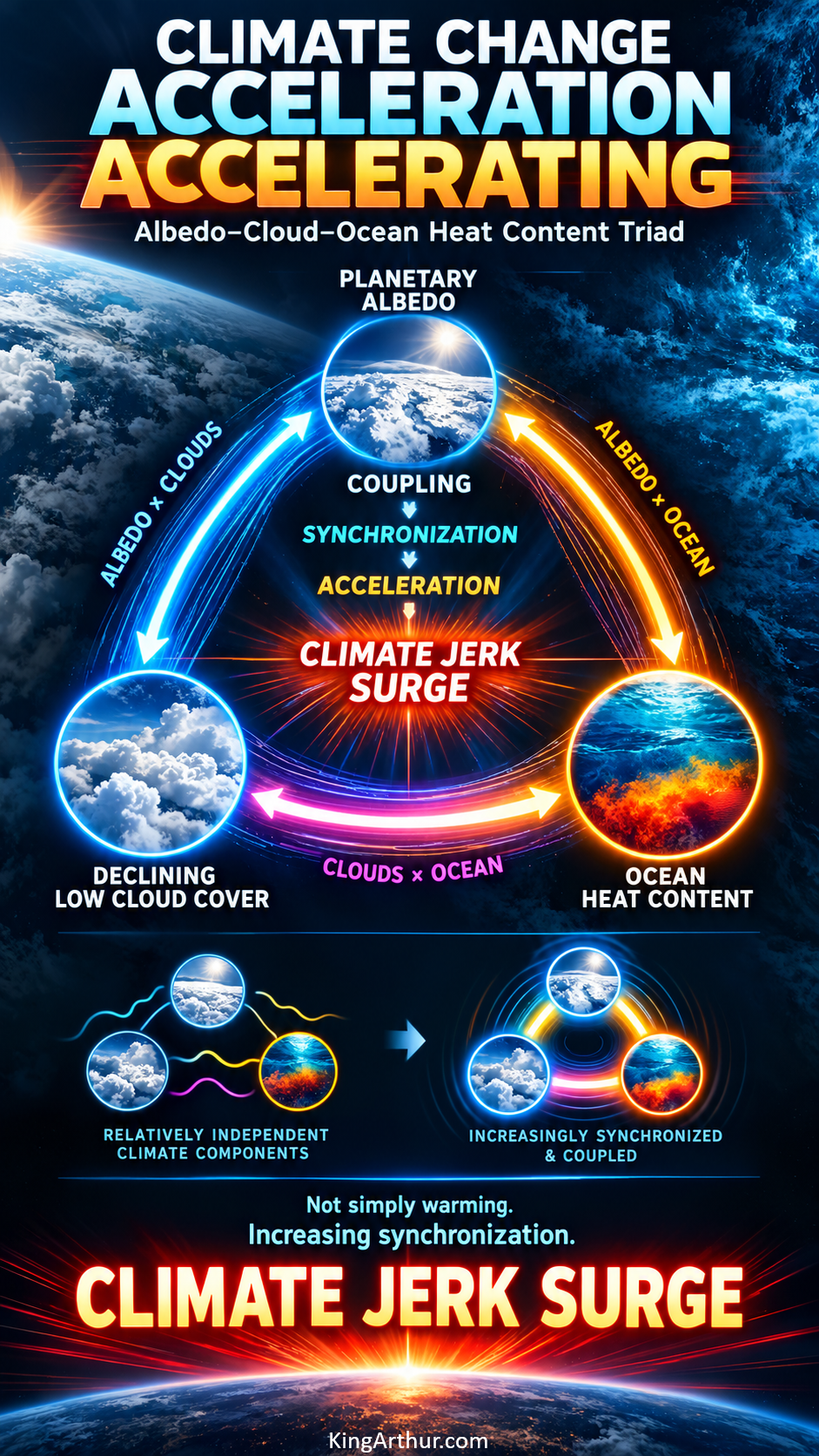
A 2026 study found that the recent change in climate-system dynamics is being expressed not simply as continued warming, but as increasing synchronization among multiple radiative and thermal feedback pathways.
Beginning most notably around 2022, an increasingly interconnected pattern emerges among six major climate-system variables: cloud cover, planetary albedo, sea ice extent, atmospheric water vapor, ocean heat content, and surface temperature.
The three largest interaction paths form a closely connected Albedo–Cloud–Ocean Heat Content triad:
Reduced aerosols + cloud variability + ocean warming + internal climate variability
→ low-cloud changes → planetary albedo decline → increased absorbed solar radiation → increased planetary heat uptake
The significance is not that a single feedback has suddenly appeared. These feedbacks are already well established. The emerging signal is that multiple feedback pathways are becoming increasingly coupled—and that the rate of this coupling is itself accelerating.
That accelerating coupling is the Climate Jerk Surge.
Climate Jerk Surge: Albedo–Cloud–Ocean Heat Content Triad
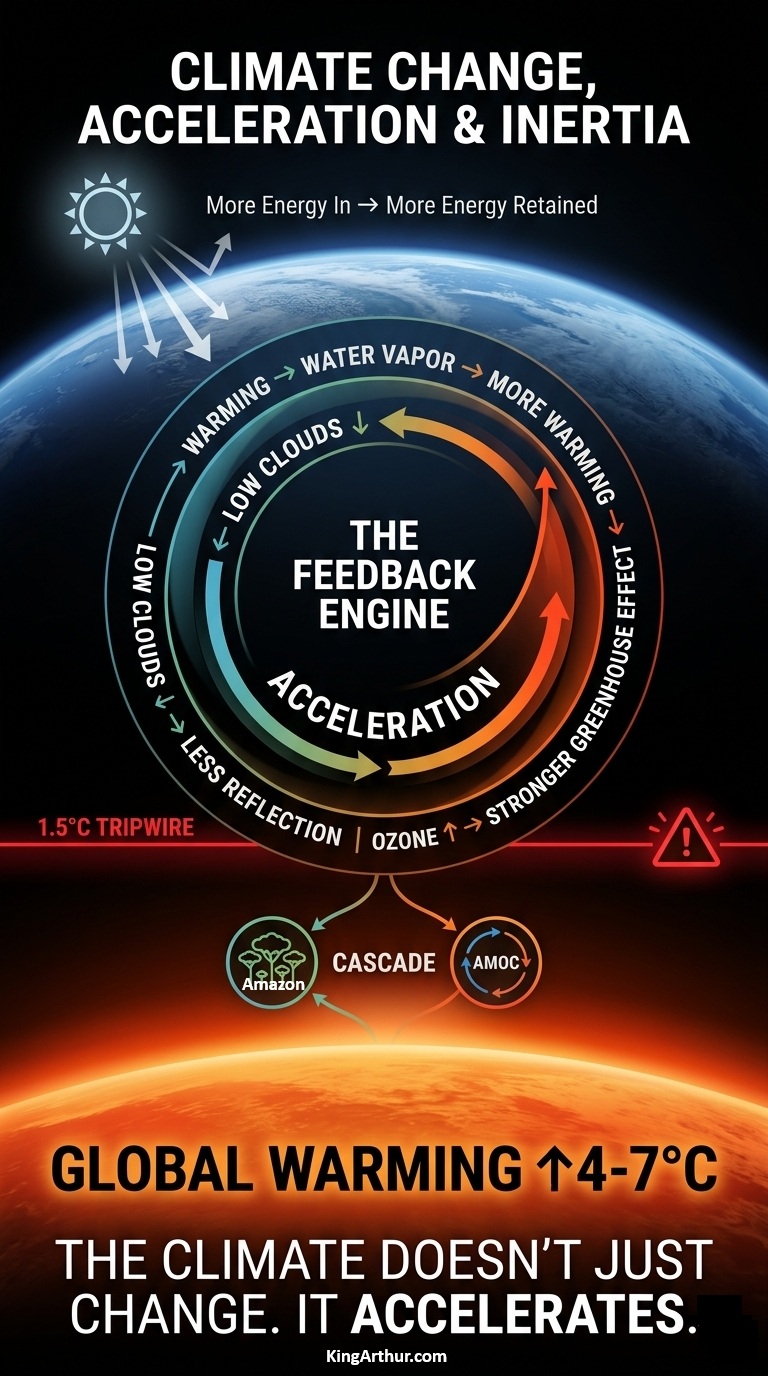
Climate change is not simply a matter of temperatures gradually rising.
It is an energy problem.
More energy is entering the climate system than leaving it—and most of that excess energy is being absorbed by the oceans.
That creates INERTIA.
But something else is happening.
As warming crosses critical thresholds, self-reinforcing feedbacks become increasingly active:
🔥 Warming → 💧 More Water Vapor → 🔥 More Warming ↺
☁️ Fewer Low Clouds → ☀️ More Energy Absorbed → 🔥 More Warming
🟠 More Tropospheric Ozone → 🌎 Stronger Greenhouse Effect → Faster Carbon-Cycle Response
These feedbacks don’t operate independently. They interact, couple, and reinforce one another.
That changes the mathematics of climate change.
The 1.5°C threshold is not simply a number on a thermometer. It is a tripwire for a climate system increasingly dominated by feedbacks and nonlinear responses.
The result is a new climate reality:
ACCELERATION + COUPLING + INERTIA
The question is no longer simply how much greenhouse gas humans emit. It is how quickly the climate system begins amplifying the warming we have already created.
Having tripped the 1.5°C tripwire, both the acceleration and inertia of climate change have created a new reality. The most likely scenario is global warming of approximately 4°C this century. If humanity does not reach net zero by 2035, approximately 4–7°C of warming by 2150 becomes the most likely scenario.
The Times They Are a-Changing: Climate Change, Acceleration, and Inertia 4–7°C
What matters most for human habitability is not simply the temperature we measure at the surface. It is the amount of energy remaining in the climate system and how that energy is redistributed.
If the temperature “only” rises 2°C while energy accumulation continues, the surface temperature becomes much less informative by itself. What becomes increasingly urgent is how that additional energy—measured in joules—is redistributed to your location.
The most obvious example is the supercharged water cycle.
For every 1°C increase in temperature, air can hold approximately 7% more water vapor. The atmosphere doesn’t care about the global average temperature. Many places can experience temperatures 10°C above their local average. That creates the potential for dramatically greater atmospheric moisture and, consequently, more intense rain, hail, and snow events when that moisture is released.
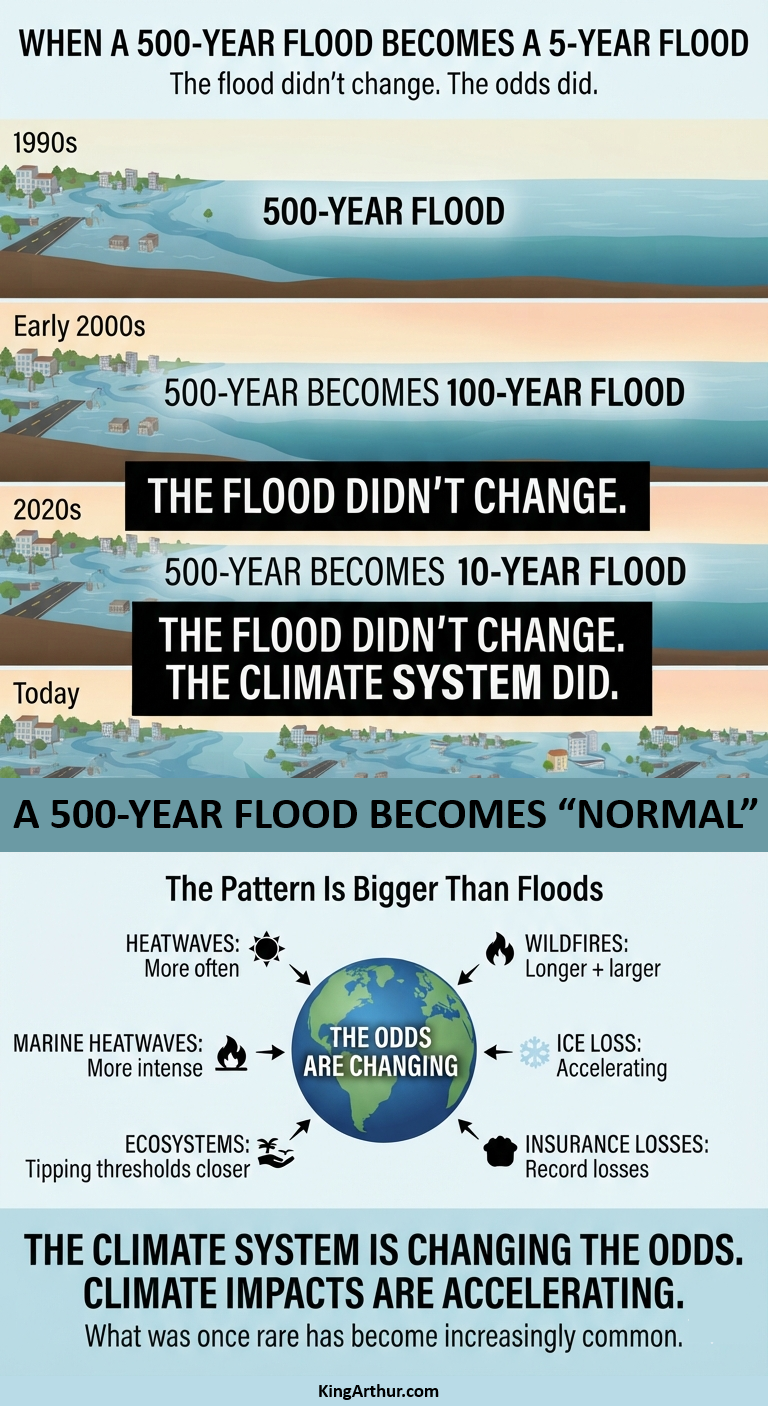
And indeed, we are seeing extreme flood events occurring with increasing frequency, including events described as having return periods of hundreds of years. Hail has also become one of the largest sources of insurance claims affecting homes, automobiles, and agriculture.
While the long-term equilibrium matters, there is a much more immediate question.
What happens to you over the next five years?
We are already seeing rainfall becoming more intense and, in many places, more destructive—violent. A warmer atmosphere can hold more water vapor, increasing the potential for extreme precipitation. The question isn’t simply how hot the planet might become over the next 50 years.
The more immediate question is:
What is the violent rain going to do to your home, your community, your infrastructure, your insurance—and you—over the next five years?
That is where climate change stops being a distant projection and starts becoming a personal reality.
Welcome to the future. Climate change is accelerating—and the acceleration itself is accelerating.
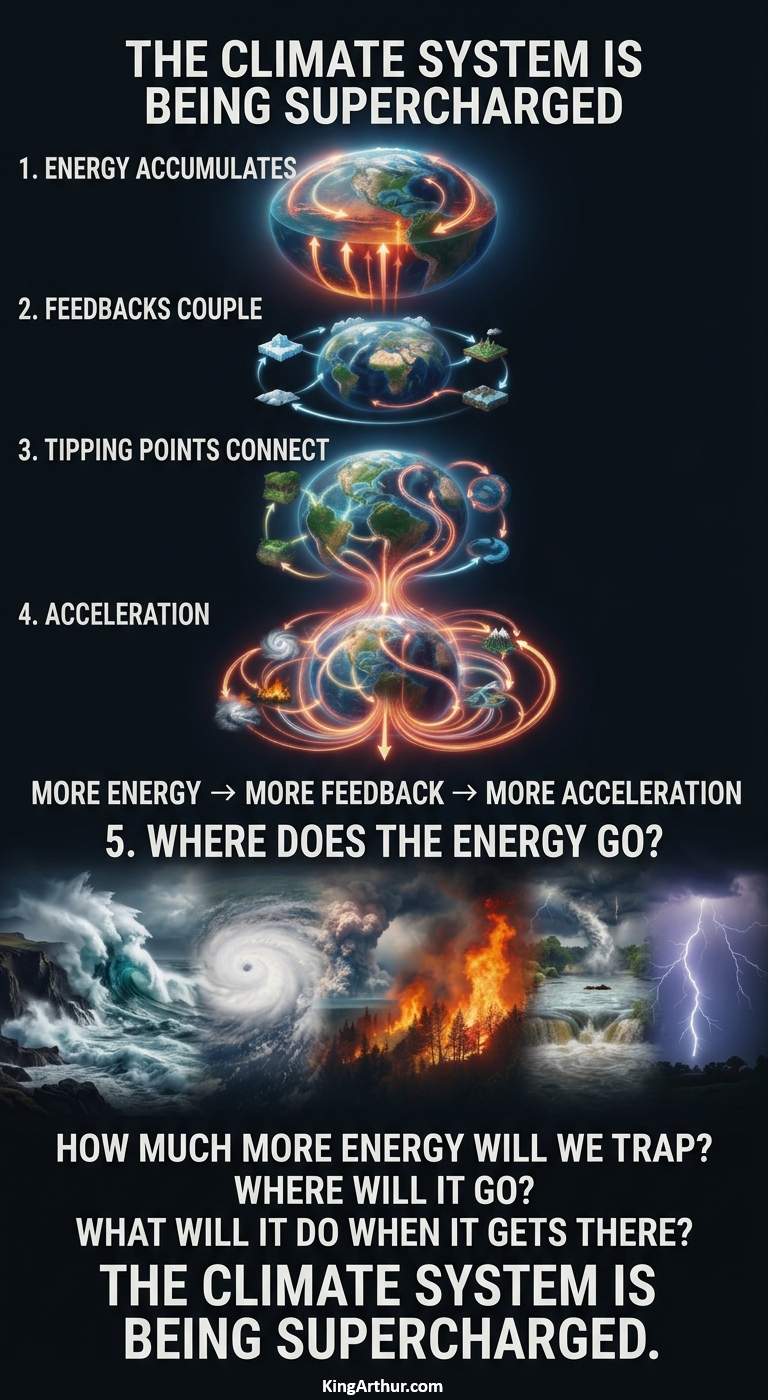
As tipping points become increasingly coupled and reinforce one another, the amount of energy moving through the climate system is accelerating—and the rate of acceleration itself is increasing.
At this point, the question is no longer simply, “How many degrees warmer will the planet become?”
The more important questions are: How much additional energy are we going to continue trapping? Where is all that energy going? And what will it do when it gets there?
We are already beginning to see the answers—in floods, heatwaves, flash droughts, wildfires, hailstorms, extreme precipitation, and increasingly volatile swings between opposing extremes.
These are not separate problems.
They are different manifestations of an increasingly energized climate system.
The planet does not experience climate change as a number on a thermometer.
It experiences it as energy moving through the system.
And that energy has to go somewhere.
The climate system is being supercharged.
The question is no longer whether that energy will affect us.
The question is where it will hit—and what it will do when it gets there.
Q: I don’t quite understand part of the paper. What does a “35 degree increase” in temperature mean? Where I live, a summer day can be around 30 degrees Celsius. Would this mean a summer day at around 65 degrees? (30+35=65). Wouldn’t that be lethal?
A: Good question. The answer is yes—and no. That’s actually part of the point of the paper.
A 65°C temperature at your location would obviously be lethal. But the 35°C figure is an energy-equivalent thought experiment, not a prediction that your local summer temperature would simply go from 30°C to 65°C.
The bigger problem with using average temperatures is just that—they are averages. An average of 65°C across a large area could mean one location is 30°C, another is 40°C, and another is far beyond either. The distribution of that energy matters far more to human habitability than the average itself.
And that’s where I don’t expect all of the already stored energy to behave “on average.” I don’t know exactly how that energy will hit you. It could manifest as violent rainfall, hail, heatwaves, wildfires, flash droughts, or any number of other energy transfers we haven’t fully anticipated.
But as long as that energy remains trapped in the Earth system, it doesn’t simply disappear. It continues moving through the system and interacting with everything else. You cannot create or destroy energy—you can only experience its feedbacks.
And yes, we would have to adapt. If conditions outside became routinely lethal, people might increasingly move underground or into heavily climate-controlled environments to survive.
In any event, an average of 65°C would be pretty close to hell—whether you’re experiencing it alive or studying it after the fact. 😏
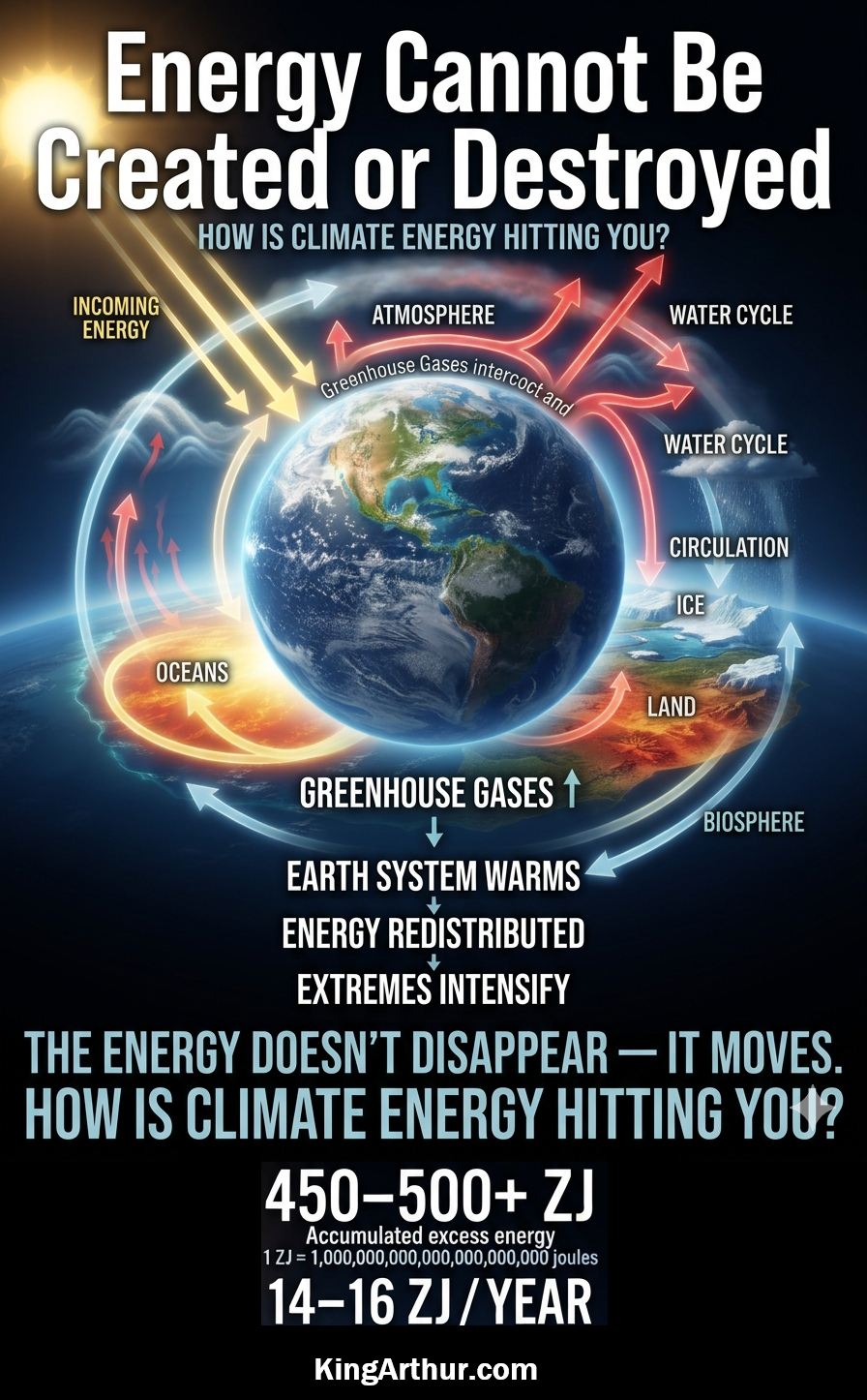
The First Law of Thermodynamics gives us the starting point:
Energy cannot be created or destroyed.
But it can be transformed.
It can be transported.
It can be stored.
And it can be released.
The climate system is doing all four.
The question is no longer whether the energy exists.
The question is: How is that energy hitting you?
Backyard Experiments
How Is the Climate Energy Hitting You? is a collection of backyard experiments conducted in conjunction with you—the reader. The goal is simple: to look at how the increased energy in the climate system is showing up in our everyday lives.
Is it becoming more extreme, more frequent, and more persistent? Are the changes becoming stranger—or even disturbing?
See: How Is Climate Energy Hitting You? The Backyard Experiments
The first tipping point season was 2023–2024, when global temperatures exceeded +1.5°C for an extended period. During that season, nine tipping points became observable. The last 30 years have borne witness to three of the most powerful “Super El Niño” events in recorded history, alongside an exceptionally strong event currently unfolding in 2026. The extreme heat released by this “supersized” El Niño is expected to temporarily push the entire planet above the 1.5°C global warming limit by late 2026 and into 2027.
Read the full hunting manual: This is Tipping Point Season
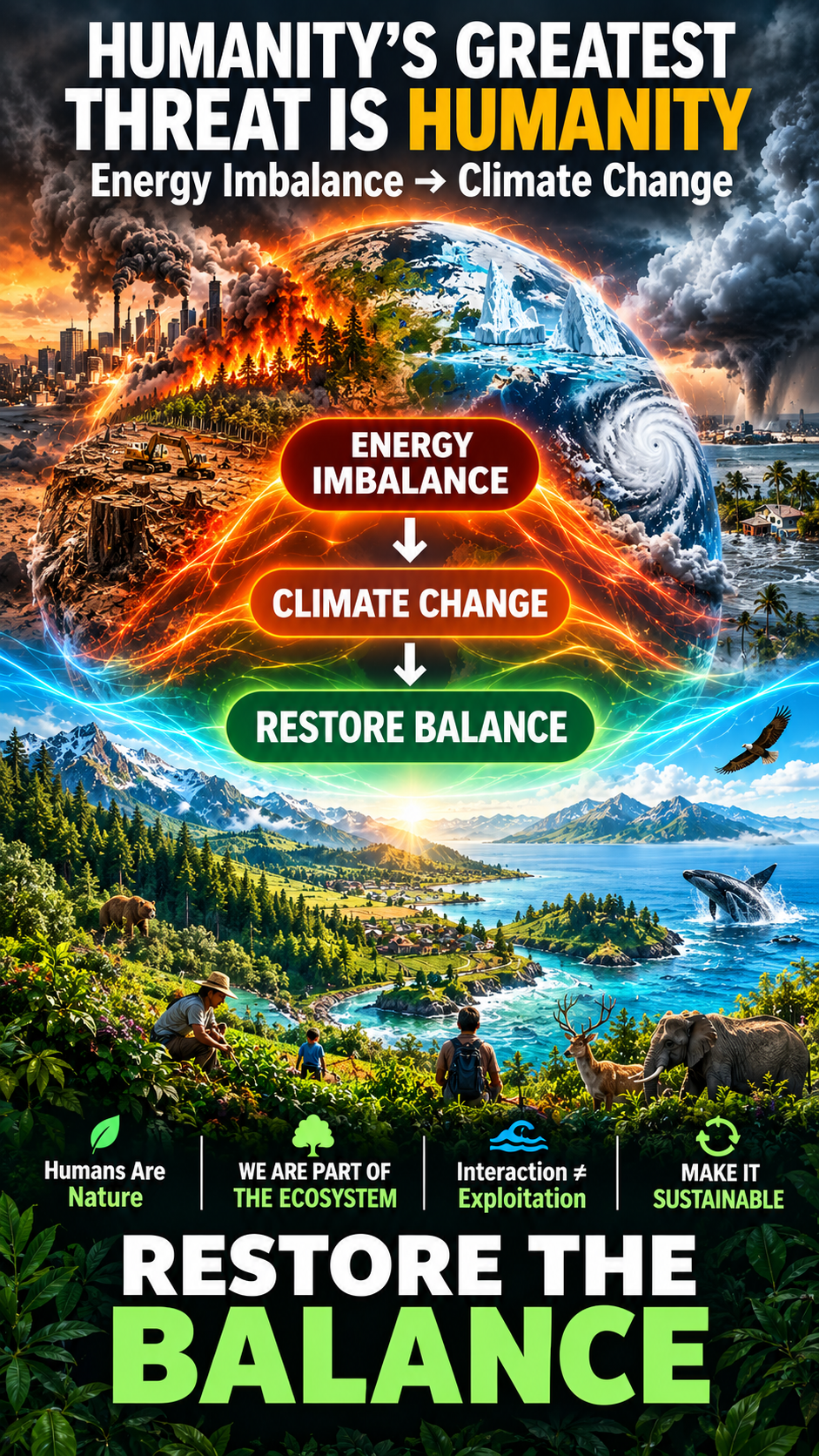
The only effective way to stop the acceleration of climate change is through the reduction of fossil-fuel combustion.
However, the most likely way of reversing the trajectory of climate change is through people using AI to develop previously unthought-of methods and technologies that can fundamentally change how we produce, consume, and manage resources—and potentially remove greenhouse gases from the atmosphere.
Read the full report: Why Do Scientists Use AI? From Computational Efficiency to Climate Innovation
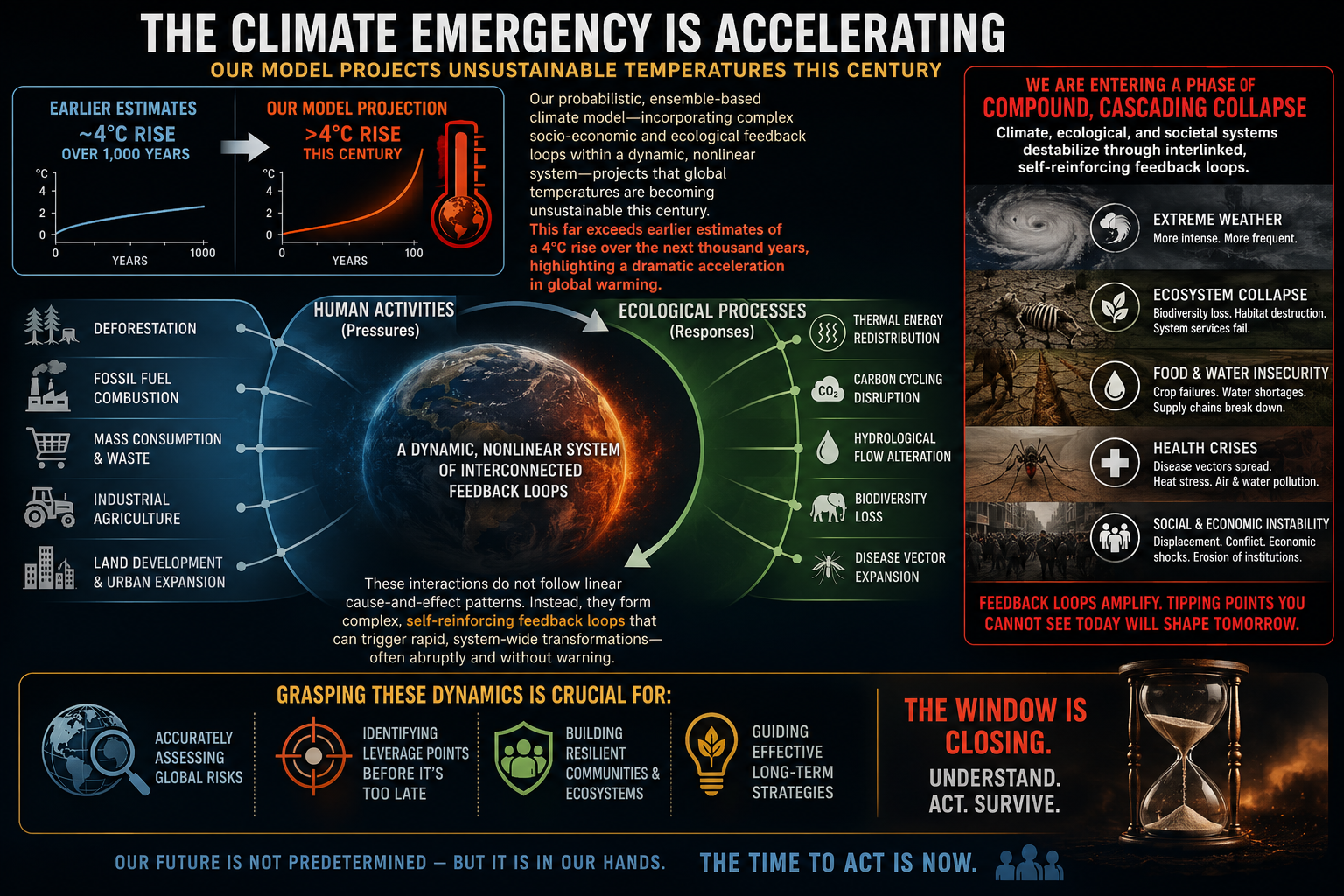
* Our probabilistic, ensemble-based climate model — which incorporates complex socio-economic and ecological feedback loops within a dynamic, nonlinear system — projects that global temperatures are becoming unsustainable this century. This far exceeds earlier estimates of a 4°C rise over the next thousand years, highlighting a dramatic acceleration in global warming. We are now entering a phase of compound, cascading collapse, where climate, ecological, and societal systems destabilize through interlinked, self-reinforcing feedback loops.
We examine how human activities — such as deforestation, fossil fuel combustion, mass consumption, industrial agriculture, and land development — interact with ecological processes like thermal energy redistribution, carbon cycling, hydrological flow, biodiversity loss, and the spread of disease vectors. These interactions do not follow linear cause-and-effect patterns. Instead, they form complex, self-reinforcing feedback loops that can trigger rapid, system-wide transformations — often abruptly and without warning. Grasping these dynamics is crucial for accurately assessing global risks and developing effective strategies for long-term survival.