by Daniel Brouse and Sidd Mukherjee
2026
Atmospheric rivers are among the most powerful weather systems on Earth. These long, narrow corridors of concentrated water vapor transport immense quantities of moisture through the atmosphere, functioning as airborne rivers that redistribute water across the planet. Once viewed primarily as pathways carrying tropical moisture toward higher latitudes, atmospheric rivers are evolving into a global phenomenon driven by a warming climate. Rising ocean temperatures, increased evaporation, melting ice, thawing permafrost, and moisture released from increasingly warm land surfaces are adding new sources of atmospheric water vapor. As the atmosphere holds more energy and moisture, atmospheric rivers are becoming broader, stronger, and more persistent—transforming from regional precipitation events into major components of a changing global climate system.
At their peak, atmospheric rivers can carry as much water through the sky as the Amazon River carries on land. When they make landfall, they release torrential rainfall, hurricane-force winds, mountain snowfall, flooding, and landslides.
Historically, atmospheric rivers have been an essential part of Earth’s hydrologic cycle, replenishing reservoirs and snowpacks. Today, however, human-induced climate change is fundamentally changing their behavior. A warmer atmosphere, warmer oceans, and rapidly changing atmospheric circulation patterns are producing stronger, wetter, slower-moving, and increasingly destructive atmospheric rivers.
Rather than isolated weather events, atmospheric rivers are becoming part of a larger transformation of Earth’s climate system.
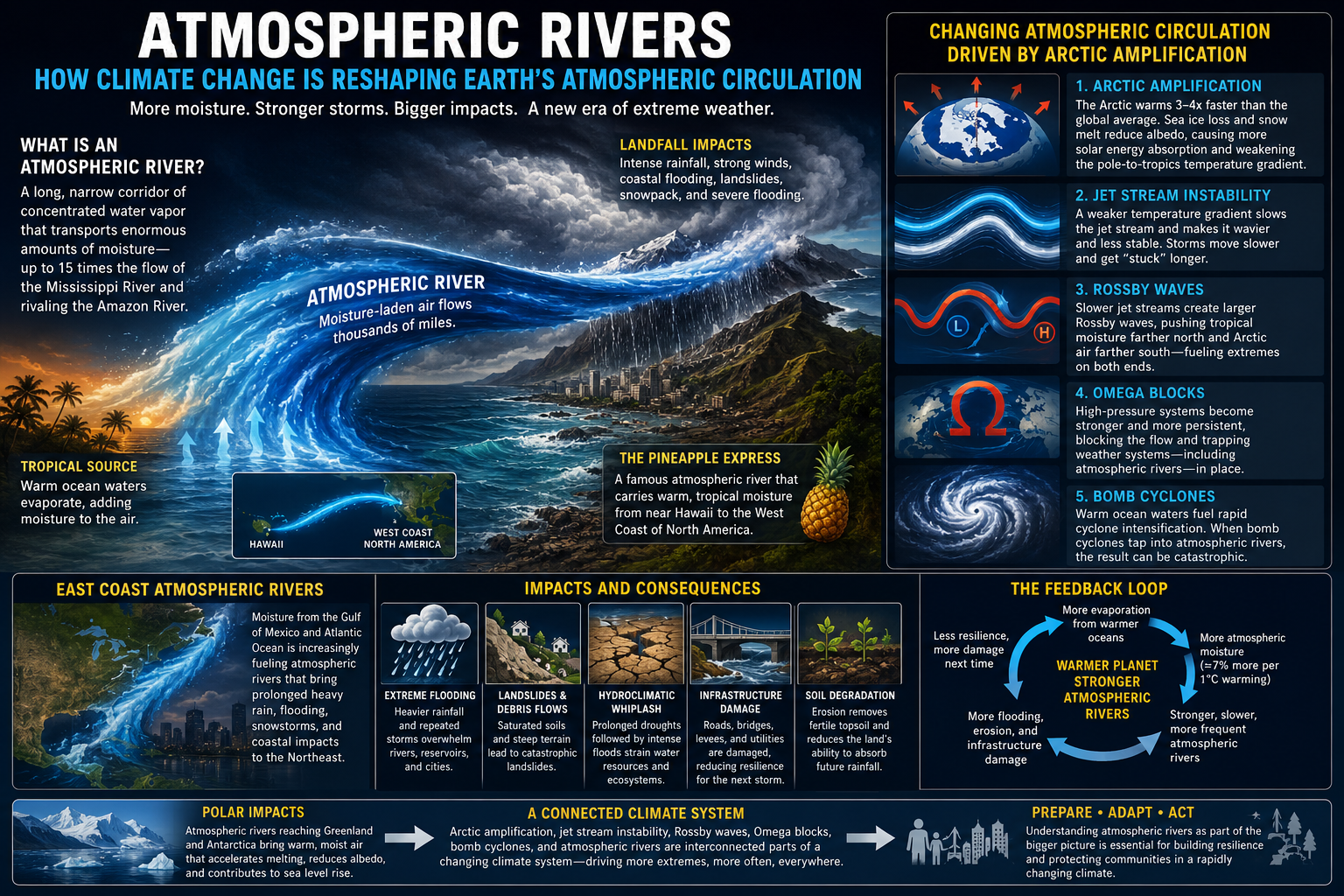
Atmospheric rivers (ARs) are narrow bands of exceptionally moist air that transport water vapor thousands of miles through the atmosphere. Although they occupy only a small fraction of the atmosphere, they account for nearly 90% of the poleward transport of water vapor outside the tropics.
When these moisture streams encounter mountains or colder air masses, the water vapor condenses into intense rain or snow.
The strongest atmospheric rivers can transport more than fifteen times the average flow of the Mississippi River and rival the discharge of the Amazon River.
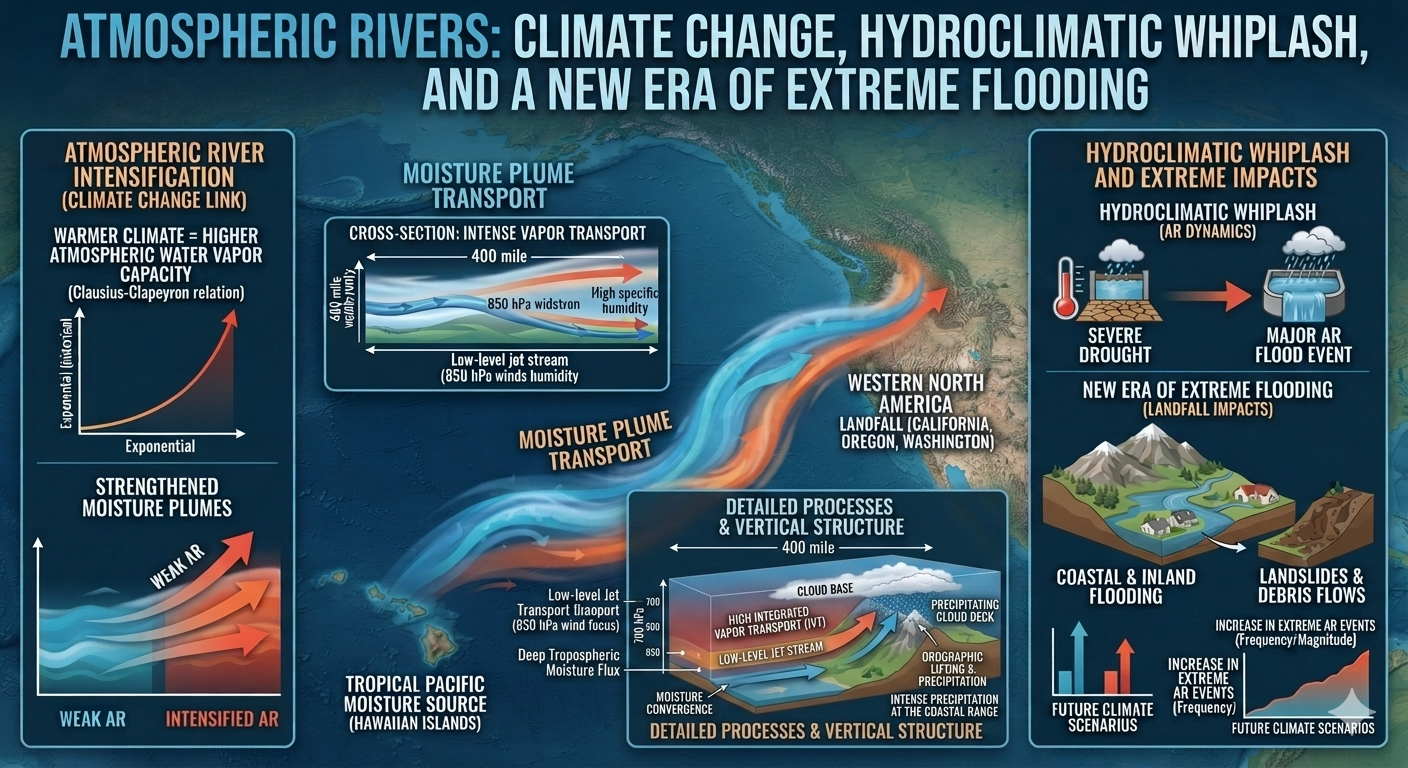
The best-known atmospheric river is the Pineapple Express, which transports warm tropical moisture from near Hawaii to western North America.
These storms have always occurred, but today they are producing more extreme flooding because:
California’s recent years of devastating floods illustrate this transition toward more powerful atmospheric rivers.
According to the Clausius-Clapeyron relationship, every 1°C of warming allows the atmosphere to hold approximately 7% more water vapor.
This additional moisture increases:
Meanwhile, record ocean heat dramatically increases evaporation, providing an ever-growing supply of atmospheric moisture.
The result is an atmosphere capable of producing unprecedented precipitation events.
Atmospheric rivers do not occur independently.
They are guided by Earth’s large-scale atmospheric circulation.
One of the most profound consequences of climate change is Arctic amplification—the Arctic warming roughly three to four times faster than the global average.
As sea ice disappears and snow cover declines, Earth’s reflective surface shrinks. Dark ocean water absorbs more solar energy, accelerating warming and reducing the temperature difference between the Arctic and the tropics.
This weakened temperature gradient fundamentally changes atmospheric circulation.
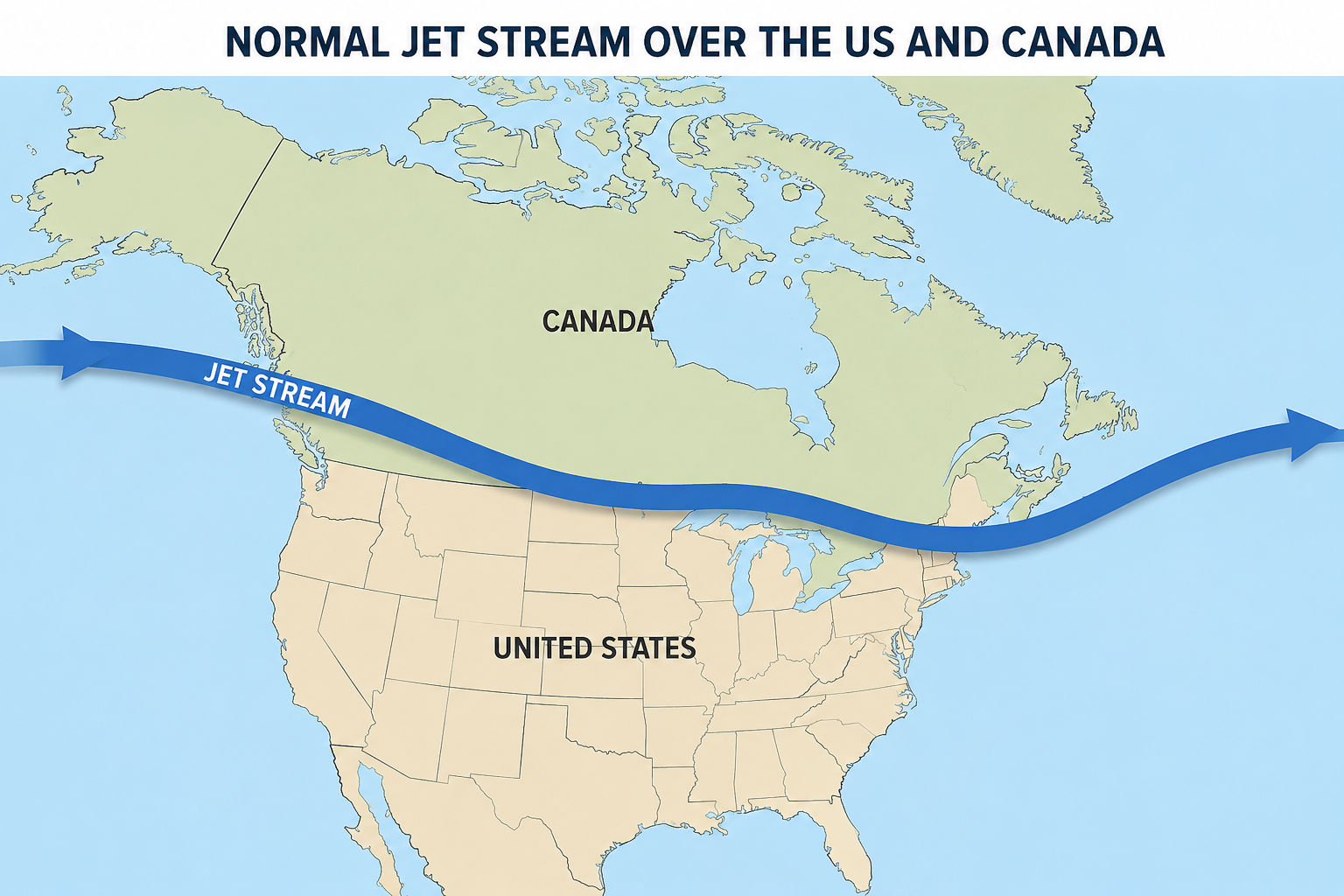
The polar jet stream is powered largely by the temperature contrast between cold Arctic air and warmer subtropical air.
As Arctic amplification weakens this contrast, the jet stream slows and becomes increasingly unstable.
Instead of flowing in relatively smooth west-to-east patterns, the jet stream develops larger north-south waves that linger over regions for extended periods.
A slower jet stream allows weather systems to stall, dramatically increasing the duration of extreme weather.
Atmospheric rivers that once passed in a day may now persist for several days, greatly increasing rainfall totals.
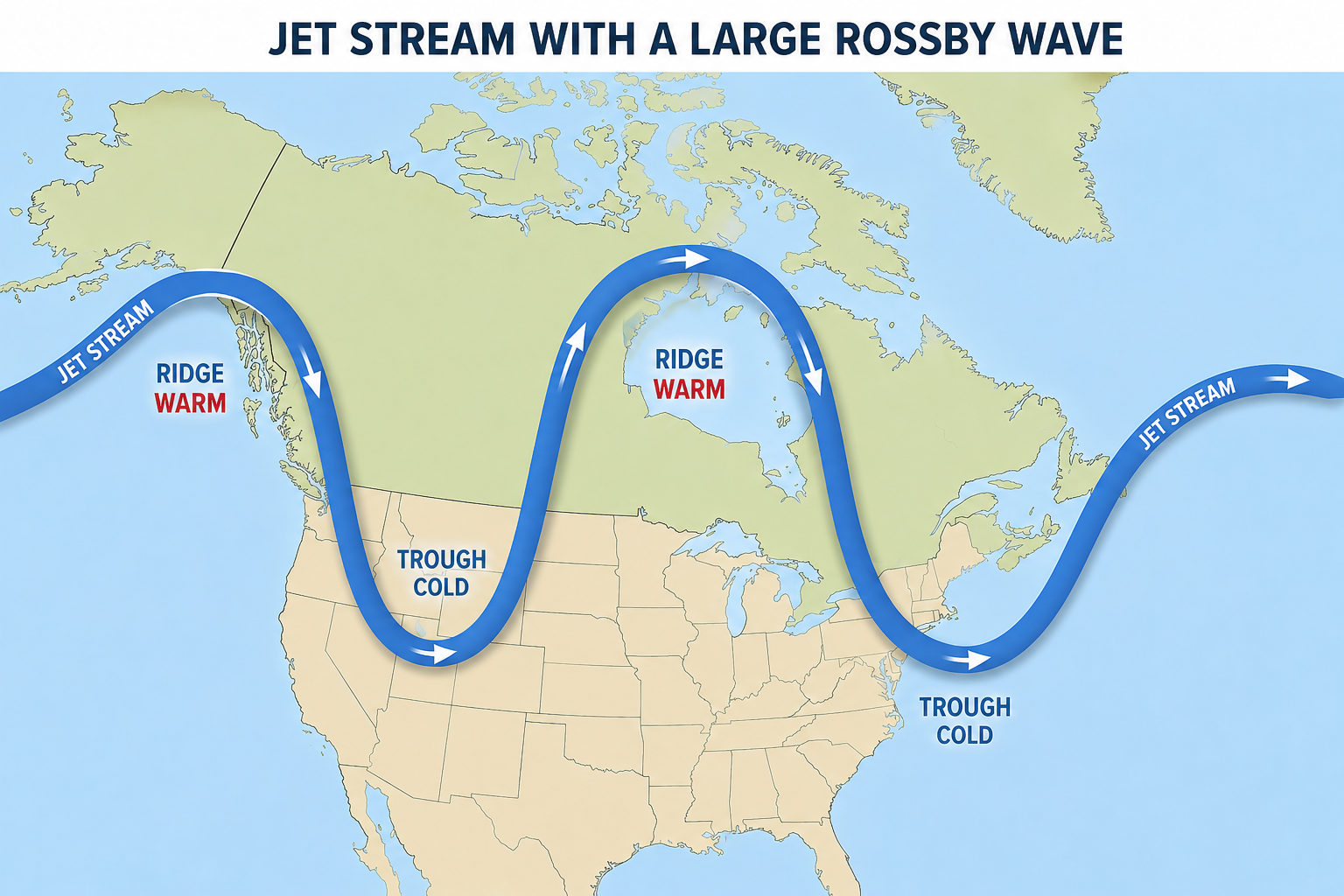
The large undulations in the jet stream are known as Rossby waves.
As the jet stream slows, Rossby waves become larger and more amplified.
These amplified waves transport tropical heat and moisture farther poleward while allowing Arctic air to plunge farther south.
The result is greater weather extremes:
Because atmospheric rivers often travel along these Rossby wave patterns, changes in wave behavior directly influence where flooding occurs and how long storms remain over one location.
Sometimes Rossby waves become so amplified that they form nearly stationary high-pressure systems resembling the Greek letter Ω (Omega).
These Omega blocks can persist for days or even weeks.
An Omega block effectively traps weather systems on either side.
For atmospheric rivers, this can be disastrous.
Instead of moving inland and weakening, repeated moisture streams may be directed into the same region, producing multiple rounds of flooding over already saturated ground.
Many of the catastrophic flood events observed during the past decade have involved stalled atmospheric rivers interacting with blocking patterns.
Atmospheric rivers frequently interact with rapidly strengthening low-pressure systems known as bomb cyclones.
A bomb cyclone develops when atmospheric pressure falls at least 24 millibars within 24 hours.
Warm ocean waters provide enormous amounts of latent heat that fuel explosive cyclone development.
When bomb cyclones intercept atmospheric rivers, the result can include:
These compound events represent one of the most destructive combinations in modern weather.
Atmospheric rivers were once viewed primarily as a West Coast phenomenon.
Recent research, however, has documented increasingly frequent atmospheric rivers affecting the eastern United States.
Moisture drawn northward from the Gulf of Mexico and the Atlantic Ocean now fuels atmospheric rivers that move along the East Coast.
These systems often produce:
The Northeast has experienced a noticeable increase in prolonged heavy-rain events consistent with stronger atmospheric rivers.
One of the most alarming developments is the increasing frequency of atmospheric rivers reaching Greenland and Antarctica.
These storms transport unusually warm, moisture-rich air into polar regions.
Their impacts include:
The resulting loss of reflectivity (albedo) accelerates melting even further.
This creates a powerful positive climate feedback that contributes directly to accelerating sea-level rise.
Atmospheric rivers are becoming central drivers of hydroclimatic whiplash—rapid swings between prolonged drought and extreme flooding.
During drought:
When an atmospheric river arrives, rainfall can no longer soak into the ground efficiently.
Instead, water rapidly becomes runoff, producing flash floods, landslides, debris flows, and catastrophic erosion.
Climate change is increasing both extremes simultaneously.
Repeated atmospheric river events are creating an emerging infrastructure feedback.
Floodwaters damage:
As infrastructure weakens, future storms cause even greater damage.
Meanwhile, repeated flooding strips away fertile topsoil, destabilizes slopes, weakens forests, and reduces agricultural productivity.
Healthy soils normally absorb rainfall like a sponge.
Degraded soils cannot.
This increases runoff, erosion, and future flooding, creating another reinforcing climate feedback.
Each component reinforces the others.
Atmospheric rivers illustrate that climate change is not simply making storms stronger — it is reorganizing Earth's atmospheric circulation. Rather than isolated weather events, atmospheric rivers are becoming one element of an interconnected system of nonlinear climate feedbacks.
Atmospheric rivers have always been an essential part of Earth’s climate system, but they are entering a new era. Human-induced warming is fundamentally altering the atmosphere’s ability to transport moisture while simultaneously reshaping the large-scale circulation patterns that govern where storms form, how long they persist, and how much destruction they produce.
Arctic amplification, jet stream instability, Rossby wave amplification, Omega blocking patterns, bomb cyclones, and expanding East Coast atmospheric rivers are not isolated phenomena. They are interconnected expressions of a climate system being pushed beyond its historical equilibrium.
As global temperatures continue to rise and the oceans accumulate additional heat, atmospheric rivers are expected to become more frequent, more intense, and more geographically widespread. Their growing role in hydroclimatic whiplash, polar ice-sheet melting, infrastructure failure, and cascading climate feedbacks makes them one of the defining hazards of the twenty-first century.
Understanding atmospheric rivers as part of this larger network of interacting climate processes is essential for improving forecasts, strengthening infrastructure, and preparing societies for a future in which extreme precipitation events become increasingly common.
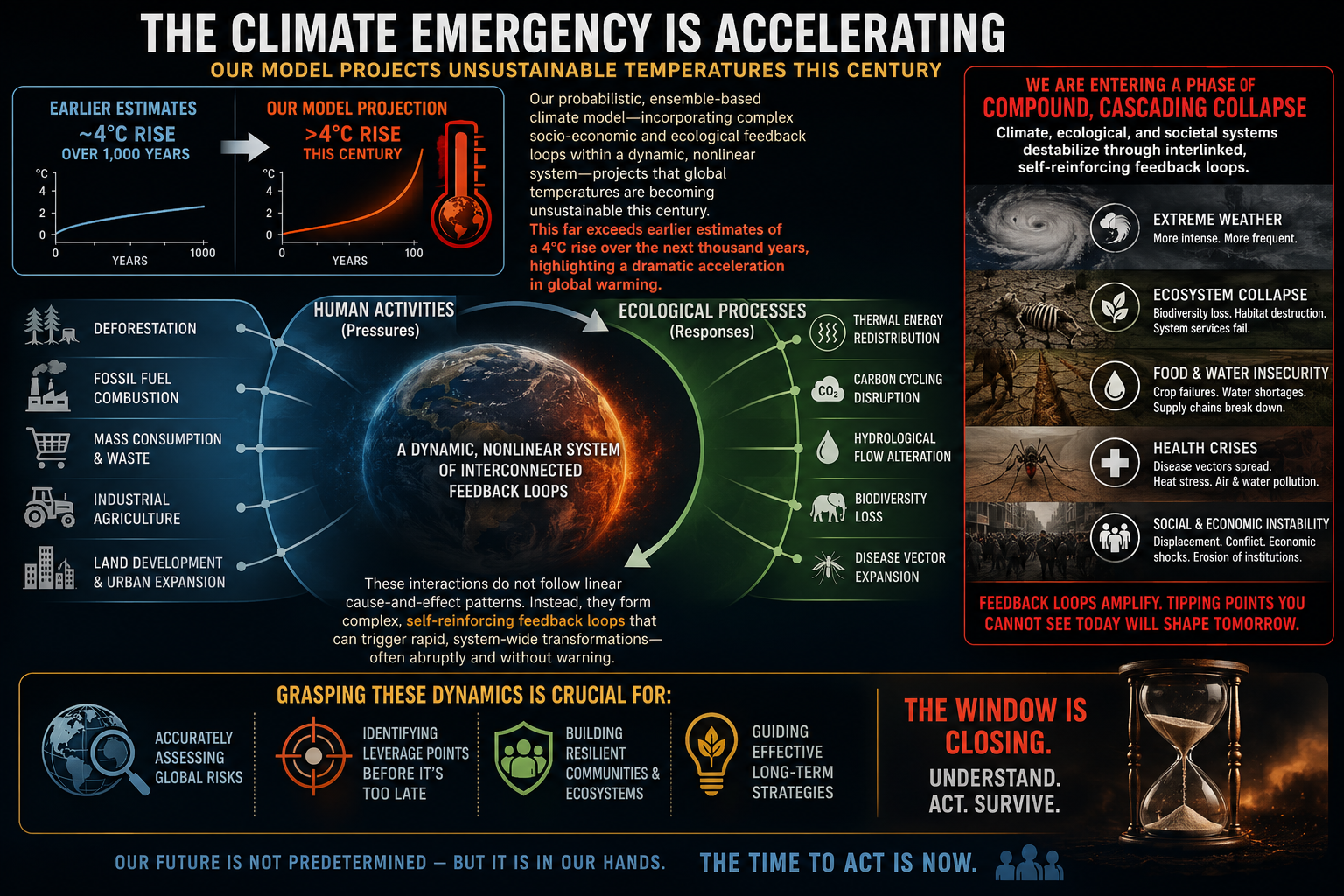
* Our probabilistic, ensemble-based climate model — which incorporates complex socio-economic and ecological feedback loops within a dynamic, nonlinear system — projects that global temperatures are becoming unsustainable this century. This far exceeds earlier estimates of a 4°C rise over the next thousand years, highlighting a dramatic acceleration in global warming. We are now entering a phase of compound, cascading collapse, where climate, ecological, and societal systems destabilize through interlinked, self-reinforcing feedback loops.
We examine how human activities — such as deforestation, fossil fuel combustion, mass consumption, industrial agriculture, and land development — interact with ecological processes like thermal energy redistribution, carbon cycling, hydrological flow, biodiversity loss, and the spread of disease vectors. These interactions do not follow linear cause-and-effect patterns. Instead, they form complex, self-reinforcing feedback loops that can trigger rapid, system-wide transformations — often abruptly and without warning. Grasping these dynamics is crucial for accurately assessing global risks and developing effective strategies for long-term survival.
Feedback Loops →
Tipping Points →
Acceleration →
Domino Effect
Feedback loops amplify climate change and can push interconnected Earth systems past critical tipping points. As tipping points are crossed, they can trigger additional feedback loops and destabilize other climate systems. This cascading "Domino Effect" compresses timescales, accelerates change, and increases the risk of rapid, nonlinear climate transformations.
Bottom line: The question is no longer how warm the planet becomes, but how life on Earth can endure when change outpaces our ability to adapt.
We cannot control the laws of physics, but we can control our pollution. The most effective action is to stop burning fossil fuels.