by Daniel Brouse
August 6, 2025
Over the past several years, extreme air pollution events have become common across the United States and beyond. If you’ve been noticing hazy skies, itchy eyes, or difficulty breathing, you’re not alone--and you’re not imagining things. With increasingly frequent wildfires, industrial emissions, and fossil fuel combustion, the air we breathe is becoming more dangerous by the day.
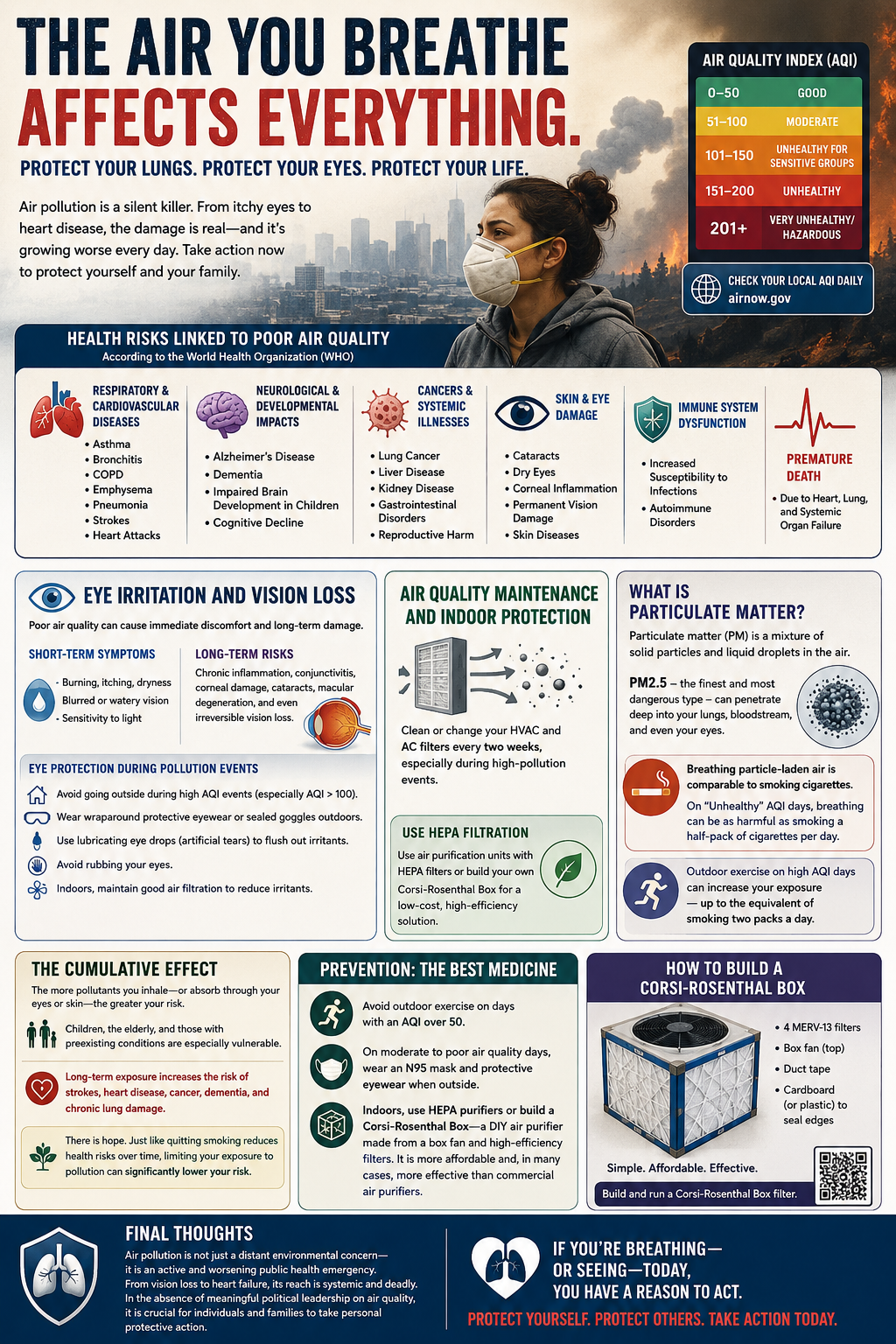
In these conditions, checking your home-s air purification systems is not just advisable--it-s essential. The list of diseases and health disorders linked to poor air quality is long and alarming. According to the World Health Organization, the following have all been directly associated with exposure to airborne pollutants:
Respiratory and cardiovascular diseases: asthma, bronchitis, COPD, emphysema, pneumonia, strokes, and heart attacks
Neurological and developmental impacts: Alzheimer’s disease, dementia, impaired brain development in children, cognitive decline
Cancers and systemic illnesses: lung cancer, liver disease, kidney disease, gastrointestinal disorders, and reproductive harm
Skin and eye damage: cataracts, dry eyes, corneal inflammation, permanent vision damage, and various skin diseases
Immune system dysfunction: increased susceptibility to infections and autoimmune disorders
Premature death: due to heart, lung, and systemic organ failure
One of the most immediate effects of poor air quality is eye irritation. Short-term symptoms include burning, itching, dryness, blurred vision, watery eyes, and sensitivity to light. Long-term exposure to airborne particulates--especially PM2.5 and ozone--has been linked to chronic inflammation of the eyes, conjunctivitis, corneal abrasion, and even degenerative conditions such as cataracts and macular degeneration, which can lead to irreversible vision loss.
Particulate matter and chemical pollutants can accumulate in the tear film and on the surface of the eye, leading to persistent inflammation and oxidative stress. These conditions are especially dangerous for those with preexisting eye issues or contact lens wearers.
To reduce your risk:
Avoid going outside during high AQI events, especially when AQI is above 100.
Wear wraparound protective eyewear or sealed goggles if you’re outdoors for extended periods.
Use lubricating eye drops (artificial tears) to flush out irritants and relieve dryness.
Avoid rubbing your eyes, which can worsen inflammation and increase the risk of infection.
Indoors, maintain good air filtration to reduce indoor pollutants that can irritate your eyes.
To protect your lungs and heart, clean or change your HVAC and air conditioner filters every two weeks, especially during high-pollution events. Better yet, use air purification units with HEPA filters or build your own Corsi-Rosenthal Box for a low-cost, high-efficiency solution.
The U.S. Environmental Protection Agency (EPA) defines particulate matter (PM) as a mixture of solid particles and liquid droplets suspended in the air. These particles range in size from visible dust and soot to microscopic toxins that can only be seen with an electron microscope. PM2.5--the finest and most dangerous type--can penetrate deep into your lungs, bloodstream, and even your eyes.
Breathing particle-laden air is comparable to smoking cigarettes. On days with an Air Quality Index (AQI) in the “Unhealthy” range, simply breathing can be as harmful as smoking a half-pack of cigarettes per day. Engaging in physical activity outdoors can magnify this damage, potentially reaching the equivalent of two packs a day.
The more particulate matter you inhale--or absorb through the eyes or skin--the greater your risk. Vulnerable populations--such as children, the elderly, and those with preexisting conditions--face an even higher danger. Long-term exposure increases the odds of strokes, heart disease, cancer, dementia, and chronic lung damage.
However, there-s hope. Just like quitting smoking reduces health risks over time, limiting your exposure to pollution can significantly lower your chance of developing serious complications.
Here are key steps to take:
Avoid outdoor exercise on days with an AQI over 50.
On moderate to poor air quality days, wear an N95 mask and protective eyewear when outside.
Indoors, use HEPA purifiers or build a Corsi-Rosenthal Box--a DIY air purifier made from a box fan and high-efficiency filters. It is more affordable and, in many cases, more effective than commercial air purifiers.
The Corsi-Rosenthal Box is an innovative, community-designed air filter that uses MERV-13 filters arranged in a cube with a box fan mounted on top. It-s a highly effective and inexpensive way to reduce indoor particle pollution. You can build one at home for under $100 with simple materials available at most hardware stores.
Build and run a Corsi-Rosenthal Box filter.
Final Thoughts
Air pollution is not just a distant environmental concern--it is an active and worsening public health emergency. From vision loss to heart failure, its reach is systemic and deadly. In the absence of meaningful political leadership on air quality, it is crucial for individuals and families to take personal protective action.
If you’re breathing--or seeing--today, you have a reason to act.
What Can I Do?
There are numerous actions you can take to contribute to saving the planet. Each person bears the responsibility to minimize pollution, discontinue the use of fossil fuels, reduce consumption, and foster a culture of love and care. The Butterfly Effect illustrates that a small change in one area can lead to significant alterations in conditions anywhere on the globe. Hence, the frequently heard statement that a fluttering butterfly in China can cause a hurricane in the Atlantic. Be a butterfly and affect the world.
Health Impacts of Air Pollution
Build a Corsi-Rosenthal Box filter
Indoor Air Pollution: How to Purify the Air, Aromatic Plants, and Phytoncides
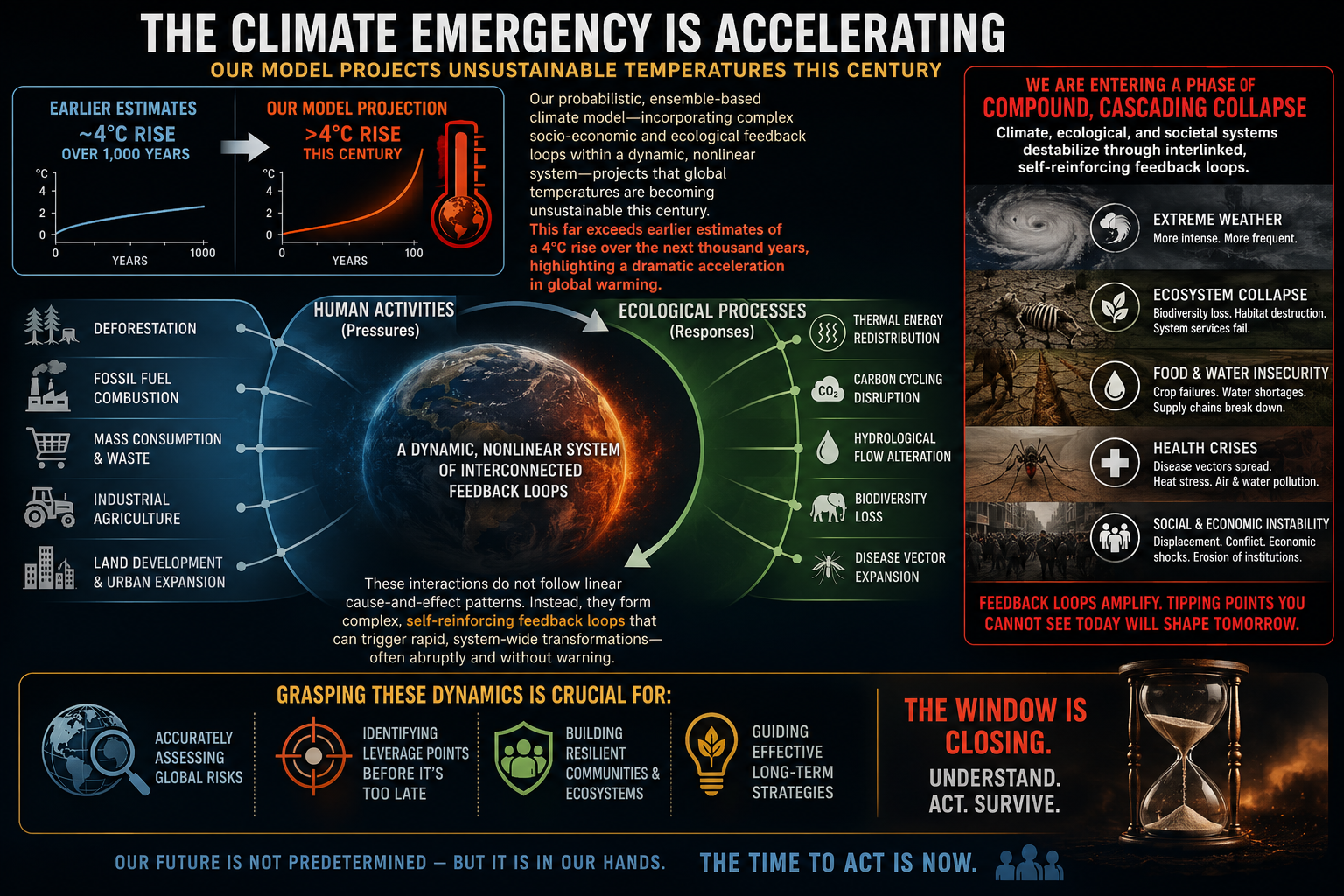
* Our probabilistic, ensemble-based climate model — which incorporates complex socio-economic and ecological feedback loops within a dynamic, nonlinear system — projects that global temperatures are becoming unsustainable this century. This far exceeds earlier estimates of a 4°C rise over the next thousand years, highlighting a dramatic acceleration in global warming. We are now entering a phase of compound, cascading collapse, where climate, ecological, and societal systems destabilize through interlinked, self-reinforcing feedback loops.
We examine how human activities — such as deforestation, fossil fuel combustion, mass consumption, industrial agriculture, and land development — interact with ecological processes like thermal energy redistribution, carbon cycling, hydrological flow, biodiversity loss, and the spread of disease vectors. These interactions do not follow linear cause-and-effect patterns. Instead, they form complex, self-reinforcing feedback loops that can trigger rapid, system-wide transformations — often abruptly and without warning. Grasping these dynamics is crucial for accurately assessing global risks and developing effective strategies for long-term survival.
Bottom line: The question is no longer how warm the planet becomes, but how life on Earth can endure when change outpaces our ability to adapt.
We cannot control the laws of physics, but we can control our pollution. The most effective action is to stop burning fossil fuels.