The central question is no longer simply how much additional warming the planet will experience. It is how rapidly the interconnected systems supporting civilization are losing resilience, how disturbances propagate between them, and whether economic institutions can adapt at a rate sufficient to keep pace.
By Daniel Brouse¹ and Sidd Mukherjee²
November 14, 2026
¹ Independent Climate Researcher and Economist, Membrane Institute, USA
² Independent Physicist, Membrane Institute, USA
Climate change is transitioning beyond a predominantly emissions-driven process into an increasingly interconnected Earth-system disturbance characterized by nonlinear acceleration, reinforcing feedbacks, interacting tipping points, and cascading consequences. The implications extend beyond environmental change into the economic, financial, ecological, and institutional systems upon which civilization depends.
This paper integrates the collaborative research of Daniel Brouse and Sidd Mukherjee, building upon their Nonlinear Acceleration Hypothesis, developed in the late 1990s, and subsequent investigations into climate feedback coupling, third-derivative behavior, tipping-point networks, and climate-economic instability.
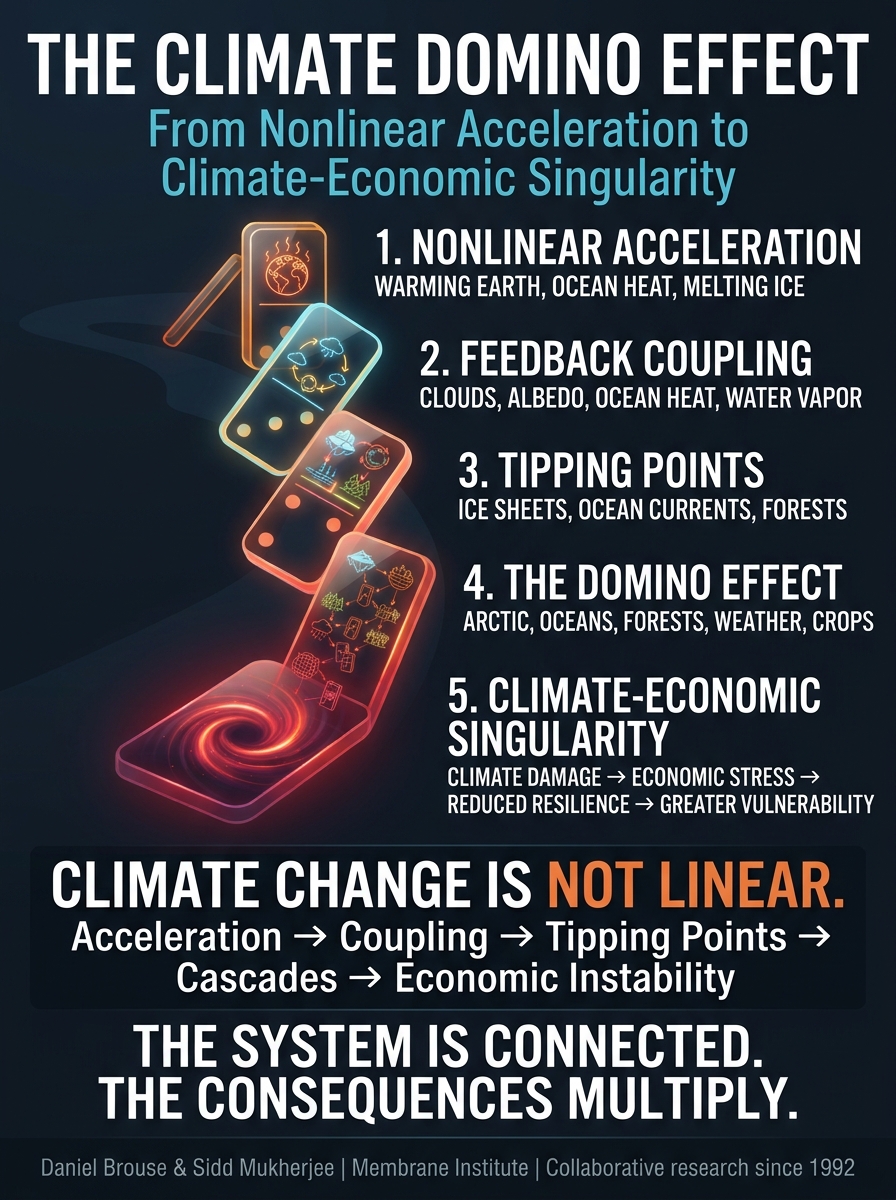
Five interconnected concepts form the foundation of this framework:
A central supporting contribution is the 2026 National Science Review paper, The Domino Effect of Climate Tipping Points: A Multidisciplinary Perspective on Global Risks. Its multidisciplinary treatment of interconnected tipping elements and cascading risks provides an important scientific foundation for understanding climate disruption as a network phenomenon rather than a collection of isolated environmental events.
This paper extends that perspective through the integration of nonlinear dynamics, climate feedback analysis, observational indicators, economic transmission mechanisms, and systemic risk.
The central argument is that climate disruption increasingly involves self-reinforcing interactions within the Earth system, while its consequences propagate into economic systems that depend on environmental stability. As these systems become more tightly coupled, historical linear assumptions, conventional risk assessments, and backward-looking climate baselines become progressively less reliable.
The defining challenge is no longer simply measuring how much the planet is warming. It is understanding how rapidly the interconnected systems supporting civilization are changing, how disturbances propagate between them, and whether economic and institutional resilience can keep pace.
The conventional description of climate change emphasizes the relationship between greenhouse gas emissions, atmospheric concentrations, radiative forcing, and increasing global temperatures.
These relationships remain fundamental to understanding anthropogenic warming. However, they do not fully describe the increasingly complex interactions occurring throughout the Earth system.
The planet is not a collection of independent environmental components. Its atmosphere, oceans, cryosphere, land surface, biosphere, and geological systems exchange energy and matter through interconnected physical and biological processes.
Changes in one component alter the conditions experienced by others.
The resulting interactions can amplify initial disturbances, accelerate subsequent changes, and destabilize systems that previously absorbed environmental stress.
This is the central premise of our collaborative research.
Beginning with the Nonlinear Acceleration Hypothesis, our work has progressively examined the transition from individual climate feedbacks to interconnected feedback networks, tipping-point interactions, cascading disruption, and ultimately climate-economic coupling.
The progression can be summarized:
Warming
↓
Feedback Activation
↓
Feedback Coupling
↓
Nonlinear Acceleration
↓
Threshold Transitions
↓
Cascading Tipping Points
↓
Ecological and Economic Disruption
↓
Climate-Economic Amplification
These processes are not necessarily sequential. They overlap, interact, and develop at different rates.
Nevertheless, the progression provides an integrated framework for examining the changing behavior of the Earth system.
The Nonlinear Acceleration Hypothesis was developed by Brouse and Mukherjee in the late 1990s.
The original proposition was that climate impacts would not increase in a simple linear relationship with time. Instead, interactions among climate processes would produce increasingly consequential changes through reinforcing feedback mechanisms.
The hypothesis was subsequently developed through investigations into:
The central distinction is between the rate at which climate change occurs and the rate at which that rate changes.
A system can experience increasing impacts without necessarily experiencing increasing acceleration. Likewise, a system can accelerate at a constant rate without experiencing increasing acceleration.
Our framework examines the higher-order dynamics.
For a climate-impact indicator represented by I(t):
First derivative:
dI/dt = Rate of change.
Second derivative:
d²I/dt² = Acceleration.
Third derivative:
d³I/dt³ = Climate Jerk.
Climate Jerk describes the rate of change in acceleration.
When the third derivative is positive over an appropriately defined interval, acceleration is increasing.
This provides an additional dimension for investigating climate behavior beyond conventional trend analysis.
A positive third derivative does not establish that every climate indicator is accelerating, nor does it independently demonstrate that a tipping point has been crossed. The result depends on the indicator, measurement period, statistical treatment, and observational uncertainty.
Nevertheless, examining third-derivative behavior across multiple independent climate indicators offers a way to investigate whether the Earth system is entering a regime characterized by increasingly rapid changes.
One of the most consequential implications of nonlinear acceleration is time compression.
Climate changes historically associated with longer timescales can produce increasingly rapid consequences as multiple processes interact.
Our research examines the compression of characteristic doubling times across climate-impact indicators, including extreme precipitation, heat extremes, wildfire behavior, ice loss, and economic damage.
The purpose is not to assume that every climate variable follows a single exponential trajectory. Different indicators have different physical constraints, statistical distributions, and response times.
Rather, the observed and proposed compression of characteristic timescales provides a framework for investigating whether climate disruption is becoming increasingly concentrated within shorter periods.
The traditional 30-year climate normal is useful for describing long-term climate conditions. However, rapidly changing climate distributions create an important limitation.
If temperatures, precipitation extremes, atmospheric moisture, and seasonal patterns change substantially within a decade, a 30-year average can increasingly describe conditions that no longer represent the current climate.
The faster the climate changes, the more a backward-looking baseline can lag behind actual conditions.
This has direct consequences for:
Our April 2026 paper, Climate Change Change: Third Derivatives, Time Compression, and the Collapse of the 30-Year Climate Baseline, develops this argument.
The central point is that institutions must increasingly evaluate the rate at which climate conditions change rather than relying exclusively on historical averages.
Climate feedbacks are processes through which an initial change produces an additional response. Positive feedbacks reinforce the original disturbance. Negative feedbacks counteract it.
The critical issue is that feedback mechanisms do not operate independently. They interact through shared energy flows, atmospheric circulation, ocean dynamics, biological processes, and changes in surface conditions.
Consequently, the combined behavior of interacting feedbacks can differ substantially from the behavior of individual mechanisms considered separately.
Ice-albedo feedback
Declining snow and ice expose darker surfaces that absorb more incoming solar radiation. Additional energy absorption contributes to further warming and ice loss.
Ocean-cryosphere coupling
Increasing ocean heat contributes to basal ice-shelf melting, grounding-line retreat, and destabilization of marine-based ice sheets.
Water-vapor feedback
Warmer atmospheric conditions increase the capacity of the atmosphere to hold moisture. Increased water vapor amplifies the greenhouse effect.
Cloud feedback
Changes in cloud coverage, altitude, optical properties, and composition alter the balance between incoming solar radiation and outgoing terrestrial radiation.
Low-level cloud reductions are particularly important because these clouds reflect substantial incoming solar energy.
Biosphere-carbon feedback
Heat, drought, wildfire, pests, and atmospheric pollutants stress vegetation, reduce photosynthetic activity, and weaken natural carbon sinks.
Permafrost feedback
Thawing permafrost releases previously frozen organic carbon through microbial decomposition, increasing atmospheric carbon dioxide and methane.
These mechanisms create multiple pathways through which disturbances propagate throughout the Earth system.
Our Coupled Climate Feedback Index provides an analytical framework for investigating interactions among major climate indicators.
The framework incorporates:
The analysis includes directional normalization, trend treatment, and pairwise and higher-order relationships.
Particular attention is given to the interaction among surface albedo, ocean heat content, and cloud behavior.
The proposed weighting framework identifies the following relationships:
| Feedback interaction | Proposed relative weight |
|---|---|
| Albedo × Ocean Heat Content | 14.3% |
| Cloud × Ocean Heat Content | 13.2% |
| Albedo × Cloud | 12.1% |
| Combined three-variable interaction | 39.6% |
These figures represent the proposed analytical weighting structure, not independently established percentages of global warming or causal attribution.
The purpose of the index is to investigate whether relationships among climate indicators are changing in ways consistent with increasing feedback coupling.
Individual feedback loops can become components of larger networks.
For example:
Ocean Heat Accumulation
↓
Sea-Ice and Ice-Shelf Loss
↓
Reduced Surface Albedo and Increased Ocean Exposure
↓
Additional Solar Energy Absorption
↓
Further Ocean Warming
↓
Additional Cryosphere Destabilization
A second pathway involves the biosphere:
Increasing Heat and Drought
↓
Vegetation Stress and Wildfires
↓
Reduced Photosynthesis and Carbon Uptake
↓
Weakened Carbon Sinks
↓
Higher Atmospheric Greenhouse Gas Concentrations
↓
Additional Warming
The interaction between these pathways creates opportunities for cross-system amplification.
This is the distinction between individual feedbacks and feedback coupling.
Our research into emerging feedback networks examines how these relationships develop into interconnected systems capable of transmitting disturbances across multiple Earth-system components.
A climate tipping point occurs when an Earth-system component crosses a critical threshold beyond which a relatively small additional disturbance can produce a major transition.
Such transitions are associated with nonlinear dynamics, bifurcation theory, hysteresis, and changes in system stability.
Before a tipping point, a system may absorb disturbances and return toward its previous condition. As resilience declines, recovery can become slower or less complete. After a critical transition, the system may move toward a different state even if the original forcing is subsequently reduced.
This distinction is particularly important when evaluating the difference between preventing further destabilization and restoring an earlier environmental condition.
Cryosphere
Ocean and marine systems
Terrestrial ecosystems
These systems are connected through heat redistribution, atmospheric circulation, ocean circulation, freshwater inputs, carbon exchange, and biological dependencies.
A disturbance in one system can therefore alter the stability of another.
The most important implication is that the stability of an individual tipping element cannot be evaluated entirely independently of its surrounding network.
The vulnerability of one system can increase as connected systems change.
For example, ocean warming affects ice shelves. Ice loss alters surface reflectivity and freshwater inputs. Freshwater changes can influence ocean circulation. Circulation changes can redistribute heat and nutrients, affecting marine ecosystems.
This creates a network of interacting vulnerabilities.
The 2026 paper by Jun Meng and Deliang Chen, The Domino Effect of Climate Tipping Points: A Multidisciplinary Perspective on Global Risks, provides important supporting documentation for this framework. Published in National Science Review, the paper examines the broader consequences of interconnected tipping points and the potential for cascading transitions across multiple systems.
Its multidisciplinary perspective reinforces an important principle:
Climate tipping points are not simply individual thresholds. They are components of an interconnected network.
The use of network-based approaches, including multilayer connectivity and percolation concepts, provides a framework for investigating how local disturbances can propagate into larger systemic disruptions.
This complements our earlier work on feedback loops, tipping points, and the Domino Effect.
The traditional domino analogy suggests that one event triggers another in a linear sequence.
The actual Earth system is more complex. One disturbance can affect several interconnected systems simultaneously. Those systems can then influence multiple additional components.
The resulting network contains overlapping pathways, feedback loops, thresholds, and dependencies.
Example 1: Arctic warming and cascading climate disruption
Arctic Warming
↓
Sea-Ice Loss
↓
Reduced Surface Albedo and Increased Solar Energy Absorption
↓
Changes in Ocean-Atmosphere Heat Exchange
↓
Changes in Atmospheric and Ocean Circulation
↓
Regional Temperature and Precipitation Changes
↓
Ecosystem Stress and Destabilization
↓
Agricultural Disruption and Economic Losses
This is an illustrative pathway, not a claim that every link occurs in a fixed sequence or that Arctic sea-ice loss alone necessarily triggers all subsequent changes.
Example 2: Ocean circulation and marine ecosystem disruption
Ocean Circulation Changes
↓
Altered Ocean Temperature and Nutrient Distribution
↓
Marine Deoxygenation and Ecosystem Stress
↓
Coral Reef Degradation and Fisheries Disruption
↓
Reduced Marine Food Production
↓
Food Security and Livelihood Pressures
↓
Economic Disruption in Coastal Communities
This pathway demonstrates how physical ocean disturbances can propagate into biological, ecological, and economic systems.
Example 3: Forest degradation and carbon-sink failure
Increasing Heat and Drought
↓
Vegetation Stress and Wildfire
↓
Forest Degradation and Reduced Photosynthesis
↓
Declining Carbon Uptake
↓
Weakened Terrestrial Carbon Sinks
↓
Additional Atmospheric Greenhouse Gas Accumulation
↓
Further Climate Stress
The important feature is the reinforcing relationship between ecosystem degradation and climate change.
Percolation theory provides a mathematical framework for examining how disturbances spread through connected networks. As network connectivity or interaction strength increases, localized disruptions can propagate across larger portions of a system.
Applied to climate science, this raises an important question:
At what point do interactions among individual tipping elements become sufficiently strong that localized disturbances can generate widespread systemic transitions?
There is no single established planetary threshold answering this question. However, multilayer network analysis provides a useful framework for studying how physical, biological, ecological, and socioeconomic systems interact.
The Domino Effect changes the way climate risk must be evaluated.
A tipping element may appear geographically isolated, but its consequences can extend across the planet through atmospheric, oceanic, ecological, and economic connections.
The resulting risks cannot be adequately characterized by evaluating individual events in isolation.
The relevant question becomes how disturbances interact, how quickly they propagate, and whether the affected systems retain sufficient resilience to prevent additional transitions.
The global economy depends on relatively stable environmental conditions. Agriculture requires productive soils, reliable water, and predictable growing conditions. Energy systems require functioning infrastructure and dependable resources. Transportation and international trade depend on ports, waterways, roads, railways, and shipping networks. Financial institutions depend on functioning businesses, insurable assets, reliable collateral, and stable economic activity.
These are not independent of environmental conditions.
The economy is embedded within the Earth system.
Consequently, environmental degradation creates economic consequences that extend far beyond the immediate cost of repairing physical damage.
Agriculture and food security
Heat stress, drought, flooding, changing precipitation patterns, and ecosystem degradation affect crop production, livestock, fisheries, and food distribution.
Simultaneous disruptions across major agricultural regions increase the potential for global food-price instability.
Insurance and financial markets
Increasing losses, higher reconstruction costs, changing hazard exposure, and declining insurability affect property values, insurance availability, mortgage markets, and financial risk.
Insurance withdrawal transfers additional exposure to homeowners, businesses, municipalities, lenders, and governments.
Infrastructure and public finances
Flooding, extreme precipitation, coastal erosion, extreme heat, and severe storms increase maintenance and replacement costs.
Governments face competing demands for emergency response, reconstruction, adaptation, public services, and debt servicing.
Energy and transportation
Extreme temperatures, water shortages, flooding, and severe weather threaten electricity generation, transmission infrastructure, transportation networks, and industrial operations.
International trade and supply chains
Disruptions in agricultural production, shipping, ports, energy supplies, and manufacturing propagate through international markets. These transmission mechanisms create an additional layer of cascading risk.
A climate disturbance initiates an economic disturbance, which can then increase vulnerability to subsequent climate disturbances.
Conventional economic analysis frequently treats environmental damage as an external cost. This becomes increasingly inadequate when climate disruption begins changing the operating conditions of the economy itself.
Consider the insurance and property market:
Increasing Property Losses
↓
Higher Insurance Premiums
↓
Reduced Property Affordability
↓
Insurance Withdrawal and Mortgage Constraints
↓
Declining Property Values
↓
Reduced Municipal Tax Revenues
↓
Constrained Infrastructure Investment
↓
Greater Exposure to Subsequent Climate Damage
The consequences extend beyond the original environmental event. Economic damage becomes an internal component of the climate-risk system.
This is the foundation of climate-economic coupling.
The Climate-Economic Singularity is our proposed framework describing the convergence of nonlinear climate acceleration, reinforcing feedback networks, cascading tipping points, and increasingly interconnected economic instability.
The term singularity is used as a systems-level concept rather than a claim that a literal mathematical singularity or a single irreversible global economic collapse has been demonstrated.
In our March 2026 paper, Approaching Singularity: Third Derivatives, Nonlinear Collapse, and Coupled Climate-Economic Instability, we developed this concept through the examination of nonlinear dynamics, physical analogies, third-derivative behavior, and coupled climate-economic processes.
A singularity-like regime is characterized by:
The essential distinction is that the system is no longer adequately described through isolated linear relationships.
The interaction can be represented as:
CLIMATE DISRUPTION
Increasing heat, extreme precipitation, drought, flooding, wildfire, ocean changes, and ecosystem degradation.
↓
ECONOMIC DAMAGE
Agricultural losses, infrastructure destruction, insurance claims, property devaluation, supply-chain disruptions, and rising public expenditures.
↓
FINANCIAL AND INSTITUTIONAL STRESS
Higher insurance costs, credit risk, municipal fiscal pressure, capital losses, market instability, and reduced investment capacity.
↓
REDUCED ADAPTIVE CAPACITY
Less available capital for infrastructure protection, climate adaptation, ecosystem restoration, and economic resilience.
↓
GREATER CLIMATE VULNERABILITY
More exposed infrastructure, vulnerable communities, fragile supply chains, and reduced capacity to absorb subsequent disturbances.
↓
ADDITIONAL ECONOMIC DAMAGE
The cycle reinforces itself.
This is the critical distinction between conventional climate-economic risk and the singularity framework.
Climate disruption does not simply impose an increasing financial cost. It can undermine the economic capacity required to manage subsequent climate damage.
Our singularity framework examines the possibility that both climate and economic indicators exhibit increasing rates of acceleration.
The progression is:
dI/dt > 0 — Impacts are increasing.
d²I/dt² > 0 — Impacts are accelerating.
d³I/dt³ > 0 — Acceleration itself is increasing.
These relationships must be evaluated against specific indicators, observation periods, and statistical methods.
The important question is whether multiple independent climate and economic indicators increasingly exhibit this behavior.
Our research examines ocean heat content, sea-level rise, ice-sheet mass loss, atmospheric circulation, extreme weather losses, and economic exposure as components of this broader investigation.
A particularly important extension of the Climate-Economic Singularity framework is our November 10, 2026 update, Ocean Maelstrom: Navigating the Climate Storm.
The report examines the systemic economic implications of ocean degradation, incorporating the Ocean Solvency framework developed in the November 2026 report by the Institute and Faculty of Actuaries, the University of Exeter, and The Ocean Race.
Ocean Solvency describes the continuing capacity of the ocean to provide the ecosystem services upon which human societies and economies depend.
These services include:
The Ocean Maelstrom scenario illustrates how multiple interacting ocean, climate, ecological, and geopolitical pressures can propagate through economic systems.
The sequence can be represented as:
Ocean Degradation
↓
Climate Disruption
↓
Food and Agricultural Instability
↓
Inflation and Supply-Chain Disruption
↓
Economic Contraction
↓
Financial and Sovereign Instability
↓
Reduced Adaptive Capacity
↓
Greater Vulnerability to Subsequent Disruptions
The scenario also examines exposure involving insurance markets, pension funds, investment portfolios, government finances, and retirement security.
Importantly, the scenario is a systemic-risk assessment, not a prediction of a specific economic contraction. Its significance is that ocean degradation can affect multiple components of economic stability simultaneously.
The ocean is not separate from the economy. It is foundational economic infrastructure.
The Climate-Economic Singularity framework extends the Domino Effect beyond the physical and ecological environment.
The interconnected system now includes:
As these systems become more tightly coupled, disruptions can propagate across multiple sectors. The resulting consequences can exceed the sum of individual losses.
This is the transition from environmental risk to systemic economic risk.
The five concepts developed throughout our research describe interconnected dimensions of the same evolving process.
| Concept | Principal mechanism | Systemic consequence |
|---|---|---|
| Nonlinear Acceleration Hypothesis | Increasing rates of climate change and acceleration | Historical trends become inadequate |
| Feedback Coupling | Reinforcement among interacting climate processes | Greater amplification of disturbances |
| Climate Tipping Points | Critical thresholds and changes in system stability | Abrupt and potentially irreversible transitions |
| Domino Effect | Propagation across interconnected systems | Cascading environmental and ecological disruption |
| Climate-Economic Singularity | Coupling of climate and economic feedback systems | Systemic economic instability and declining resilience |
The complete framework can be summarized:
WARMING
↓
FEEDBACK ACTIVATION
↓
FEEDBACK COUPLING
↓
NONLINEAR ACCELERATION
↓
THRESHOLD TRANSITIONS
↓
CASCADING TIPPING POINTS
↓
ECOLOGICAL AND ECONOMIC DISRUPTION
↓
CLIMATE-ECONOMIC AMPLIFICATION
↓
REDUCED SYSTEMIC RESILIENCE
This is a conceptual progression, not a fixed sequence of inevitable events. Individual processes can overlap, reinforce one another, and develop at different rates.
Nevertheless, the integrated framework provides a means of examining the transition from emissions-driven warming to increasingly interconnected Earth-system and economic instability.
Global average temperature remains an essential climate indicator, but it cannot independently characterize the stability of the entire Earth system.
A more comprehensive approach must examine:
The relationships among these indicators are as important as their individual trends.
Systems approaching critical transitions can exhibit changes in their behavior before a major transition occurs.
Potential warning signals include:
These indicators can provide useful information about changing resilience. However, early-warning signals are not universal, and their absence does not establish that a system is stable.
The observational challenge is to identify changes in system behavior while distinguishing genuine shifts from natural variability, measurement limitations, and statistical artifacts.
The next generation of climate-risk analysis must connect Earth-system observations with economic and financial indicators.
A comprehensive monitoring framework integrates:
This approach improves the ability to identify not only individual climate thresholds but also the interactions that increase the potential for cascading disruptions.
It also provides a more realistic assessment of how environmental changes propagate through the global economy.
The integrated framework has important implications for climate policy.
Emissions reductions remain essential because they limit additional external forcing and reduce the likelihood of further destabilization. However, climate policy must also address the internal dynamics of the Earth system and the growing economic consequences of interconnected climate disruption.
1. Protect climate-regulating systems
Prioritize the cryosphere, forests, wetlands, marine ecosystems, and other systems that contribute to planetary climate regulation.
2. Monitor coupled feedbacks
Develop integrated observational systems that identify changes in relationships among ocean heat, albedo, clouds, ice, atmospheric moisture, and biological carbon uptake.
3. Evaluate cascading risk
Assess infrastructure, food production, water security, insurance markets, and financial institutions against compound and interconnected climate hazards rather than isolated historical events.
4. Build economic resilience
Strengthen infrastructure, diversify supply chains, improve emergency preparedness, protect natural systems, and reduce financial exposure to correlated climate risks.
5. Integrate mitigation with measurable environmental benefits
Climate stewardship must extend beyond reducing emissions to include actions that improve the functioning of natural systems and reduce environmental stress.
Our Integrated Climate Stewardship framework expresses this through a straightforward principle:
ZERO-OUT + BENEFIT-IN.
Reduce environmental damage while actively contributing measurable benefits to the systems that sustain life and economic activity.
The objective is not merely to slow deterioration. It is to restore and strengthen resilience wherever possible.
The most important implication of our collaborative research is that climate change cannot be adequately evaluated as a linear response to greenhouse gas emissions.
The Earth system is interconnected, nonlinear, and capable of abrupt transitions.
The Nonlinear Acceleration Hypothesis identifies the increasing importance of acceleration in climate disruption.
Feedback Coupling explains how individual amplification mechanisms interact and form larger networks.
Climate Tipping Points identify critical thresholds beyond which major Earth-system transitions can occur.
The Domino Effect explains how those transitions propagate through interconnected physical, biological, ecological, and socioeconomic networks.
The Climate-Economic Singularity extends the analysis into the global economy, where climate damage increasingly affects the systems responsible for maintaining economic stability and financing recovery.
The 2026 analysis by Meng and Chen provides an important multidisciplinary foundation for understanding how tipping elements interact and how localized disturbances can generate cascading global risks.
Our collaborative work extends this perspective by integrating nonlinear acceleration, climate feedback coupling, third-derivative analysis, and economic transmission mechanisms into a unified framework.
The resulting picture is one of increasing interdependence.
Climate instability damages economic systems. Economic instability reduces the resources available for adaptation and resilience. Reduced resilience increases exposure to subsequent climate disturbances.
The cycle reinforces itself.
The consequences extend from the physical environment into property markets, insurance systems, agriculture, infrastructure, financial institutions, government budgets, and international commerce.
The global economy is operating within an Earth system whose stability it depends upon but whose destabilization it must increasingly absorb.
This creates a fundamental challenge for conventional economic analysis: the systems supporting economic production and financial stability are themselves exposed to the environmental deterioration driving the risks.
The central question is no longer simply how much additional warming the planet will experience. It is how rapidly the interconnected systems supporting civilization are losing resilience, how disturbances propagate between them, and whether economic institutions can adapt at a rate sufficient to keep pace.
Understanding this transition is essential to anticipating the next phase of climate risk.
The solution requires more than measuring change. It requires understanding the interactions driving change, recognizing the thresholds that alter system behavior, and protecting the environmental and economic foundations of civilization.
1. Nonlinear Acceleration of Climate Change (1999)
Brouse, D., & Mukherjee, S. (1999). Nonlinear Acceleration of Climate Change. Membrane Institute Working Paper Series.
Foundational development of the Nonlinear Acceleration Hypothesis.
2. Tipped Tipping Points and the Domino Effect: Accelerating Climate Collapse (2026)
Brouse, D., & Mukherjee, S. The Human Induced Climate Change Experiment and the Domino Effect.
Develops the relationship among nonlinear acceleration, tipping-point interactions, feedback networks, and cascading climate disruption.
3. Climate Change Change: Third Derivatives, Time Compression, and the Collapse of the 30-Year Climate Baseline (April 2026)
Brouse, D., & Mukherjee, S. (2026).
Examines third-derivative behavior, climate time compression, changing climate baselines, and implications for forecasting and economic risk.
4. Approaching Singularity: Third Derivatives, Nonlinear Collapse, and Coupled Climate-Economic Instability (March 2026)
Brouse, D., & Mukherjee, S. (2026).
Develops the Climate-Economic Singularity framework through nonlinear dynamics, third derivatives, physical analogies, and interconnected climate-economic feedback systems.
5. Climate Jerk Surge: Albedo-Cloud-Ocean Heat Content Triad (September 2026)
Brouse, D. (2026).
Examines the interaction among surface albedo, cloud behavior, and ocean heat content.
6. Climate Jerk Surge Math and Methods (September 2026)
Brouse, D. (2026).
Documents the analytical methods associated with the Coupled Climate Feedback Index and higher-order feedback interactions.
7. Observational Evidence for Climate Jerk: Multidisciplinary Indicators of Accelerating Climate Acceleration (June 2026)
Brouse, D., & Mukherjee, S. (2026).
Examines multiple observational indicators and their implications for third-derivative climate behavior.
8. The Compression of Doubling Times Across Earth-System Indicators: Evidence for Increasing Nonlinearity in the Climate System (June 2026)
Brouse, D., & Mukherjee, S. (2026).
Examines changing characteristic timescales across multiple Earth-system indicators.
9. Emergent Climate Dynamics: The Nonlinear Acceleration of Climate Impacts (March 2026)
Brouse, D., & Mukherjee, S. (2026).
Develops the nonlinear dynamics framework underlying accelerating climate impacts.
10. A Unified Energetics Framework for Accelerating Climate Change: From Radiative Forcing to Drag Physics (March 2026)
Brouse, D., & Mukherjee, S. (2026).
Examines climate acceleration through an integrated energy and physical-dynamics framework.
11. The Compression of Time: Third Derivatives, Vortex Dynamics, and Wormholes in Climate-Economic Singularity (March 2026)
Brouse, D., & Mukherjee, S. (2026).
Explores time compression, nonlinear amplification, and singularity-like system behavior.
12. Ocean Maelstrom: Navigating the Climate Storm (November 10, 2026)
Brouse, D., & Mukherjee, S. (2026). Climate-Economic Coupling and Singularity: Ocean Solvency and the Ocean Maelstrom.
Examines the transmission of ocean degradation through food security, supply chains, insurance, pensions, financial markets, and economic stability.
13. The Domino Effect of Climate Tipping Points: A Multidisciplinary Perspective on Global Risks (2026)
Meng, J., & Chen, D. (2026). National Science Review, 13(20), nwag042.
https://academic.oup.com/nsr/article/13/20/nwag042/8437927
Primary external supporting paper for interconnected tipping elements, multilayer networks, and cascading global risks.
14. Tipping Elements in the Earth’s Climate System (2008)
Lenton, T. M., et al. (2008). Proceedings of the National Academy of Sciences, 105(6), 1786–1793.
https://doi.org/10.1073/pnas.0705414105
15. Trajectories of the Earth System in the Anthropocene (2018)
Steffen, W., et al. (2018). Proceedings of the National Academy of Sciences, 115(33), 8252–8259.
https://doi.org/10.1073/pnas.1810141115
16. Early-Warning Signals for Critical Transitions (2009)
Scheffer, M., et al. (2009). Nature, 461, 53–59.
https://doi.org/10.1038/nature08227
17. Catastrophic Cascade of Failures in Interdependent Networks (2010)
Buldyrev, S. V., et al. (2010). Nature, 464, 1025–1028.
https://doi.org/10.1038/nature08932
18. Climate Tipping Point Interactions and Cascades: A Review (2024)
Wunderling, N., et al. (2024). Earth System Dynamics, 15, 41–74.
https://doi.org/10.5194/esd-15-41-2024
19. Physics-Based Early Warning Signal Shows That AMOC Is on Tipping Course (2024)
van Westen, R. M., Kliphuis, M., & Dijkstra, H. A. (2024). Science Advances, 10, eadk1189.
https://doi.org/10.1126/sciadv.adk1189
Daniel Brouse
Independent Climate Researcher and Economist
Co-founder, Membrane Institute
Research interests: Nonlinear climate dynamics, climate-economic coupling, financial risk, climate feedback networks, and integrated climate stewardship.
Sidd Mukherjee, Ph.D.
Independent Physicist
Co-founder, Membrane Institute
Research interests: Physics, nonlinear systems, energy dynamics, mathematical modeling, and climate-system interactions.
Membrane Institute / Membrane.com
Collaborative independent research initiated in 1992.
This paper synthesizes the authors’ collaborative research and extends it through an integrated Earth-system and climate-economic risk framework. The proposed indices, acceleration metrics, and singularity framework are research constructs whose quantitative interpretations should be evaluated against observational evidence, statistical uncertainty, and established physical models.
Feedback Loops → Tipping Points → Feedback Loop Coupling and Tipping-Point Network → Acceleration → Domino Effect
Feedback loops amplify climate change and can push interconnected Earth systems past critical tipping points. As tipping points are crossed, they can trigger additional feedback loops and destabilize other climate systems. This cascading "Domino Effect" compresses timescales, accelerates change, and increases the risk of rapid, nonlinear climate transformations.
Current Status: The Climate Tipping Point Crisis Is Here