Is Climate Change on a Runaway Train?
by Daniel Brouse and Sidd Mukherjee
June 2, 2026
A Public-Access Discussion of Nonlinear Climate Risk
Abstract
Climate change is often discussed in terms of gradual warming. However, growing evidence suggests that many climate impacts may be accelerating through interacting feedback loops and nonlinear system behavior. This raises an important question:
Is climate change entering a runaway state?
The answer depends largely on how the term runaway is defined. While current observations do not support the conclusion that Earth is undergoing a Venus-like runaway greenhouse effect, numerous climate, ecological, and economic subsystems are exhibiting increasingly self-reinforcing dynamics. Understanding these dynamics is essential for evaluating future risks and identifying effective mitigation and adaptation strategies.
What Does “Runaway” Mean?
The word runaway is often interpreted as an absolute condition: a system that has become completely uncontrollable.
In reality, complex systems rarely transition from stable to unstable in a single step. Instead, they often move through a spectrum of increasingly nonlinear behavior as feedback mechanisms strengthen and begin interacting with one another.
One of the challenges facing climate science is that there is no universally accepted definition of what constitutes a runaway state in the Earth system, nor is there a single observable threshold that clearly indicates when such a transition has occurred.
This uncertainty is scientifically important.
In many complex systems, critical transitions are only fully recognized in hindsight, after the system response is already underway.
The scientific question is therefore not whether Earth has entered a fully runaway state. Rather, the question is:
To what extent are self-reinforcing feedbacks becoming dominant drivers of system behavior?
The Train Analogy
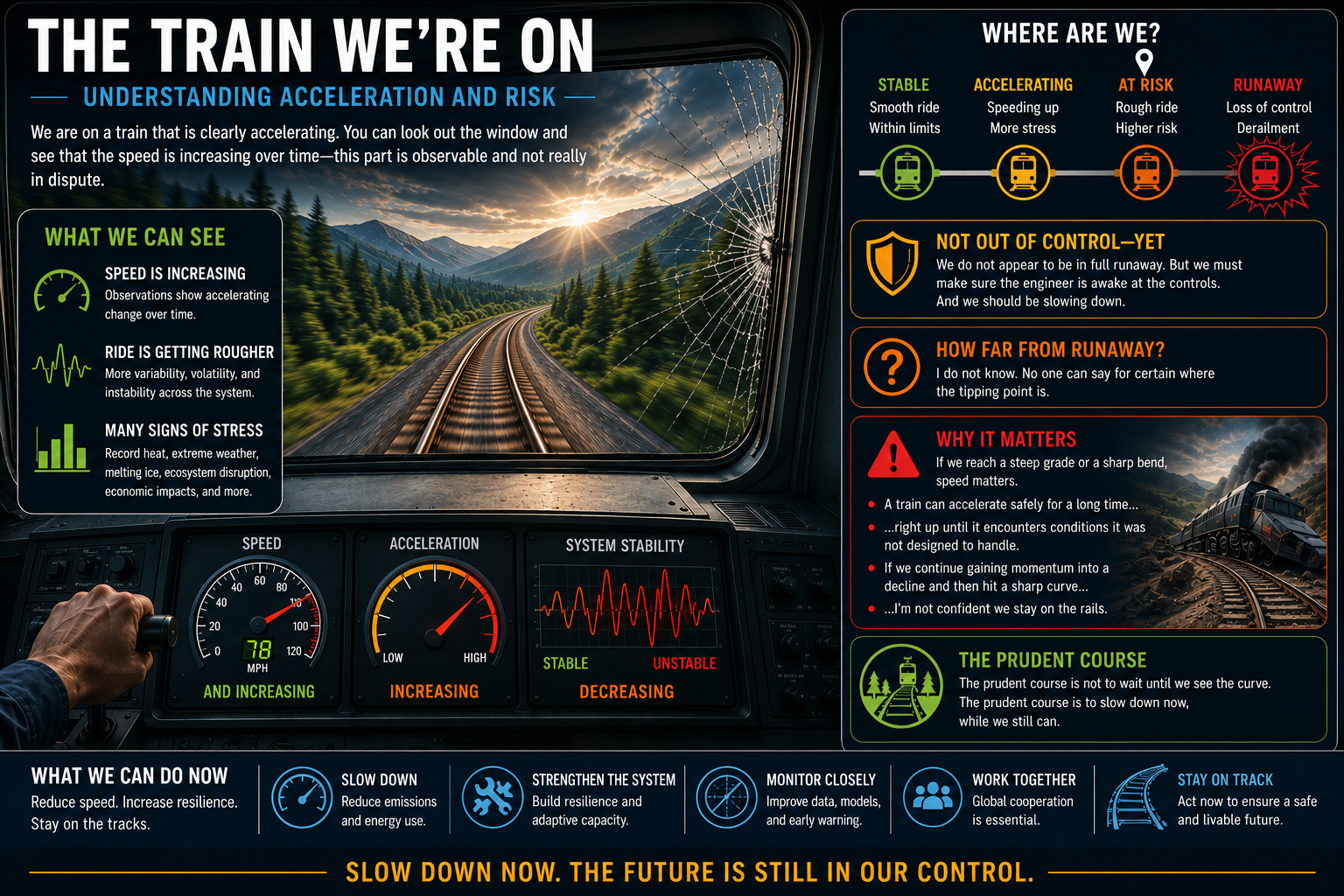
A useful way to think about climate change is through the analogy of an accelerating train.
Imagine riding on a train.
Looking out the window, you can clearly see that the train is moving faster than it was before. That increase in speed is observable and largely undisputed.
At the same time, the ride is becoming less smooth. There is more vibration, more instability, and greater variability throughout the system.
The train is still on the tracks.
The engineer still has control.
But momentum is increasing.
The critical question is not whether the train is moving. The critical question is what lies ahead.
A train can safely accelerate for a very long time under favorable conditions. Problems arise when increasing speed encounters constraints that the system was not designed to handle.
A steep decline.
A sharp curve.
A damaged bridge.
The faster the train is moving when it reaches those conditions, the more difficult it becomes to avoid derailment.
Climate change presents a similar risk-management challenge.
The prudent course is not to wait until the curve becomes visible.
The prudent course is to reduce risk while options remain available.
Evidence of Increasing Nonlinearity
A growing number of climate indicators exhibit behavior that appears inconsistent with simple linear change.
Examples include:
- accelerating sea-level rise,
- increasing atmospheric moisture,
- intensifying precipitation extremes,
- expanding wildfire activity,
- growing ocean heat content,
- ice-sheet instability,
- ecosystem degradation,
- climate-related insurance losses,
- and increasing infrastructure vulnerability.
Each of these processes is influenced by multiple interacting feedback mechanisms.
The concern is not any single indicator in isolation.
The concern is the coupling among many indicators simultaneously.
As feedbacks strengthen, the response of the overall system may become increasingly nonlinear, making future outcomes more difficult to predict using historical trends alone.
Climate, Economics, and Systemic Risk
Climate change is not solely an environmental issue.
It is increasingly becoming an economic risk-management problem.
My own research background is in economics, complex systems, and climate risk management. My research partner, Sidd Mukherjee, is a physicist. Although our disciplines differ, we have independently arrived at similar conclusions regarding the growing importance of coupled climate–economic feedbacks.
One of the clearest examples may be found in the insurance industry.
Insurance functions as society’s primary mechanism for distributing risk. When insurers withdraw from regions, significantly increase premiums, or reduce coverage availability, they are responding to observed changes in risk rather than theoretical possibilities.
These responses can propagate through:
- housing markets,
- mortgage systems,
- infrastructure investment,
- municipal finance,
- migration patterns,
- and broader economic networks.
Understanding how climate risks move through these interconnected systems remains a major focus of our research.
The Nonlinear Acceleration Framework
Our work has explored what we call the Nonlinear Acceleration Framework.
The central idea is simple:
Climate impacts are not driven solely by direct warming. They are also influenced by interactions among physical, ecological, social, and economic feedback loops.
When feedbacks interact, change may occur faster than expected from temperature trends alone.
Whether specific acceleration estimates ultimately prove accurate is less important than the broader observation:
Many climate indicators appear to be changing at rates that challenge assumptions of gradual, linear progression.
This possibility deserves serious scientific attention.
What We Think
Although uncertainty remains substantial, both Sidd and I believe several major climate-related systems are already experiencing significant destabilization.
My greatest concern is the increasing fragility of climate-linked economic systems, particularly insurance and real estate.
Sidd’s greatest concern is the potential destabilization of large ecological systems, especially the Amazon rainforest, which plays a critical role in global carbon cycling, hydrology, and biodiversity.
Example: Amazon Rainforest Dieback
Where we strongly agree is that many of these processes are not future possibilities waiting to begin.
They are already observable today.
The debate increasingly concerns magnitude, timing, interaction, and ultimate consequences.
In 2023 and 2024 much of the scientific community came to the conclusion that multiple major tipping points had entered self-reinforcing feedbacks. 2024 was the hottest year on record. The Antarctic saw recording breaking ice sheet destabilization. Large portions of Siberia caught on fire. The most alarming signal was Canada’s borreal forests catching on fire. In 2023, Sidd said, “Do you remember back in the early 2000’s when we thought we wouldn’t live to see the extreme changes due to global warming?”
Daniel replied, “I think 2023 is the most significant year so far. We saw confirmation of tipping points being crossed for Mountain Glacier Loss, Greenland Ice Sheet Collapse, Antarctic Ice Sheet Collapse, and potentially the Collapse of AMOC.”
Sidd continued, “We already knew that. It was Canada catching on fire that I could not believe. I never thought I’d live to see the day.”
Daniel asked, “Do you think the permafrost and peatlands will have zombie fires and cause the permafrost tipping point?”
Sidd responded, “Yes. They are gone, too. We already know from the permafrost peatland fires in Siberia.”
2023 was the year we saw confirmation that multiple tipping points were accelerating and feeding each other.
Conclusion
Climate change is not a runaway greenhouse catastrophe unfolding overnight.
Nor is it a simple linear process that can be understood by extending historical trends indefinitely into the future.
The evidence increasingly points toward a complex system characterized by interacting feedback loops, threshold behavior, and growing nonlinear responses.
The most important question is no longer whether climate change is occurring.
The question is how rapidly interconnected climate, ecological, economic, and social systems will respond as feedbacks continue to strengthen.
Understanding that response may determine how effectively humanity navigates the century ahead.
Important Scientific Note
A full “Hothouse Earth” or Venus-like runaway greenhouse scenario is not considered plausible within the next century based on current scientific understanding.
However, present-day emissions and feedback processes may commit future generations to long-term warming pathways that become increasingly difficult to reverse.
Some research has explored high-end warming outcomes exceeding 10°C over multi-century timescales under strong feedback participation. The key issue is not whether such outcomes occur in the near term, but whether current decisions influence long-term climate trajectories in ways that constrain future options.
The central challenge is therefore not immediate runaway warming, but the possibility of crossing thresholds that commit the Earth system to progressively more difficult and costly futures.
Is Climate Change Runaway? Maybe.
Unfortunately, the underlying science increasingly points in that direction. More importantly, it highlights what may be the most critical issue facing society today: not whether climate change is occurring, but whether we are approaching thresholds beyond which many impacts become effectively irreversible on human timescales.
None of us are arguing that the entire Earth system is in a fully runaway state today. However, observations accumulated over the past four decades suggest that multiple climate indicators are accelerating faster than many earlier projections anticipated. We are also observing increasing evidence of self-reinforcing feedback loops emerging across interconnected climate, ecological, and economic systems.
The central question is no longer whether runaway behavior is possible in principle. The question is how we recognize the transition if and when enough individual subsystems enter self-reinforcing states that the larger coupled system begins exhibiting runaway characteristics of its own.
Our observations, along with those of many other researchers over the past four decades, indicate a significant acceleration in climate-related impacts and feedbacks. When we first developed portions of this hypothesis in the 1990s, observed acceleration rates were closer to what could be described as roughly 2¹-fold per century behavior. More recent analyses across multiple independent datasets suggest substantially shorter characteristic timescales, with amplification patterns closer to 2⁶-fold behavior on decadal scales.
Depending on how the calculations are formulated, this implies:
- roughly a 60-fold increase in the effective growth constant, or
- approximately two orders of magnitude faster system amplification.
The exact numbers remain a matter of scientific debate, but the broader trend is increasingly difficult to ignore: the system appears to be accelerating faster than many earlier projections anticipated.
By 2023, multiple feedback loops were becoming directly observable in real-world data. Because of that, the question is no longer whether self-reinforcing climate processes are possible. The more important question is how we will recognize when enough interacting feedbacks have pushed the larger system beyond a critical threshold.
What is already clear is that substantial climate change has been locked in for at least the next several generations, even under extremely aggressive emissions reductions. If emissions continue and additional tipping elements become engaged, the probability of triggering broader system-wide instability increases significantly.
That is why the debate is shifting away from whether climate change is occurring and toward understanding the speed, scale, and interaction of the feedbacks that are now emerging.
Easy-to-Read Resource
Singularity: The Runaway Guitar Feedback Scenario
Definitions of: runaway climate indicator feedbacks, runaway greenhouse effect, Hothouse Earth, Venus Syndrome, and singularity
* Our probabilistic, ensemble-based climate model — which incorporates complex socio-economic and ecological feedback loops within a dynamic, nonlinear system — projects that global temperatures are becoming unsustainable this century. This far exceeds earlier estimates of a 4°C rise over the next thousand years, highlighting a dramatic acceleration in global warming. We are now entering a phase of compound, cascading collapse, where climate, ecological, and societal systems destabilize through interlinked, self-reinforcing feedback loops.
We examine how human activities — such as deforestation, fossil fuel combustion, mass consumption, industrial agriculture, and land development — interact with ecological processes like thermal energy redistribution, carbon cycling, hydrological flow, biodiversity loss, and the spread of disease vectors. These interactions do not follow linear cause-and-effect patterns. Instead, they form complex, self-reinforcing feedback loops that can trigger rapid, system-wide transformations — often abruptly and without warning. Grasping these dynamics is crucial for accurately assessing global risks and developing effective strategies for long-term survival.
Hansen's recent analyses provide evidence consistent with accelerating climate change and increasing climate sensitivity, findings that align with several aspects of our nonlinear acceleration framework. While interpretations differ regarding magnitude and future trajectories, the growing body of observational evidence suggests that multiple climate indicators are exhibiting nonlinear behavior and interacting feedbacks.
References
Primary Sources
Brouse, D., & Mukherjee, S. (2026). Approaching Singularity: Third Derivatives, Nonlinear Collapse, and Coupled Climate–Economic Instability. Membrane.com Climate Science Series. Retrieved from http://membrane.com/global_warming/Singularity-Climate-Economic-Coupling.html
Brouse, D., & Mukherjee, S. (2026). 2026: Confirmation of Nonlinear Climate Acceleration in the Arctic–North Atlantic System. Membrane.com Climate Science Series. Retrieved from http://membrane.com/global_warming/Nonlinear-Climate-Acceleration.html
Brouse, D., & Mukherjee, S. (2026). Amazon Rainforest Dieback: Emerging Risks, Feedback Loops, and Scenario-Based Projections. Membrane.com Climate Science Series. Retrieved from http://membrane.com/global_warming/Amazon-Dieback.html
Brouse, D., & Mukherjee, S. (2026). A Unified Energetics Framework for Accelerating Climate Change: From Radiative Forcing to Drag Physics. Membrane.com Climate Science Series. Retrieved from http://membrane.com/global_warming/Climate-Change-Math-and-Physics.html
Hansen and Colleagues
Hansen, J. E. (2025). Runaway Climate: The Point of No Return. Climate Science, Awareness and Action Newsletter. Retrieved from https://mailchi.mp/caa/runaway-climate-the-point-of-no-return
Hansen, J. E., Kharecha, P., Morgan, P., et al. (2025). Global Warming Acceleration: Impact on Sea Ice. Retrieved from http://membrane.com/global_warming/notes/SeaIce-Acceleration-02April2025.pdf
Hansen, J. E., Kharecha, P., & Morgan, P. (2025). Warning! This "Colorful Chart" is Censored by IPCC. Retrieved from http://membrane.com/global_warming/notes/Hansen-Acceleration-2025.pdf
Peer-Reviewed Literature
Baldwin, M. P., et al. (2021). Climate system variability and atmospheric circulation changes. Reviews of Geophysics, 59(1).
Caesar, L., McCarthy, G. D., Thornalley, D. J. R., Cahill, N., & Rahmstorf, S. (2021). Current Atlantic Meridional Overturning Circulation weakest in the last millennium. Nature Geoscience, 14, 118–120.
Francis, J. A., & Vavrus, S. J. (2012). Evidence linking Arctic amplification to extreme weather in mid-latitudes. Geophysical Research Letters, 39(6).
IMBIE Team. (2020). Mass balance of the Greenland Ice Sheet from 1992–2018. Nature, 579, 233–239.
Khan, S. A., Aschwanden, A., Bjørk, A. A., et al. (2016). Greenland ice sheet mass balance and sea-level contribution. Science Advances, 2(11), e1600931.
Mann, M. E., Rahmstorf, S., Kornhuber, K., et al. (2017). Influence of anthropogenic climate change on planetary wave resonance and extreme weather events. Scientific Reports, 7, 45242.
Overland, J. E., Hanna, E., Hanssen-Bauer, I., et al. (2019). The urgency of Arctic climate change. Nature Climate Change, 9, 181–184.
Serreze, M. C., & Barry, R. G. (2011). Processes and impacts of Arctic amplification. Global and Planetary Change, 77(1–2), 85–96.
Svennevig, K., et al. (2023). Climate-driven slope failures and cryosphere destabilization in Greenland. Geophysical Research Letters, 50.
Major Assessments and Data Sources
IPCC. (2021). Climate Change 2021: The Physical Science Basis. Contribution of Working Group I to the Sixth Assessment Report. Cambridge University Press.
NASA. (2025). Global Mean Sea Level from Satellite Altimetry. National Aeronautics and Space Administration. Retrieved from https://sealevel.nasa.gov
National Oceanic and Atmospheric Administration (NOAA). (2025). Climate Indicators and Global Monitoring Data. Retrieved from https://www.noaa.gov
World Meteorological Organization (WMO). (2024). State of the Global Climate 2024. Geneva, Switzerland.
Copernicus Climate Change Service (C3S). (2025). Global Climate Highlights. European Union.
Additional Recent Literature Relevant to Nonlinear Climate Dynamics
Armstrong McKay, D. I., Staal, A., Abrams, J. F., et al. (2022). Exceeding 1.5°C global warming could trigger multiple climate tipping points. Science, 377(6611), eabn7950.
Boers, N. (2021). Observation-based early-warning signals for a collapse of the Atlantic Meridional Overturning Circulation. Nature Climate Change, 11, 680–688.
Lenton, T. M., Rockström, J., Gaffney, O., et al. (2019). Climate tipping points—too risky to bet against. Nature, 575, 592–595.
Ripple, W. J., Wolf, C., Gregg, J. W., et al. (2024). The 2024 State of the Climate Report: Perilous Times on Planet Earth. BioScience.
Steffen, W., Rockström, J., Richardson, K., et al. (2018). Trajectories of the Earth System in the Anthropocene. Proceedings of the National Academy of Sciences, 115(33), 8252–8259.
Richardson, K., Steffen, W., Lucht, W., et al. (2023). Earth beyond six of nine planetary boundaries. Science Advances, 9(37), eadh2458.